Dek: KLA-L invokes Common Article 3, Article 21 to reject UAPA ‘terrorist’ tag; says May 13 note mirrored central force restrictions
Edited by: St Ginth Haokip, Kukiland Express Desk
Songpi: May 19, 2026
The Kuki Liberation Army–Letkholun (KLA-L) on Monday issued a detailed rebuttal to a legal complaint seeking an FIR against its May 13 security advisory, asserting that the release was “rooted entirely in public safety, accident prevention, and the preservation of a fragile peace.” The Department of Information and Publicity said a complaint submitted to the Manipur Director General of Police seeks action under Sections 196 and 197 of the Bharatiya Nyaya Sanhita (BNS), accusing the group of promoting communal hatred.
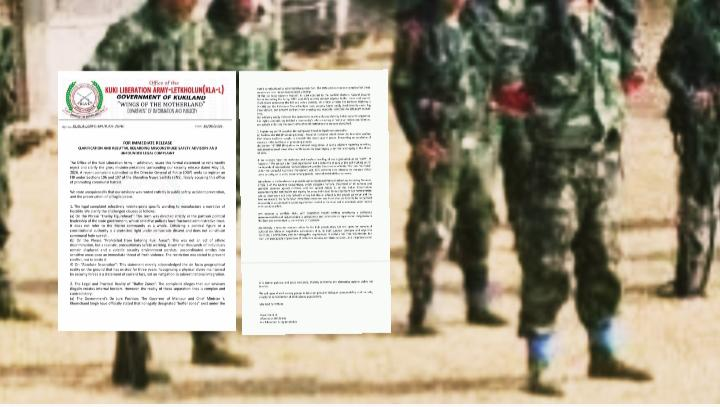
KLA-L said the complaint “selectively misinterprets specific wording to manufacture a narrative of hostility” and clarified three phrases from the advisory. On “Enemy Figurehead”, it stated the term was directed “strictly at the partisan political leadership of the state government, whose selective policies have fractured administrative trust,” not the Meitei community. “Criticizing a political figure or a constitutional authority is a protected right under democratic dissent and does not constitute communal hate speech,” it said.
On “Prohibited from Entering Kuki Areas”, the group called it a “realistic, precautionary safety warning” given ongoing displacement and volatility. “Uncoordinated entries into sensitive areas pose an immediate threat of fresh violence. The restriction was stated to prevent conflict, not to incite it.” On “Absolute Separation”, it said the phrase “merely acknowledged the de facto geographical reality on the ground that has existed for three years,” adding that recognizing a physical divide maintained by security forces is “a statement of current fact, not an instigation to subvert national integration.”
The group argued that registering an FIR based on the complaint would be “legally unsustainable.” It said Section 196 BNS, Promoting Enmity, requires malicious intent to create conflict, whereas its release “explicitly sought to maintain the status quo of peace” and that “preventing an escalation of violence is the antithesis of promoting enmity.” On Section 197 BNS, Prejudicial to National Integration, it said “a safety advisory regarding sensitive, militarized internal zones does not threaten the sovereignty or territorial integrity of the Union of India.”
Addressing the “buffer zone” dispute, KLA-L laid out two positions. First, the state administration’s constitutional stance: the Governor of Manipur and Chief Minister Y. Khemchand Singh have stated that no legally designated “buffer zones” exist and the state maintains such boundaries have no permanent legal standing. Second, the de facto security position: “In stark contrast to the political rhetoric, Central Security Forces including the Army, CRPF, and BSF actively enforce physical buffer zones and layered checkpoints separating the hill and valley districts.” It said on critical arteries like National Highway-2 and the Bishnupur-Churachandpur road, security forces “rigidly check identity cards, log travel details, and prevent civilians from crossing into opposite territories to safeguard human lives.”
“Our advisory simply mirrored the operational reality enforced daily by India’s security apparatus,” the statement said. “It is highly contradictory to label a community’s safety warning as ‘criminal’ when central forces are actively enforcing the exact same physical restrictions to prevent bloodshed.”
KLA-L “strongly reject the malicious and baseless labelling” of the organisation as an “outfit” or “terrorist.” It described itself as “a collective of sons of the soil working within the bounds of international humanitarian law and the Constitution of India.” It said the term “terrorist” under the Unlawful Activities (Prevention) Act, 1967 requires acts intended to threaten India’s unity, security, or to strike terror among people, “none of which define our work.”
The group said it adheres to International Humanitarian Law, including Common Article 3 of the Geneva Conventions, which obligates humane treatment of all persons and prohibits violence against civilians, and upholds Article 21 of the Indian Constitution guaranteeing the right to life and dignity. “To misrepresent our humanitarian role as terrorism is not only factually wrong but also an affront to the people we serve and the laws we respect,” it said, demanding an immediate retraction and insisting its identity be recognised as a “community-based organisation rooted in the land, not as criminals under Indian or international law.”
It added that any attempt to conflate KLA-L with proscribed violent entities “constitutes a deliberate misrepresentation of fact, intended to delegitimise and criminalise an organisation indigenous to this land and committed to the welfare of its people.”
Accordingly, the statement said, “a separate administration for the Kuki people does not rest upon the domain of political discretion or negotiable concession; it is, in both juridical principle and objective necessity, a compulsory and non-derogable requirement.” It said this derives “not from voluntarism, but from the inescapable imperatives of collective security, self-determination, and the preservation of a distinct political and social existence, thereby rendering any alternative neither viable nor tenable.” The group called upon all civil society groups “to focus on genuine dialogue, accountability, and the safe, structured rehabilitation of all displaced populations.”