District shuts down as victims interred with gun salute; CoTU demands Centre act against NSCN-IM and ZUF-Kamson, release 14 hostages, prosecute perpetrators, and secure border villages.
Edited by: Kimbawinu Vaiphei, Kukiland Express Desk
Kanggui, June 7, 2026
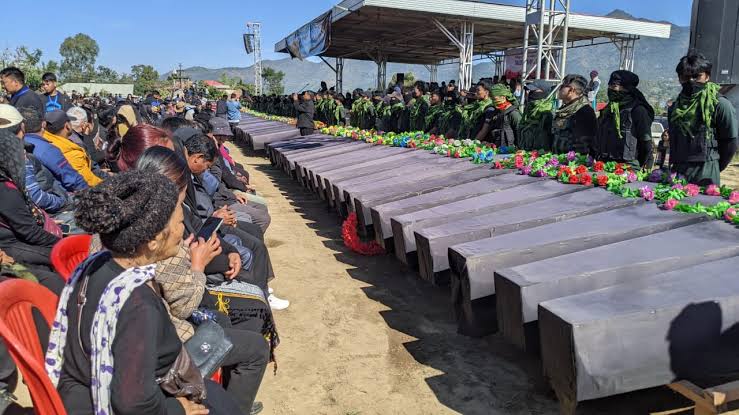
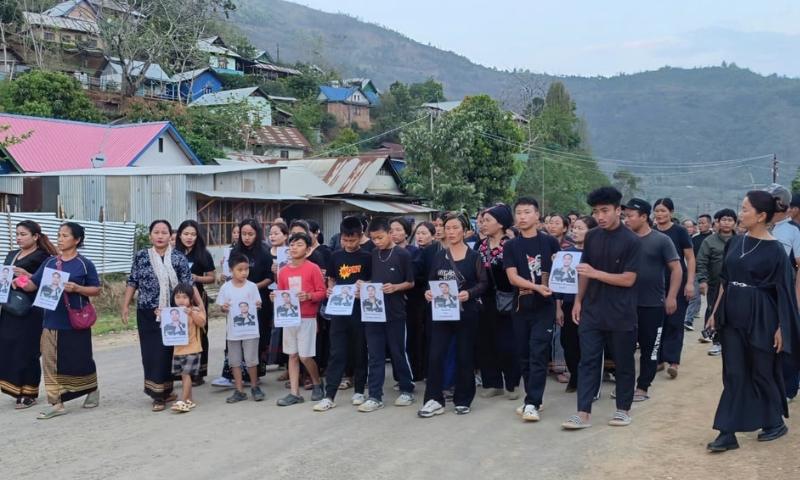
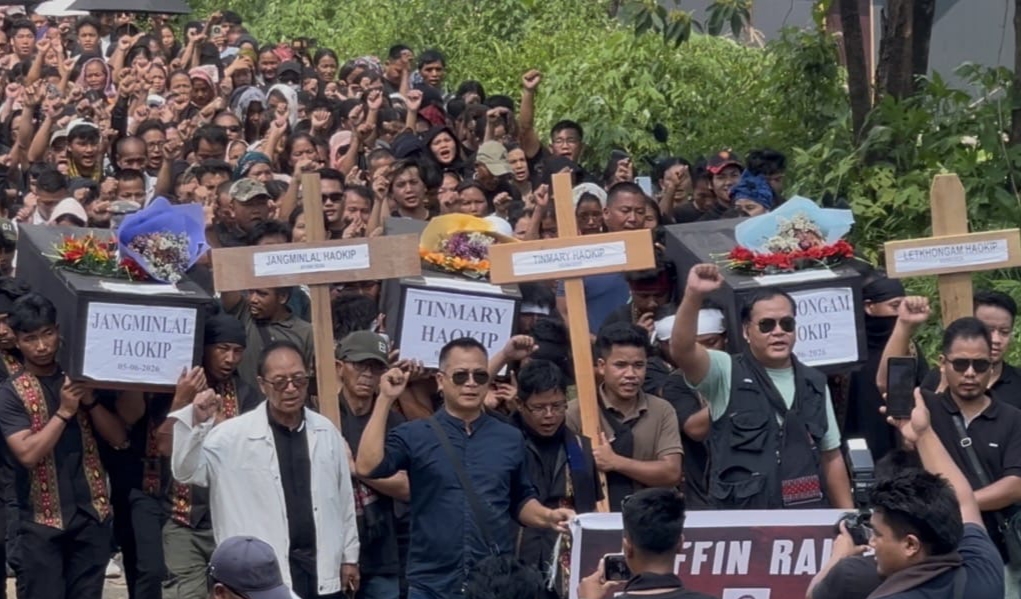
Kangpokpi came to a standstill Saturday as thousands of mourners walked a 35-kilometre coffin rally from the District Headquarters to Phaijang Martyrs’ Cemetery, burying three Loibol villagers killed in the June 5 pre-dawn attack by NSCN-IM and ZUF-Kamson cadres. The victims — a young couple and a man whose wife is expecting — were laid to rest after a condolence service marked by traditional shawls, a ceremonial gun salute, and slogans demanding justice. With markets closed and transport halted under a district-wide shutdown, the procession became one of the largest public gatherings in Sadar Hills this year, framed by leaders as a direct appeal to New Delhi and the international community.
Youth in traditional attire carried the coffins shoulder-to-shoulder from Kangpokpi District Hospital, flanked by Kuki Inpi Manipur leaders and civil society groups. Family members addressed the crowd before the burial, while mourners filled the route with chants calling for an end to bloodshed and protection for civilians. Community representatives said the rally was intended to signal restraint and dignity in mourning, even as grief turned to demands for accountability. The bodies were received with full honours, underscoring what organisers called the community’s resolve not to normalise recurring violence in peripheral villages.
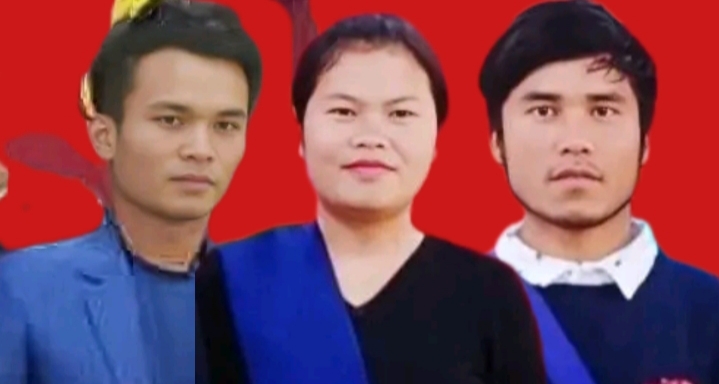
Three Kuki villagers killed in the June 5 NSCN-IM/ZUF-Kamson attack were buried June 6 at Phaijang Martyrs’ Cemetery. Thousands joined the 35-km coffin rally from Kangpokpi.
Speaking at the cemetery, Committee on Tribal Unity spokesperson Ng. Lun Kipgen said the Kuki had “chosen the path of dignity, prayer and faith” despite repeated killings by NSCN-IM and ZUF-Kamson. He linked the Loibol attack to the May 13 murder of three church leaders and the burning of Kharam Vaiphei village, calling it part of coordinated operations by NSCN-IM and ZUF-Kamson to inflame ethnic tensions. Kipgen warned against efforts to “drag the region back towards the violence that marked the Kuki-Naga conflict of the 1990s,” stressing that the community would not resort to retaliation. “Our people desire peace, but peace cannot survive without justice,” he told mourners and press gathered at Phaijang.
CoTU pressed four immediate demands to the Centre: action against NSCN-IM and ZUF-Kamson for the Loibol and May 13 killings; swift prosecution of those responsible; release of 14 Kuki civilians held hostage in Senapati; and reinforced security in vulnerable villages. The committee cautioned that without adequate state deployment, village volunteers would continue lawful preventive measures to protect settlements. Leaders described the coffin rally as a “symbolic appeal to the conscience of the nation,” arguing that civilian insecurity in Kuki areas remains unaddressed despite repeated representations to authorities.
The burial closes a week of heightened tension in Manipur’s hill districts following the Loibol incident. While normal life resumed in Kangpokpi by evening, civil society groups said they would monitor the government’s response to CoTU’s demands. With the monsoon approaching and farming activity set to begin in border villages, community elders say security guarantees will determine whether displaced families return to cultivate land. For now, Phaijang adds three more graves to the Martyrs’ Cemetery, as calls for central intervention grow louder across Kuki territories.