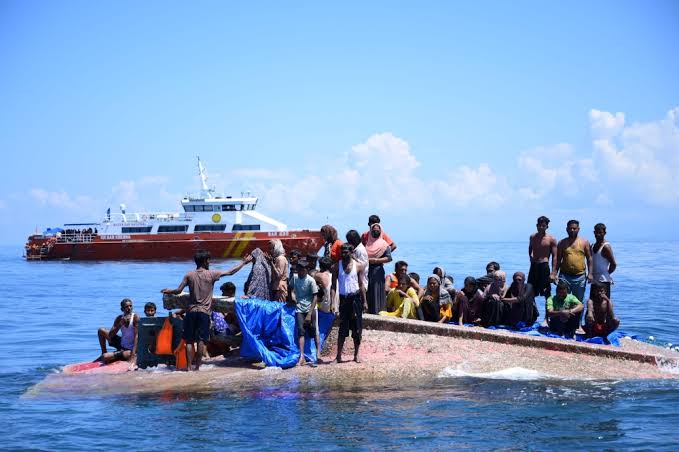
Moreh: Myanmar’s brutal civil war has crossed a grim milestone with more than 100,000 people killed, making it Asia’s deadliest ongoing conflict, even as global attention has shifted to Ukraine, Gaza and other crises. The war began after the February 2021 military coup that ousted elected leader Aung San Suu Kyi and ended a decade of fragile democratic opening that had once welcomed Barack Obama in 2012 as a symbol of hope and reform.
Aung San Suu Kyi, 81, made a rare public appearance this week while still under detention by the junta, a reminder of the elected government that was toppled. Her National League for Democracy had won a landslide in the November 2020 general elections before the army refused to accept the results and seized power, alleging voter fraud without evidence. Since then, the country has plunged into nationwide armed resistance, with former peaceful protesters, students and doctors now forming People’s Defence Forces allied with long-established ethnic armed organizations like the Kachin, Karen, Karenni and Chin groups.
From Isolation to Legitimacy: Moscow Jets and Beijing’s Red Carpet
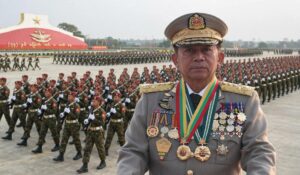
For years after the coup, the military regime led by Senior General Min Aung Hlaing faced severe diplomatic isolation, Western sanctions and condemnation at the United Nations General Assembly. That isolation is now breaking down rapidly. In July 2026, Myanmar hosted Russian troops for joint counter-terrorism military exercises near the capital Naypyidaw, the first such drill since 2021. Moscow has supplied advanced Mi-35 attack helicopters, Yak-130 fighter jets, surveillance drones and aviation fuel that have turned the tide in the central dry zone against poorly armed resistance groups who have no air defence.
Myanmar Meitei Kathe Body MIDA Rejects Links to Manipur, Slams Junta-Allied Meitei Militants
China has decisively picked a side, analysts say. In June 2026, Chinese President Xi Jinping hosted Min Aung Hlaing on a full state visit to Beijing, offering multi-billion dollar economic deals, protection for rare-earth mining operations in Kachin State, and crucial diplomatic cover at the UN Security Council to block further sanctions. Earlier in the same month, Prime Minister Narendra Modi also met the general in New Delhi, focusing on border security, the Kaladan Multi-Modal Transit project and the growing refugee crisis in Mizoram and Manipur. For the junta, these visits are a major diplomatic victory despite Western condemnation of sham elections.
China and Russia’s open backing has made Myanmar’s war far deadlier and harder to end. While Beijing provides diplomatic shield, CH-3 and CH-4 drones, and funding to secure its oil and gas pipelines from Kyaukphyu port to Yunnan province, Moscow supplies fighter jets, air defence systems and fuel that enable daily airstrikes on villages and schools. This steady flow of weapons has allowed the junta to offset severe manpower shortages after losing an estimated 30,000 soldiers through defections and combat, and to regain territory, pushing the death toll past one lakh and prolonging civilian suffering across the country.
Sham Polls, Hollow Victory: A Nation Pushed Back 20 Years
Those elections, held in two phases in December 2025 and January 2026 under tight military control, curfew and heavy internet shutdowns, and without Suu Kyi’s party, were dismissed as fraudulent and unfree by the US, EU, UK and ASEAN observers. The junta barred international media, jailed journalists and arrested hundreds of opposition candidates. Yet they have given the regime a pretext to claim constitutional legitimacy and transition from the State Administration Council to a so-called presidential system. Richard Horsey of International Crisis Group said Min Aung Hlaing feels he is winning on his terms.
That victory is hollow, experts warn. According to the UN Development Programme, poverty has doubled since 2020 with nearly half the population now below the poverty line, over 3.2 million people are internally displaced, and the currency kyat has collapsed by over 70 percent against the dollar. Development, health and education have been pushed back by 20 years. The military diverts more than 45 percent of the national budget to defence, bombing its own villages with airstrikes daily while social services, hospitals and schools have completely crumbled across Sagaing, Magway and Chin State.
Thailand Visit and The Revenge War: Why Fighting Won’t Stop
This week, Min Aung Hlaing is on a sensitive bilateral visit to neighbouring Thailand, an ASEAN member that once condemned the coup and led the peace effort. Talks are expected to cover border trade at Mae Sot-Myawaddy, control of meth and opium trafficking and the dismantling of massive scam centres run by Chinese gangs in Myawaddy and KK Park where thousands of Indians were trafficked. For rights groups like Fortify Rights and Amnesty International, shaking what they call a bloody hand sends the wrong message. They argue ASEAN’s Five-Point Consensus has failed completely.
Morgan Michaels of the International Institute for Strategic Studies says internationally Myanmar has already got what it wants to survive comfortably without Western approval. With Russia providing weapons, China buying jade, timber and rare-earths worth billions, and India seeking stability along the 1,643 km porous border with Mizoram and Manipur, the junta no longer needs legitimacy from Washington. The UN humanitarian response plan is only 28 percent funded for 2026, while border economies thrive on narcotics and arms smuggling. The world’s inattention has become the junta’s greatest strategic asset.
On the ground near Bago region, a resistance fighter speaking via Starlink satellite internet told NPR that no one talks about federal democracy or revolution anymore. All they want now is revenge for friends killed, homes burned and livelihoods destroyed by the military’s scorched-earth policy and Four Cuts strategy. With gunfire audible in the background, he vowed they will not give in despite lacking anti-air weapons to stop jets. For many in Moreh and across the border, the war has become deeply personal, ensuring Myanmar’s conflict will continue to burn for years regardless of international neglect.