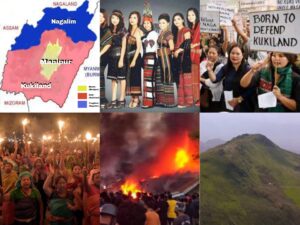
The renewed demand for NRC by Meitei groups in Manipur must be examined in its historical and territorial context. If NRC is to be implemented at all, it must be confined strictly to the Meitei-dominated valley areas. Meiteis have no historical, legal, or customary right to enforce NRC or any other population exercise in Kuki and Naga ancestral hill areas. The hills were never part of the Meitei kingdom and are not an extension of valley polity, and this was proved by the September 21, 1949 Merger Agreement signed between Maharaja Bodhchandra Singh and the Dominion Government of India.
History is clear on this. The hill areas of present-day Manipur were never under Meitei rule. British administrative records, colonial maps, and historical accounts consistently treat the hills and valley as separate entities. The Kuki and Naga chiefs ruled their own territories, governed by customary laws and village authority, long before the formation of the modern state of Manipur in 1972. The merger of Manipur with India in 1949 cannot retroactively convert autonomous tribal lands into Meitei land.
The Government of India must recognize this fundamental reality – Kuki, Naga and Meitei are distinct peoples with distinct territories, identities, and histories. They never shared the same land, culture, or administrative system. The protection of tribal land under Article 371C of the Constitution itself acknowledges this separation. It was included precisely because the hill areas require special protection from valley dominance. Any attempt to impose valley-centric policies like NRC on the hills violates this constitutional spirit. If Kuki and Naga want NRC, the choice is theirs alone, not that of another community or outsiders.
Moreover, the demand for NRC in hill areas is not about illegal immigration, but about territorial expansion and demographic control. Kuki and Naga lands are protected by customary ownership, recognized village chiefs, and community institutions. No Meitei individual, organisation, or valley-based authority has the right to question who belongs to Churachandpur, Pherzawl, Tengnoupal, Chandel, Kangpokpi or any Naga district. The right to determine identity and belonging in the hills belongs solely to the tribal people and their traditional institutions.
Even the Government of India must respect the tribal land rights of Kuki and Naga areas as guaranteed by the Constitution. Under Articles 371C, 244(2), the Sixth Schedule spirit, and other constitutional protections, the hill areas are not ordinary revenue land to be administered by the valley. The Centre has a constitutional duty to protect, not dilute, tribal land, identity and autonomy. Ignoring these safeguards and allowing valley-centric demands to override tribal rights will only deepen mistrust in the constitutional system itself.
“Especially, the Kuki area is totally separated from Manipur not only from historical records, but also since May 3, 2023, Kuki and Meitei communities have been physically, geographically and politically separated. The Kuki community now only demands the recognition of Kuki areas as a separate Kuki State or Union Territory by the Government of India.”
The Indian Constitution itself stands as the strongest shield for tribal land. Article 371C provides for a Hill Areas Committee to protect tribal interests, while Article 46 directs the State to protect Scheduled Tribes from social injustice and exploitation. The Fifth Schedule spirit, the Forest Rights Act of 2006, and the principle of Free, Prior and Informed Consent under international conventions recognized by India, all affirm that tribal land cannot be alienated, surveyed, or enumerated by non-tribal entities without tribal consent. Imposing NRC by Meitei demand on hill areas would be a direct violation of these constitutional protections.
Furthermore, the Supreme Court has repeatedly upheld that tribal customary law and ownership is protected under the Constitution. In Samata vs State of Andhra Pradesh (1997) and other judgments, the apex court affirmed that tribal lands are inalienable. The Manipur Legislative Assembly (Hill Areas Committee) Order, 1972 clearly separates hill administration from valley administration. Therefore, any NRC exercise in the hills without the approval of the Hill Areas Committee, Autonomous District Councils, and village chiefs is unconstitutional, illegal, and void ab initio.
Respect for every community’s rights, land, and identity is the only path to lasting peace among different communities. Meiteis must respect Kuki and Naga rights over their ancestral hills, just as tribals respect Meitei rights over the valley. Peace cannot be built on encroachment, imposition, or domination, but on mutual respect, constitutional morality, and territorial integrity. Only when each community’s boundaries and rights are honoured can Meitei, Kuki and Naga move towards genuine coexistence as neighbours and stability.
Therefore, if the Meitei community wants NRC, let it be implemented in Imphal East, Imphal West, Thoubal and Bishnupur – their own settled areas. The hills must be excluded completely. The Indian Government must stop viewing Manipur as a single homogenous entity. Peace will only come when Delhi accepts that Manipur is home to three separate peoples, and that hill areas can never be governed by valley diktats.