Songpi/Kathmandu: The death toll from the devastating flash floods that tore through the Nepal-Tibet border has surged to 392 on Thursday, with rescue teams wading through thick mud, debris and shattered homes and racing against time to trace more than 1,468 people still missing across both sides of the Himalayas, including at least 290 Indian nationals who had travelled for pilgrimage, trekking and work at hydropower sites.
According to the latest update issued by Nepal Police and the National Disaster Risk Reduction and Management Authority at 6:20 pm local time on Thursday, 389 bodies have been recovered from eight districts in Nepal. The highest casualties were reported from Chitwan with 132 deaths, followed by Nawalparasi East with 82, Dhading with 33, Gorkha with 30, Nuwakot with 28, Tanahun with 22, Rasuwa with 17 and Nawalparasi West with 15. Three more deaths were confirmed in Tibet’s Gyirong County near the Nepal border, taking the combined toll across both nations to 392.
Death Toll Mounts as Rescue Race Continues Across Rasuwa and Tibet Border
Officials said 910 people remain missing or out of contact in Nepal alone. The list includes 28 Nepal Police personnel, 44 Nepal Army personnel, 13 Armed Police Force personnel, 15 Customs Office personnel, 4 Immigration Office personnel, 162 staff members working at various hydropower and customs offices and 579 tourists. In Tibet, Chinese state media reported 558 people missing, including 260 foreigners and nearly 100 Chinese nationals who went missing on the Nepal side, taking the total missing to over 1,468.
The Ministry of External Affairs in New Delhi said at least 290 Indian nationals remain uncontactable, many of them pilgrims who had travelled for the Kailash-Mansarovar Yatra via Nepal. MEA spokesperson Randhir Jaiswal said 21 pilgrims from Tamil Nadu have been rescued so far and their names have been published, while efforts are underway to trace the rest. The missing foreigners in Nepal come from more than 30 countries, including 65 from the United States, 53 from Ukraine, 51 from Malaysia, 35 from Australia, 33 from Britain, 25 from Canada, besides pilgrims from Germany, Russia and Singapore.
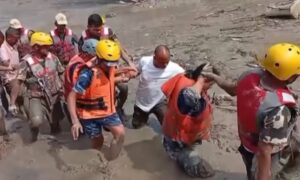
Rescue operations are being severely hampered by broken road connectivity, washed away bridges and unstable slopes. The Nepal Army has deployed helicopters, sniffer dogs, drones and engineering teams, while more than 40 private helicopter charter flights have been mobilised from Tribhuvan International Airport in Kathmandu to ferry relief materials under army coordination. Officials said 796 people have been rescued by air and another 796 evacuated by land routes. Temporary shelters have been set up in schools and community buildings for about 3,500 displaced people who lost everything.
A 32-member group from Kolkata on Kailash-Mansarovar Yatra comprising 30 tourists and two tour managers is among those untraceable from West Bengal, along with 11 persons from Gujarat, 13 from Karnataka including 11 from Bengaluru Urban, 114 from Maharashtra, 57 from Tamil Nadu and 30 from Kerala. Families across India have been urged to contact control rooms. A woman from Raipur who travelled on August 22 and a software engineer from Karnataka living in Australia are among those reported missing by their families.
Glacial Collapse, Not Earthquake: USGS Reveals Real Trigger Behind Tsunami of Mud
What triggered the catastrophe is now clear after days of confusion. The US Geological Survey confirmed that the disaster was not caused by an earthquake as initially reported by Nepal’s Foreign Minister. The seismic activity recorded as magnitude 4.4 at 8:37 am local time on August 26 was actually generated by a massive glacial collapse and debris flow, later revised to magnitude 5.2 after analysis of long-period seismic waves and satellite imagery. The event was initially misreported as an earthquake.
Glaciologists studying satellite footage said the disaster began with a landslide involving several million cubic meters of rock in the watershed north of Langtang Lirung, a 7,234 metre peak in Nepal, which swept a glacier along with it. The rockslide set everything in motion, not the glacier itself. The glacier collapsed after being destabilised. This created an enormous avalanche of ice, rock and mud that slammed into the Lhende Khola river on the Nepal-Tibet border, temporarily blocking its flow and forming a natural dam.
The natural dam then burst within minutes, sending a tsunami of freezing water, mud, boulders and debris at terrifying speed down the Bhote Koshi and Trishuli river systems through Rasuwa, Dhading, Nuwakot, Chitwan, Gorkha, Tanahu and Nawalparasi districts. Verified videos showed crushing masses of water sweeping away dozens of people at the border. The surge washed away homes, vehicles, 19 motorable bridges, several temporary bridges, 40 km of roads, power transmission lines and severely damaged at least 13 hydropower projects including the Trishuli-I project where 63 Indian workers were later rescued.
Experts said this is a grim reminder of accelerating climate change in the Himalayas, referred to as the world’s Third Pole because it contains the largest amount of snow and ice after the Arctic and Antarctic. Steep slopes made of permafrost frozen for centuries are now destabilising as temperatures rise. The Bhote Koshi valley is the main link between Kathmandu and Lhasa and is lined with hydropower projects highly vulnerable to such glacial lake outburst floods and debris flows.
Fresh Flood Threat as New Barrier Lakes Form Upstream on Bhote Koshi
A fresh and potentially more dangerous threat now looms over downstream communities. Both Nepal and China have warned of a second flood surge after satellite imagery showed two new barrier lakes have formed upstream behind massive piles of debris blocking the Bhote Koshi and Lhende rivers. Nepal’s Department of Hydrology and Meteorology issued a special notice warning that the lakes behind the debris are rising rapidly and could burst anytime, urging residents and rescuers to stay away from river banks.
The International Centre for Integrated Mountain Development in Kathmandu warned that with a blockage still lodged upstream on the border river, a second flood is imminent. Its climate expert Qianggong Zhang said water trapped by immense piles of debris could cause another outburst. The NDRRMA has appealed to all residents in Rasuwa, Nuwakot, Dhading, Gorkha, Chitwan and Nawalparasi to remain alert and avoid low-lying areas near the rivers until the lakes are safely drained.
Across the border, Chinese Premier Li Qiang visited Gyirong Township near the Nepal border post in Tibet on Thursday to supervise rescue operations, accompanied by senior officials. State-run Xinhua said rescue efforts are being complicated by the instability of the reservoir lake upstream and narrow mountain roads blocked by landslides. Beijing’s Foreign Ministry said it is verifying details of nearly 100 Chinese nationals missing in Nepal and that rescue teams with dogs and drones have been deployed.
India has launched a massive coordination and relief effort. External Affairs Minister S Jaishankar held a high-level review meeting with Foreign Secretary and Indian Ambassadors in Kathmandu and Beijing, stating that urgent efforts are underway to ascertain the well-being of all Indians. India has sent two IAF aircraft carrying 47.5 tonnes of Humanitarian Assistance and Disaster Relief material, medicines and food packets. A 24×7 Control Room has been set up in MEA at +91 11 2308 8718, +91 11 2308 8719 and WhatsApp +91 99682 91988.
States across India have also activated emergency protocols. Tamil Nadu Chief Minister C Joseph Vijay deputed a team to Kathmandu and announced toll-free helpline 1800 309 3793. Karnataka opened helpline 1070 and 080-22253707. Maharashtra confirmed 114 tourists stranded, West Bengal 32, Gujarat 11, Kerala 30 and Assam opened a help desk in Delhi. Uttar Pradesh sounded high alert in Maharajganj and Kushinagar and deployed a 32-member SDRF platoon to Nepal. Bihar Chief Minister Samrat Choudhary conducted an aerial survey of the Valmikinagar barrage after discharge surged to 1.50 lakh cusecs.
International response has poured in for the Himalayan disaster. The UN Secretary General Antonio Guterres expressed deep sadness and allocated an initial 2 million dollars for relief. The UK announced 5 million pounds in aid with 33 Britons missing, with King Charles III saying he was heartbroken. Sri Lanka announced 1 million dollars in humanitarian assistance. The Vishva Hindu Parishad launched a Nepal Flood Relief Campaign seeking public support. As search operations continue amid scenes described as a giant graveyard of sand, pebbles and blood, authorities fear the toll may rise further in the coming days.