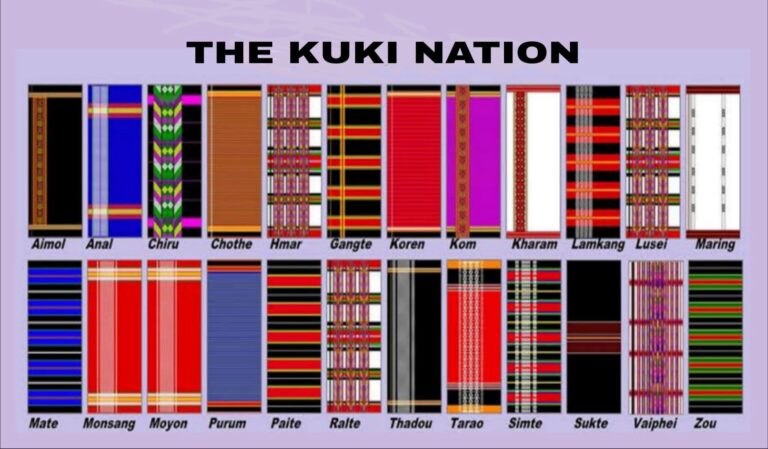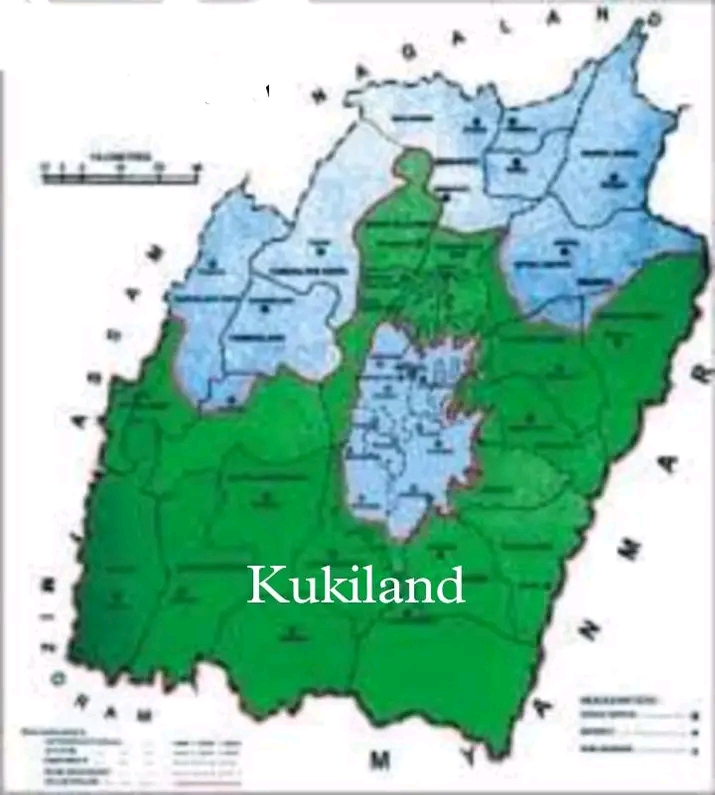
The Kuki people possess a rich and documented history that long predates British colonial rule. The name ‘Kuki’ appears in ancient texts, including the Mahabharata and the Tripura Rajmala, with references dating back to the 6th and 7th centuries — centuries before the British arrived in India. In the 17th century, the British colonial administration formally recognized and recorded the tribals inhabiting the Chittagong Hill Tracts in present-day Bangladesh, Northeast India, and parts of western Myanmar as ‘Kuki’.
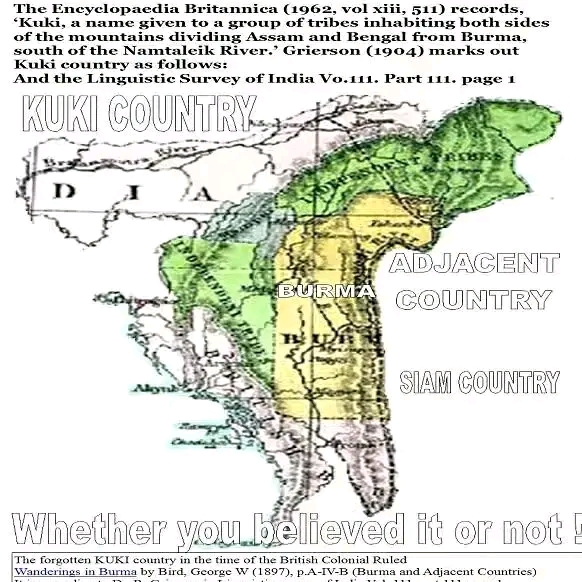
This recognition was not merely administrative. In 1904, British authorities drew a political map identifying the independent hill tracts of the community as the ‘Kuki Independent Hill Country’, or Kukiland. This historical mapping is central to understanding the Kuki identity and the community’s distinct territorial and political claims in the region. For the Kuki History & Identity Protection Committee, such records affirm a continuity of peoplehood and land that colonial policy acknowledged.
The post-colonial period, however, saw shifts in nomenclature and identity politics. In the 1950s, the term ‘Mizo’ emerged in the Lushai Hills — now Mizoram — under the leadership of Laldenga. In recent years, the term ‘Zo’ has gained currency in some circles as a pan-tribal identity. This, in our view, is a misinterpretation. ‘Zo’ is derived from ‘Mizo’, a designation specific to one tribe in Mizoram. It does not historically encompass the Kukis of India, the Chins of Myanmar, or the Bawms of the Chittagong Hill Tracts in Bangladesh. No historical record or government document acknowledges ‘Zo’ as a pan-tribal identity. As a derivative of ‘Mizo’, its political usage should remain confined to Mizoram.
There are no historical records of ‘Zo’ or ‘Zoland’ in ancient texts, colonial archives, or pre-colonial chronicles. Unlike ‘Kuki’, which appears in the Mahabharata, Tripura Rajmala, and British ethnographic surveys from the 17th century onward, ‘Zo and Zoland’ is a recent construct composed by some writers and commentators without documentary or archaeological basis. We must know the real history of the Kuki. The historical record has already proved that Kuki is our nation and identity. To substitute that legacy with newly coined terms erases centuries of documented peoplehood and the sacrifices made to defend it. Political narratives cannot override primary sources, gazetteers, and maps that consistently identify this land and its people as Kuki.

Further, claims linking ‘Zo’ to the Chinese term ‘Zhou’ have no historical or etymological basis. The Kuki nation existed as a distinct entity long before British rule. Our forefathers defended this homeland valiantly, notably in the Kuki War of 1860-1861 and the Anglo-Kuki War of 1917-1919. These conflicts reflect a deep-rooted commitment to sovereignty and self-determination that defines Kuki political history.
The Kuki nation has a well-documented history and territorial claim that must be recognized on its own terms, distinct from newer nomenclatures that have emerged in recent decades. The Kuki people have a proud heritage, and preserving and acknowledging this unique identity is essential. Let us stand united in protecting our history and asserting our rights. May the Kuki nation prosper, and may our identity remain a beacon for generations to come.
The writer can be reached at
Email: kimneihoihaokip12345@gmail.com
Disclaimer: This article reflects the views and interpretations of the author regarding Kuki history, identity, and territorial narratives. Historical and political claims discussed remain subjects of academic and public debate.