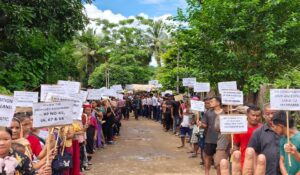
Chandel: The remote Indo-Myanmar frontier in Chandel District reverberated with slogans on Monday as thousands of Kuki villagers from across the Khengjoi Sector staged a powerful public rally against the proposed realignment and re-demarcation of the Indo-Myanmar international boundary.
Organised under the banner of the Affected Border Area Kuki Chiefs of Khengjoi Sector, Chandel, the rally began simultaneously from Khengjang and Molcham villages and converged at the inter-village junction, where village chiefs addressed the gathering. Villagers from Molcham, Khengjang, Jangngoulen, Khumkot, Joldam and neighbouring hamlets took part, carrying placards that read “Respect Traditional Boundaries” and “We Will Not Part With Our Ancestral Land.”
According to the statement released by the Chiefs after the rally, the immediate cause of the agitation is a directive issued by the Ministry of Home Affairs following the high-level security review meeting held on May 11, 2026, in New Delhi under the chairmanship of Union Home Minister Amit Shah. The MHA has reportedly directed concerned agencies to complete the entire pending border demarcation work within three months, which includes re-verification and realignment of several Boundary Pillars in Manipur’s border districts.
For Khengjoi, the most contentious are Boundary Pillar No. 65 at Molcham, BP No. 66 at Jangngoulen, BP No. 67 at Khumkot and BP No. 68 at Joldam. The Chiefs said the new coordinates proposed by survey officials are shifted northwards from the existing, historically recognised ground position, which would effectively place large tracts of settled village land on the Myanmar side of the fence.
This is not the first time the border issue has flared up in Khengjoi. Villagers recalled that the area has been facing uncertainty since the border fencing works began in 2013-2014. Several Memorandums have been submitted in the past to the Deputy Commissioner, Chandel, the Government of Manipur and the Ministry of Home Affairs, but no transparent public consultation has been held with the actual landowners.
Explaining the gravity of the situation, the release stated that the lands in question are not vacant or forest tracts, but settled ancestral homesteads, wet rice cultivation fields, jhum lands, community forests, water sources and sacred burial grounds where generations of forefathers are laid to rest. For the Kuki community of this frontier, land is inseparable from identity, culture and livelihood.
“If the proposed realignment is implemented, more than 500 households across four villages will lose their permanent paddy fields, and over 30 ancestral burial sites will be separated by the border,” a village chief from Molcham told Kukiland Express on the sidelines of the rally. “Our people have guarded this frontier of India for centuries. We are Indians by heart, but we cannot be asked to sacrifice our homes to prove our nationality.”
The Chiefs further pointed out that the proposed move is undemocratic and violates customary land rights protected under Article 371C of the Constitution and the Manipur Hill Areas traditions. They alleged that no consent was taken from the Village Chiefs or the Hill House Tax holders before finalising the new alignment.
Reiterating their stand, the Chiefs said the present ground position, as maintained and cultivated for generations, should be retained as the only solution. They declared in unison that not an inch of village land will be allowed to be parted away under any circumstances.
The association has put forth three immediate demands before the Government of India:
First, immediate suspension of the proposed realignment of BP Nos. 65 to 68 in Khengjoi Sector.
Second, constitution of a joint survey team comprising officials of the Survey of India, Border Management officials and representatives of the affected Kuki Chiefs and villagers to verify the ground position.
Third, holding of a formal public hearing in Khengjang and Molcham before any final decision is taken.
The Chiefs warned that if the Government proceeds with the demarcation without addressing their concerns, they will be compelled to launch a series of intensified democratic forms of agitation, including indefinite bandh along the border roads and non-cooperation with border construction agencies.
The rally concluded peacefully with a pledge to protect the ancestral land at any cost, while appealing to all Kuki civil society organisations, church bodies and elected representatives to stand with the border villagers in this crucial hour.