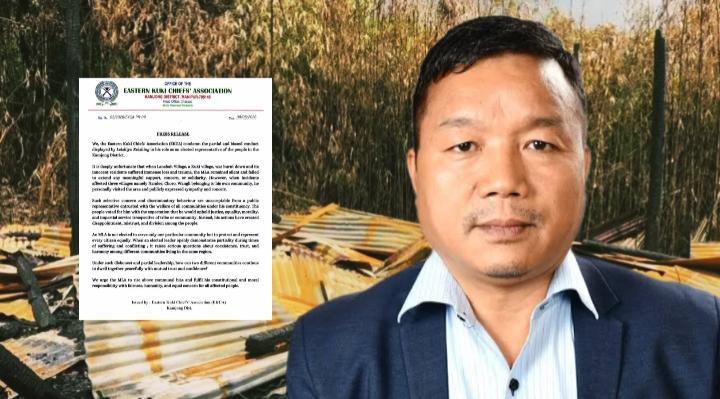
New Delhi: A two-day national conference on the theme Reimagining Kuki Society in the 21st Century, organised by the Kuki Students Organisation, Delhi and NCR, concluded on August 14 in New Delhi. The conference brought together academic scholars, researchers and professionals of the Kuki community from different parts of the country to deliberate on the challenges and future roadmap of the community in the modern era.
The conference was meticulously curated and featured six technical sessions spread over two days, with each session focusing on a distinct sub-theme relevant to contemporary Kuki society. The event brought together an impressive lineup of scholars from premier institutions including JNU, Delhi University, NEHU, University of Hyderabad and Gauhati University, and witnessed enthusiastic participation and interactive discussions.
The first technical session on Day One was led by Dr. Lalminthang Kipgen from NCERT, New Delhi, along with co-speaker Ms. Gabriela Chongloi. They presented on the sub-theme Digital Era and the Kukis: Digital Literacy, Access, Activism, Documentation and Social Media. The session highlighted the impact of Artificial Intelligence and digital platforms on modern society and the Kuki political movement.
The speakers emphasized that while the community has been active on digital platforms, there is a lack of organized documentation and strategic advocacy. Participants raised questions on how the society has failed to effectively utilise digitalisation to strengthen its ideology and push its collective cause, and called for greater digital literacy among youth to project Kuki history to a global audience.
The second session was presented by Rev. Dr. Jangkholam Haokip, President of Bethesda Khankho Foundation, and Rev. Dr. Paul Paolen Haokip from Caleb Institute, Haryana, on Indigenous and Knowledge Practices. Both speakers reflected on the role of religious beliefs, oral traditions and customary laws in sustaining the social fabric of the community.
They observed that a section of society has drifted away from the true meaning of its faith and traditional values, which has weakened the collective cause. They stressed the need to reconnect with indigenous wisdom while adapting to contemporary realities to ensure cultural continuity in the face of globalization.
The third and final session of Day One featured Dr. D. Letkhojam Haokip from Gauhati University and Prof. Pauthang Haokip from Jawaharlal Nehru University, Delhi. They spoke on Historiography, Identity, Language, Memory and Literature, emphasising the importance of rewriting history from an indigenous perspective.
The scholars argued that language, literature and collective memory are crucial tools for asserting identity. They called for reclaiming Kuki historiography from external narratives and encouraging community-driven research and literary production to strengthen cultural pride and historical consciousness among the younger generation.
Day Two began with a compelling presentation by Dr. Hoineilhing Sitlhou from the University of Hyderabad on Gender and Social Structures, Traditional Institutions, Social Practices, Gender Roles and Intersectionality. The session sparked intense discussion on how tradition and culture have shaped gender differentials in Kuki society.
Participants, especially young women attendees, deliberated on how customary practices define the role and space of women. The discourse highlighted the need for a more inclusive approach that ensures gender equity and social justice without eroding cultural identity, and for challenging stereotypes that limit women’s participation.
The second session on Day Two was one of the most engaging, led by renowned academicians Prof. T. T. Haokip from North Eastern Hill University and Dr. Thongkholal Haokip from the University of Delhi. Their sub-theme was Kuki Politics, Social Movements, Conflicts and Way Forward, Chiefship and Democratic Governance, Delimitation and Governmentality.
The speakers provided deep insights into the evolution of Kuki politics, its successes and shortcomings, and the road ahead. Drawing from their personal experiences, they discussed the complexities of chiefship versus democratic governance, the contentious issue of delimitation, and the elite-mass gap in political mobilisation, calling for more accountable and people-centric leadership.
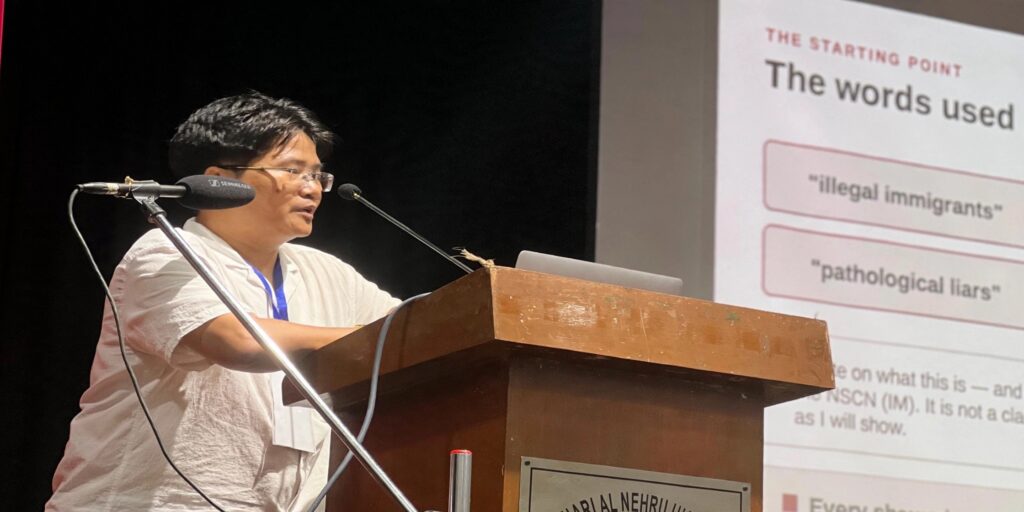
File Photo: Dr. Lalminthang Kipgen, Assistant Professor, NCERT, New Delhi,* speaking on Digital Era and the Kukis at the Two-Day National Conference on Reimagining Kuki Society in the 21st Century organised by KSO Delhi and NCR.
The technical sessions concluded with a presentation by Dr. Lalsanglen Haokip from the University of Delhi on Economy and Environment, Agriculture, Land Use and Forestry. He led a detailed discussion on government land reform policies and their impact on Kuki-inhabited areas, particularly in Manipur.
He elaborated on the community’s traditional land ownership system rooted in culture and how it affects the relationship between common people and stakeholders. He stressed that land is not merely an economic resource but the foundation of Kuki identity and political autonomy, and called for sustainable agricultural practices and protection of customary land rights.
In its closing remarks, the KSO Delhi and NCR organizing committee expressed gratitude to all resource persons, participants and volunteers, stating that the overwhelming response reaffirmed the need for such academic platforms. The committee announced that the proceedings will be compiled and published as an edited volume to serve as a lasting resource for future policy and academic discourse aimed at building a resilient and forward-looking Kuki society.