Manipur’s present crisis cannot be understood as a simple law and order problem. Though Kuki, Naga and Meitei may share a common Tibeto-Burman origin traced to ancient migrations from the East, centuries of living in three different geographies have forged three entirely different nations within one state. Their territorial imagination, political system and cultural identity are so distinct that forcing them into a single political formula has become the root cause of the conflict. This is why a single solution will never work.
The history of Manipur is often told as a story of three peoples. The Meitei in the valley, the Naga in the northern hills and the Kuki in the southern hills. Modern politics has sharpened their differences, but the deeper history points to a common beginning and a divergent journey. Because of this divergence, Manipur today needs not one but three separate political settlements.
Anthropologists and historians broadly place all three groups within the great migration that moved southward from the upper reaches of Tibet, southern China and the Yunnan corridor along the Mekong and Chindwin river systems. Linguistically, Meiteilon, the Naga languages and the Kuki languages all belong to the Tibeto-Burman family of the Sino-Tibetan stock. The oral traditions of all three retain memories of a northeastern origin, migration through caves, hills and river valleys, and gradual settlement in what is today the Manipur basin and its surrounding mountains.
This shared ancestry, however, did not create a shared identity. Geography and state formation created three different worlds, and three different concepts of land.
The Valley Kingdom: The Meitei Model of Statehood
The Meitei were the first to consolidate a valley state. By the first century CE, the Nongda Lairen Pakhangba period marks the beginning of the Kangleipak Kingdom, or Manipur, in the Imphal valley. Wet rice cultivation, a centralized Sanamahi kingship and later the adoption of Vaishnavism in the 18th century under King Garibniwaz gave the Meitei a distinct valley civilization, a script, chronicles like the Cheitharol Kumbaba and a concept of land as kingdom territory with clear boundaries and revenue administration. The valley became the political centre.
The Village Republics: The Naga Concept of Land
The Naga tribes in Manipur, comprising Tangkhul, Mao, Maram, Poumai, Rongmei, Liangmai, Zeme and others, settled in the higher and more northern ranges around the valley. Their migration was earlier and in smaller clan waves. Without a centralized kingdom, they built a republican village system. Each village was a sovereign republic with its own council, morung and customary law. Their land concept was not kingdom but ancestral village territory owned by the community. Identity was strongly clan and village based, later consolidated under the broader political term Naga in the 20th century during the Naga national movement.
The Chiefdom Homeland: The Kuki Idea of Kukiland
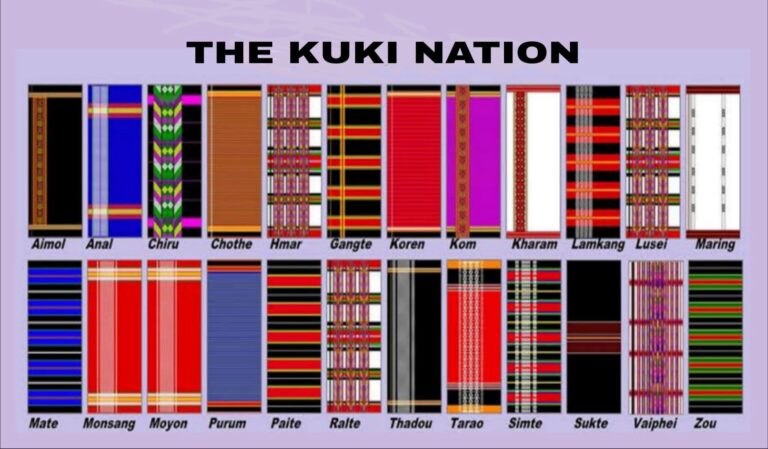
The Kuki tribes in Manipur, comprising Gangte, Hmar, Vaiphei, Zou, Simte, Paite, Kom, Aimol, Chiru, Anal, Mizo and others, share a similar identity and culture and have demanded a Kuki State or Union Territory under the Constitution of India since 1960. Their village chief system, called Haosa, and jhum based economy created a dispersed but culturally unified world. For them, land was defined by chiefdom and by the concept of Kukiland as a cultural homeland rather than a valley kingdom.
Know More About Kuki History: From Rajmala to Anglo-Kuki War
British colonial records from 1777 onwards refer to Kukis in the frontier. The Tripura Rajmala and references in the Mahabharata from the 6th to 7th century are often cited by historians as recording the early presence of Kuki settlements spread across the southern hills of Manipur, connecting present day Manipur, Mizoram, parts of Northeast India and the Chin Hills of Myanmar and the Chittagong Hill Tracts of Bangladesh. The Kuki movement for self administration dates back to the Kuki Revolt of the 1860s and the Anglo-Kuki War or Kuki Rebellion of 1917-1919 against British colonial rule.
Three Peoples, Three Land Philosophies
Thus the same migration produced three land philosophies. For the Meitei, land is Kangleipak, the valley state. For the Naga, land is village and tribe. For the Kuki, land is chiefdom and a contiguous hill homeland across modern borders. Identity followed land.
Colonialism and post colonial state making hardened these differences. The British created separate administration for hill and valley. The Merger Agreement of 1949 brought the princely state of Manipur into India but left the question of hill autonomy unresolved. The creation of Scheduled Tribe status, the Hill Areas Committee and later demands for Inner Line Permit, Naga Greater Lim and Kuki territorial council all emerged from these unresolved land and identity questions.
The Unresolved Question of Recognition
Today the debate is no longer about origin but about recognition, and this is where the state has failed the most. All three groups claim indigeneity, but define it in fundamentally incompatible ways that a single policy can never satisfy.
The Meitei assert indigeneity through historical kingship. For them, the boundaries of the Kangleipak Kingdom as recorded in the Cheitharol Kumbaba and other royal chronicles represent the legitimate territory of Manipur, and any division of it is seen as a loss of civilizational integrity. Their demand for Scheduled Tribe status and Inner Line Permit is driven by a fear of being reduced to a minority in their own valley.
The Naga assert indigeneity through ancestral village ownership. For them, legitimacy does not come from a king or a written chronicle, but from blood, burial grounds and the unbroken occupation of their village lands since time immemorial. Their political demand is not for more autonomy within Manipur, but for integration with the larger Naga homeland under the Framework Agreement and the concept of Greater Nagalim.
The Kuki assert indigeneity through chiefdom rights and historical continuity of the hill homeland. For them, Kukiland is not a new demand but a restoration of a homeland that existed before colonial maps divided it between India, Myanmar and Bangladesh. Their demand for a separate State or Union Territory with legislature under Article 239A of the Constitution is based on customary land rights, the institution of Haosa, and the need for physical security after decades of ethnic violence and political marginalization.
Until the Government of India recognizes that these are three distinct definitions of indigeneity and three different political aspirations, any attempt to force a common solution through a single Hill Areas Committee or a uniform law will only deepen the conflict.
Why India Needs Three Separate Settlements
Understanding that the three peoples may share a common migratory root does not erase their present differences. It in fact explains why the conflict in Manipur is so deep. It is not a conflict of outsiders, but a conflict of different geographies, different identities, different lands and boundaries.
A single political formula for Manipur has failed because it tries to fit three different historical realities into one administrative unit. For lasting peace, the Government of India needs to recognize their differences of land and identities and address each with a separate political settlement that respects historical distinctiveness while ensuring coexistence, a valley centric settlement for the Meitei, a Naga settlement based on ancestral village autonomy, and a State or Union Territory settlement for the Kuki people.
Without Three Settlements, Conflict Will Never End
If India fails to acknowledge the reality that Manipur is no longer a single political entity but a state of three distinct peoples with three different histories of land and identity, the cycle of conflict between Kuki, Naga and Meitei will never come to an end. Preserving Manipur as one undivided administrative unit at all costs has only deepened mistrust and bloodshed. Only by reorganizing the state into three separate political arrangements can New Delhi ensure lasting peace, justice and coexistence for all three communities.