On September 15, the Indian Army evacuated 40 NSCN-IM cadres surrounded at Chawangkhening within minutes. For Kuki villagers who have buried over 25 civilians killed since March without any such protection, that swift rescue exposes a selective and unconstitutional security approach in Manipur.
The night of September 15 revealed the hierarchy of protection in Manipur. According to local accounts, two Kuki women were killed in the morning while working in their jhum fields, and later that night, NSCN-IM cadres allegedly attacked Kholen village, leaving an elderly Kuki woman severely injured. Enraged by these back-to-back attacks, Kuki village volunteers marched toward Chawangkhening, a Liangmai settlement near Kangpokpi town. The village is widely accused by Kuki villages along IT Road of enforcing an economic blockade on essential supplies for months. What began at 11 PM as retaliatory firing continued until 3 AM, with volunteers gradually breaking through the village defences.
By midnight, the dynamics on the ground had shifted decisively. Reports from the ground and viral videos indicate that civilians had already been moved to Senapati, while around 40 armed NSCN-IM cadres were trapped at one end of Chawangkhening, surrounded and unable to escape. Kuki volunteers had entered the village and set fire to three houses. The cadres, who were allegedly involved in the earlier attacks on Kuki farmers, were completely cornered. At that critical moment, they reportedly contacted the nearby Assam Rifles post and the COBRA unit stationed in Kangpokpi for urgent assistance.
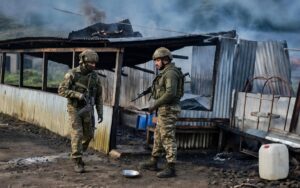
What followed demonstrates how efficient the state can be when it chooses to act. Security forces arrived without delay, engaged the Kuki volunteers, and created a safe corridor to evacuate the 40 cadres. The operation was swift, quiet and successful. Damage to the village was contained to a minimum. The Indian Armed Forces had, in effect, saved the lives of an armed group that was on the verge of being overrun. The videos of this evacuation now serve as undeniable evidence for every Kuki household that protection in Kangpokpi can arrive within minutes, but only for certain people.
The central question is not whether Chawangkhening should have been protected. Every civilian settlement deserves protection. The question is why the same standard has never been applied to Kuki villages. Since March 2026, Kuki civil society organisations have documented more than 25 Kuki civilians killed in attacks attributed to NSCN-IM and ZUF-K. These victims include cultivators shot in their fields, women targeted during agricultural work, and elderly residents injured inside their own villages. In none of these incidents did the Army mount a midnight rescue, establish a buffer, or evacuate vulnerable Kuki families. The absence of intervention then, and the immediacy of intervention now, has created a deep and justified sense of betrayal.
Watch Viral Video: https://www.facebook.com/share/r/1JoRxB3egy/
This pattern reinforces the perception of institutional bias. In Manipur, central forces are increasingly viewed not as neutral peacekeepers but as selective enforcers whose actions favour Meitei and Naga communities for political convenience. When Kuki villages face blockades on IT Road, when their farmers are killed, there is silence and inaction. When Kuki volunteers retaliate after prolonged provocation, the state responds with overwhelming force to protect the opposing side. The implication is clear and dangerous: Kuki lives are negotiable, while others are non-negotiable. This is not mere sentiment; it is the conclusion drawn from repeated experience over the last two years.
The incident also raises serious questions about the ceasefire agreement. NSCN-IM is under a ceasefire with the Government of India, which requires its armed cadres to remain inside designated camps. The reported presence of 40 fully armed cadres in a civilian village near Kangpokpi at night, actively engaged in combat, appears to be a direct violation of ground rules. Instead of holding the group accountable for this violation, the Army rescued and relocated its cadres. By doing so, the custodian of the ceasefire has protected the violators of the ceasefire. This undermines the very credibility of the peace process and signals that violations will be rewarded with state protection if the group in question is strategically useful to New Delhi.
Such selective protection constitutes a violation of constitutional principles. Article 14 guarantees equality before the law, and Article 21 guarantees the right to life with dignity for every citizen. Security cannot be distributed on the basis of ethnicity or political utility. When the state provides an immediate security umbrella to one community while denying it to another that has suffered continuous civilian casualties, it breaches both provisions. The Constitution does not permit the Indian Army to decide at 2 AM whose life is worth saving. Yet at Chawangkhening, that decision was made visibly and decisively.
The Government of India must provide transparent answers. It must order an independent inquiry into what 40 NSCN-IM cadres were doing in Chawangkhening and whether their presence violates ceasefire terms. It must disclose the protocol that allowed security forces to evacuate armed cadres while Kuki villages remain unprotected. It must also extend the same urgency to securing Kuki villages like Kholen, compensating victims’ families, and ensuring uninterrupted supply of essentials on IT Road. Continued silence will only confirm the allegation of a politically driven, selective approach under the BJP government led by Prime Minister Narendra Modi.
Manipur cannot achieve lasting peace through selective force. Peace requires justice and equal protection. A strategy that tolerates blockades against Kuki villages, overlooks the killing of Kuki civilians, and then intervenes only to save those accused of those killings, is unsustainable. If New Delhi wishes to be seen as a neutral guardian of the Constitution in the hills of Manipur, it must protect Kuki villages with the same speed and commitment it showed at Chawangkhening. Until that happens, the dominant narrative on IT Road will remain unchanged: in Manipur, India protects those who attack Kukis, but not the Kukis who are attacked.