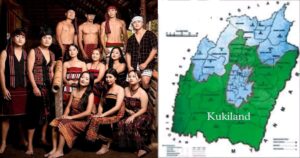
The debate over land in the hills of Manipur is not new, but it has become dangerously dishonest. There is a growing trend of claiming lands where one has never lived, never cultivated, and never buried one’s ancestors. The Kuki Hills are not an imaginary line drawn on a political memorandum; they are a lived reality. They are the villages on the ridges, the jhum fields in the valleys, the graveyards of our forefathers, and the customary boundaries that our chiefs have protected for generations.
The historical record proves who the real landowners are. The Meiteis paid tax to the Kuki chiefs of Loikhai village and Saitu village to worship at Thangting Hilla and Koubru Hills. They paid tax because the land belongs to the Kuki community. This payment is clear proof that the Kukis are the original landowners of the hills of Manipur. We gave the hills only for their worship of their Meitei Lai deities. Today they claim Koubru and Thangting Hills are Meitei land. This is a call for war. So, stop claiming the land you do not enter without Kuki permission.
History is very clear about who lives where. British administrative records, from William Shaw’s Notes on the Kukis to the reports of Colonel John Shakespeare, have documented Kuki settlements across the hills that stretch from Chassad in the east to present-day Saikul, Sadar Hills, Churachandpur, Chandel, and beyond. The village names, the oral histories, and the very stones that mark our village gates bear testimony. You cannot walk into Tengnoupal, Churachandpur, Kangpokpi, Pherzawl, and Chandel and erase that history. These are not uninhabited forests; these are Kuki villages with chiefs and land rights under customary law.
The irony is that the same people who claim ownership have never been able to set foot in these villages without permission. For decades, anyone entering Kuki villages has needed the knowledge and consent of the Kuki chief and the villagers. That is how customary law works in the hills. If a land truly belonged to you, you would not need to seek permission to enter it, nor would you need an MLA’s letter to demand combing operations to make it accessible. Ownership is not established by representations to Imphal, but by residence, by cultivation, and by customary practice.
We, the Kukis, are not claiming lands in Senapati, Thoubal, or Bishnupur where we have never lived. We respect the land of our Kacha Naga and Meitei brothers in their own settlements. What we ask for is the same respect in return. Do not claim Kangpokpi, do not claim Churachandpur, do not claim Chandel, Tengnoupal, and Pherzawl when your footprint has never existed there. A political map cannot replace a village. A press release cannot replace a hearth. The Constitution of India itself, through Article 371C and the protection of Hill Areas, recognizes this customary ownership of the hill people.
Therefore, let the principle be simple and equal: No selective security, no selective history. If the State and Central Governments are serious about peace, they must protect all villages equally and stop legitimizing claims over lands where claimants have never lived. The Kuki Hills will remain Kuki Hills, not because we shout the loudest, but because we live there, we till the land there, and we defend it with our lives.
The Kukis have lived in these hills since the 6th century till today. Our presence is not recent, not planted, and not borrowed. From ancient oral chronicles to colonial records, Kuki settlements across these hills are well documented. This land is our home, our heritage, and our future. No matter how many false narratives are created, the Kuki people will never give up their ancestral land to anyone. Our roots are too deep to be pulled out by political pressure.
Kuki history and identity cannot be deleted or distorted. You may try to rewrite maps, rename villages, or spread misinformation on social media, but you cannot erase a people. Our customary laws, our chieftainship system, our language, and our sacrifices in defending this frontier for the British and for India, are part of recorded history. An identity that has survived centuries of challenges cannot be erased by propaganda.
Finally, it must be made clear that the separation between the Kukis, Meiteis, and Kacha Nagas did not begin on 3rd May 2023. We have had separate customary lands, separate chieftainships, and separate administrative practices long before India gained independence. We co-existed as distinct communities with distinct territories. The violence of 2023 only made the physical separation visible; it did not create it. To claim otherwise is to distort history for political convenience.