Songpi: Displaced families in Churachandpur have once again pressed the Manipur Government for urgent relief, rehabilitation and justice, submitting a fresh six-point charter of demands to Chief Secretary Rajeev Singh Thakur during his visit to the district on Monday. The memorandum was handed over by leaders of the Joint Internally Displaced Persons Committee, Churachandpur, at a brief meeting held at the conference hall of the Deputy Commissioner’s Office. After the meeting, the committee leaders addressed reporters at the Circuit House in Bijang village to explain the demands and the growing frustration among the displaced population.
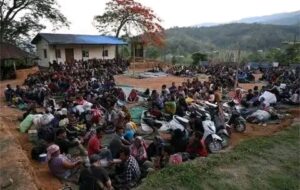
Co-convener Dr. Vumkhoneh Haokip said Churachandpur alone is sheltering 35,896 internally displaced persons, of whom 15,409 are living in relief camps while 20,487 are staying outside camps in the houses of relatives or in rented accommodation. He said both groups are displaced persons under national guidelines and international norms, and must be treated equally, but in practice a sharp and unfair divide has been created between camp and non-camp IDPs. According to him, those living outside camps have been left almost entirely without assistance for nearly four years, without even basic support in cash or food grains.
The committee said it has repeatedly raised the issue before the Union Home Ministry, the Chief Minister, the Chief Secretary and the Governor through memorandums, rallies, sit-in protests and other democratic means over the past several years. Despite these sustained efforts, it alleged, no positive or satisfactory action has been taken so far, leaving thousands of families to survive on their own without a stable source of income, housing or state support. The leaders said this prolonged neglect has become the core grievance of the displaced community and the reason for submitting yet another charter.
The first demand relates to the immediate registration of non-camp IDPs. The committee argued that if the Government does not recognise those living outside camps as registered displaced persons, it must complete the registration without further delay, because the crisis is not yet over and displacement is still continuing. Inclusion in the official list, it said, is the gateway to all other benefits, and denying registration amounts to denying the very existence of thousands of displaced families.
On housing, the committee welcomed the Government’s stated intention to settle and rehabilitate displaced persons, but said the assistance has reached only a very small number of beneficiaries so far. It demanded that housing assistance be speeded up and extended to all displaced families without discrimination between camp and non-camp IDPs. The leaders said many families continue to live in overcrowded rented rooms or with relatives, with no security of tenure and no prospect of returning home.
The committee also demanded a government job for the next of kin of the 260 people from the Kuki community who were killed during the crisis, along with a special employment package for displaced persons. Dr. Haokip said displaced families lost movable and immovable property, livelihoods and all means of survival, and now need a sustainable source of income to rebuild their lives. A government job for bereaved families, he said, would provide both dignity and a measure of justice, while a broader employment package would help thousands of others stand on their own feet again.
Regarding financial support, the committee demanded that Direct Benefit Transfer be extended to all IDPs irrespective of whether they live in camps or outside. At present, it said, DBT is given only to camp inmates, while non-camp IDPs get nothing, a disparity it described as unjust and contrary to the principle of equal treatment. The committee also raised the issue of property damage compensation, pointing out that displaced persons were asked to submit property damage forms and FIRs for lost property nearly four years ago, but no action has followed. It demanded immediate release of compensation and assistance for property loss.
The committee warned that if the charter of demands is not fulfilled, it will be compelled to launch democratic agitations, including bandhs and shutdowns. The leaders said they still prefer dialogue and a peaceful resolution, but stressed that patience among displaced families is running out after years of assurances without results.