Kathmandu: Two weeks after a massive glacial collapse high in the mountains unleashed a catastrophic wall of water, mud and debris across the China-Nepal border, the humanitarian crisis continues to deepen with the death toll crossing 1,410 and more than 5,651 people still listed as miLanKdisaster, described by survivors as a sudden black wave that swallowed entire settlements, has become one of the deadliest glacial flood events in the Himalayan region in decades.
According to Nepal’s disaster management authority, the brunt of the tragedy was borne by Nepal, where 1,367 people have been confirmed dead and another 5,132 remain missing as of Wednesday morning. On the Chinese side of the border, state media reported 43 deaths and 519 people still unaccounted for. The figures were released almost 15 days after the August 26 event, indicating that recovery operations are far from over and the final casualty count could rise significantly.
The flood originated from a glacial collapse near the border, which released an enormous volume of meltwater, boulders and silt into the Bhotekoshi river system. Eyewitnesses and officials said the surge moved with tsunami-like force, destroying bridges, roads, homes and critical hydropower infrastructure within minutes. Many of the missing include hydropower project workers who were inside or near tunnels when the flood hit, as well as migrant labourers and foreign nationals working in the area.
Rescue operations remain focused on three major hydropower projects – Trishuli 3A, Trishuli 3B and Chilime – where dozens of workers are feared trapped deep inside silt-filled tunnels. Nepal Army Spokesman Raja Ram Basnet told AFP that search and rescue work inside the tunnels is still ongoing under extremely difficult conditions. Rescuers are battling low oxygen, unstable debris and continuous water seepage. So far, only three people have been pulled out alive from deep inside the tunnels – two Nepalis last Friday and a Chinese national on September 5 – with no further survivors found since then.
NIA Links US Mercenary VanDyke And 6 Ukrainians To Drone Attack On Myanmar Civilian Aircraft
With hopes of finding more survivors fading, authorities have now shifted part of their effort towards identification and recovery. On Wednesday, the government issued a public appeal asking families of missing persons, especially those living overseas, to submit DNA samples via email to aid identification. The notice detailed specific genetic tests required depending on the relationship and sex of the relative, advising parents and children of the missing to provide samples on priority. Officials said this step became necessary as many bodies recovered are unrecognizable due to severe trauma and prolonged submersion.
The human cost beyond deaths is also staggering. Thousands of people displaced by the flood are now living in temporary relief camps set up along higher ground in Rasuwa, Nuwakot and adjoining districts. Aid agency Save the Children reported that as many as 540 children have been separated from their parents during the chaotic evacuation. Nepal Police said special measures are being taken in all temporary shelters to protect vulnerable groups. Spokesman Abi Narayan Kafle said police have increased vigilance in camps housing children, women and minorities to prevent sexual abuse and exploitation, and have started providing psychosocial counselling for traumatized survivors.
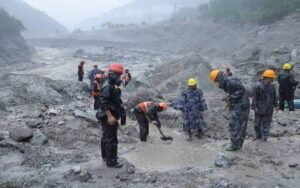
Along the Bhotekoshi river corridor, a massive search campaign for bodies is underway. Security personnel, Armed Police Force teams and local volunteers are combing through layers of mud, sand and uprooted trees, while drones are being used to scan inaccessible stretches of the riverbank where bodies could be buried. Kafle said the search is being expanded daily as water levels recede, revealing more debris fields. The sight of families putting up photographs of their missing loved ones outside a morgue in Kathmandu has become a heartbreaking daily routine in the capital.
Hundreds of foreigners are among those missing, officials confirmed, highlighting the international dimension of the disaster. The border region is a hub for cross-border trade, hydropower construction and tourism, attracting workers from India, China and other countries. Embassies in Kathmandu have been coordinating with Nepal’s disaster authority to trace their nationals. Meanwhile, connectivity remains badly hit, with several sections of the Pasang Lhamu Highway and access roads to hydropower sites still blocked or washed away, hampering the movement of heavy equipment needed for tunnel de-silting.
Scientists and disaster experts say the exact trigger of the glacial collapse is still under investigation, but the link to climate change is undeniable. Nepal, a low-lying contributor to global greenhouse gas emissions, is among the most vulnerable countries to climate-induced disasters. Rising temperatures are accelerating glacial melt across the Himalayas, creating unstable glacial lakes that can burst without warning. Experts have long warned that the combination of glacial lake outburst floods and extreme rainfall is increasing the risk of such cascading disasters in the region.
As the nation mourns, the government estimates that reconstruction could cost billions of dollars, a massive burden for the largely rural country of 30 million people. Beyond rebuilding infrastructure, authorities face the long-term challenge of relocating high-risk settlements, improving early warning systems and regulating construction around glacial rivers. For now, the priority remains finding the missing and providing dignity to the dead, as families continue to wait outside hospitals and morgues hoping for news that may never come.