Chandel: The Haokip Youth Organisation (HYO), General Headquarters, Lamka, Songpi District, has issued a detailed press release in reply to the recent press release of the Thadou Tribe Council (TTC), General Headquarters. In the release, bearing number HYO/GHQ/PR-10/2026 and dated 19 November 2026, the organisation said it rejects the TTC reply in full. It restated its central position that Thadou is a clan and not a tribe, and that Kuki is a nation. The organisation said no foreign book and no gazette can change genealogy and lineage, and it urged media houses to publish its statement in full.
The HYO said its statement was issued by its Department of Information and Publicity. It framed the release as a reply to TTC, and as a clarification of what it described as its own history, genealogy, and identity. The organisation said the debate is not about personal enmity, but about how names, clans, and larger identities are understood within the community. It said the issue touches questions of seniority, lineage, customary law, and the way different groups relate to one another under a shared history.
According to the HYO, foreign writers do not know the genealogy of the community. It argued that outsiders who came from outside did not sit in local councils, did not know the story of Khul, Songthu lineage, and seniority, and therefore could not fully understand internal distinctions. The organisation said such writers heard one clan name and wrote it for all. On this ground, it said the record of some foreign writers is not its history, but their misunderstanding.
The organisation further argued that recognition of Thadou as a tribe by some government is totally false. It described such recognition as an insult to genealogy and lineage, and as a divide-and-rule policy. In its view, a gazette cannot create a tribe, cannot change a clan into a tribe, and cannot make a youngest brother encompass elder clans. It said administrative recognition cannot override what it called customary and genealogical reality.
The HYO said Thadou was left alone by other clans because Thadou is a clan. It listed Guite, Haokip, Lunkim, Lhundim, Touthang, Misao, Kilong, Lhanghal, and others as clans that share similar dialect, culture, and tradition. According to the statement, these clans remained separate clans under one or two lineages, and never accepted themselves as Thadou tribe. It said the youngest clan has no right and no customary law to control the elders in society.
In the same section, the organisation said a tribe name must cover different clans, not one or two clans. It argued that a tribe name should be created based on similar dialect and tradition to cover different clans, and not by one or two clans like Thadou clan and Mate clan. It said to make one clan into a tribe over all others is imposition, not unity. It said such an approach cannot produce genuine unity among groups that see themselves as distinct clans.
The press release also claimed that the present Thadou tribe structure is run by Thadou sub-clans and some individuals only. It named Singson, Lhouvum, Lhoujem, Singsit, Thomsong, Sitlhou, and some individuals from other clans, including Michael Lamjathang Haokip, James Haokip, and N. Biren Singh. It said the structure is not accepted by Haokip, Doungel, Kipgen, Guite, and other similar dialect clans. It argued that a tribe cannot be run by one or two sub-clans and a few individuals.

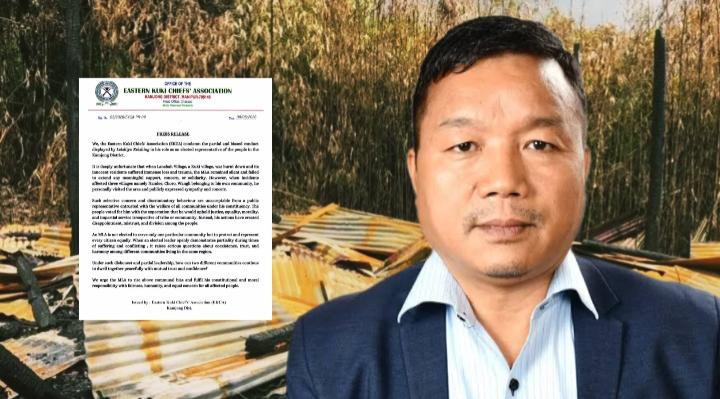
File Photo: Haokip Youth Organisation press release issued 19 November 2026, rejecting TTC reply, stating Thadou is a clan, Kuki a nation.
The HYO said Kuki covers many tribes and sub-tribes according to historical record, whether people accept it or not. It said Kuki does not belong to one clan, while Thadou belongs to one clan. On this basis, it said Kuki as a larger identity is different in nature from Thadou as a single clan. It maintained that the distinction is central to understanding its objection to the TTC position.
On the origin of the name Kuki, the HYO said the name is ancient, and was not given by Bengali or British writers during the 18th-19th century. It claimed the name was used since the 6th-7th century, and was found in the textbook of Rajmala, the royal chronicle of Tripura, and Mahabharata during the 7th century. It said Kuki is ancient, older than British rule, and older than the 1956 gazette. It presented this claim as evidence against the view that the name was a colonial creation.
The organisation said Kuki is a nation, not a mere nomenclature, not a mere label, and not a mere tribe name created by outsiders. It said Kuki is a nation because Kuki has ancestral land, common history, common freedom struggle, common genealogy, common culture, and common future. It pointed to the Anglo-Kuki War, 1917-1919, and said Kuki chiefs from different clans fought together in that war as one nation, and that Kuki people died together as one nation.
The HYO argued that a nation covers many tribes and many clans, while a clan cannot cover a nation. It said the youngest Thadou clan cannot cover elder clans, and the Mate clan cannot cover other clans. It accused TTC of trying to make Kuki a small label and Thadou a big tribe, which it described as upside down. It restated its formulation that Kuki is the nation and Thadou is a clan.
In its concluding position, the HYO said it does not hate Thadou clan. It described Thadou clan as its youngest brother, and said it respects Thadou as its younger brother. It said what it rejects is the claim that its youngest brother is a separate tribe above others. The organisation said respect for the clan as a younger brother and rejection of the tribe claim can exist together, and that its objection is to status and hierarchy, not to the people themselves.
The organisation requested all media houses and the public not to entertain what it called self-styled organisations of Michael Lamjathang Haokip and James Haokip. It listed Thadou Tribe Council, Thadou Inpi Manipur, Thadou Students Association, Thadou Community International, Thadou Human Rights Advocacy, and others. It urged media houses to treat such bodies with caution, and to publish its own press release in full so that its position is presented without alteration.
The HYO concluded by asking for wide publication of its statement. It said the Department of Information and Publicity, General Headquarters, had issued the release on 19 November 2026. It reiterated its motto, Youth for a better tomorrow, and said the clarification was necessary at a sensitive time. It said it hoped its explanation would help the public, media, and community members understand its stand on clan, tribe, and nation, and on the need for unity based on what it called correct genealogy and history.