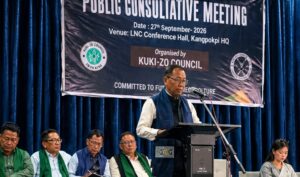
Kanggui: The political leadership of the Kuki community on Tuesday came together in Kangpokpi to send a unified and unambiguous message to New Delhi and Imphal that their demand for a separate Union Territory with Legislature under the Constitution of India remains firm, uncompromised and the only viable solution for lasting peace and security in the region. The high-level consultation, convened under the theme “Unity, Consultation, Progress”, was held at Hotel LNC in Kangpokpi town and lasted for over six hours, marking one of the largest gatherings of Kuki political, civil society, religious, intellectual and traditional leaders in recent months. The meeting was organised by the Committee on Tribal Unity (CoTU), moderated by Joint Secretary of the Kuki Council Douminlal Haokip, and was attended by sitting MLAs from Sadar Hills, former Members of District Council, church leaders, chiefs, and representatives of all major Kuki tribe organisations and frontal organisations, reflecting a rare show of unity at a critical juncture.
Addressing the media after the closed-door deliberation, Chairman of the Kuki Council, Henlenthang, stated that the consultation in Kangpokpi is part of a series of consultations already held in Churachandpur, Tengnoupal and Chandel districts to bridge internal communication gaps, dispel confusion and reaffirm the collective political aspiration of the Kuki people. He asserted that attempts by certain vested interests and government agencies to create division within the community and to dilute the political demand through developmental packages have failed. The Council made it clear that development without political security is meaningless, especially for a community that has faced systematic violence, displacement of more than 50,000 people, and the killing of over 200 innocent Kuki civilians since May 2023. The Council reiterated that only a separate administration in the form of a Union Territory with Legislature can guarantee the safety of lives, protection of ancestral land and preservation of cultural identity.
The consultation deliberated in detail on the current political situation, the ongoing Suspension of Operation talks with the Kuki National Organisation and the United People’s Front, and the humanitarian crisis faced by internally displaced Kuki people. The Council unanimously resolved to continue extending full support to the KNO and UPF as the sole authorised platforms for political dialogue with the Government of India. It was resolved that any solution must be political, constitutional and honourable, and should address the root cause of the conflict, which is the long-standing marginalisation and insecurity of the Kuki people under the Manipur administration. The leaders also stressed the need for strengthening unity among all Kuki sub-tribes including Vaiphei, Gangte, Kom, Simte and others, and to ensure that all village chiefs, women organisations, student bodies and church forums work under a common objective.
One of the most sensitive and urgent issues discussed at the conclave was the fate of Kuki bodies that have been lying in cold storage at the Churachandpur District Hospital morgue for months. The Kuki Council expressed deep anguish and outrage that despite repeated appeals, the Government has failed to deliver justice and facilitate a dignified burial for the martyrs who were brutally killed in the ethnic violence. The Chairman announced that the Council has set a firm deadline of October 10, 2026 for the Government to take concrete action, including a judicial inquiry and necessary arrangements for justice to the families of the deceased. He warned that if no positive response is received by the deadline, the Council will be compelled to intensify its democratic movement.
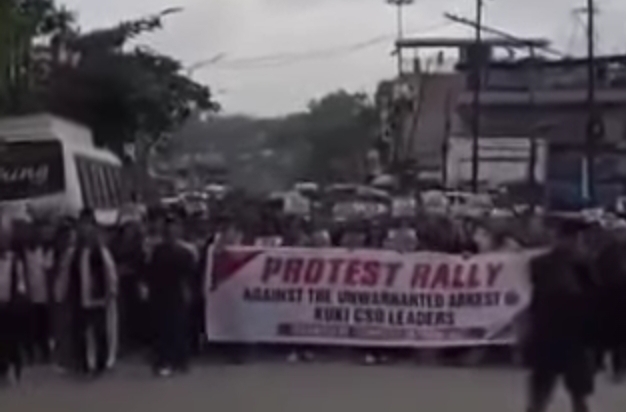
“If nothing happens by October 10, we will intensify our movement by organising massive protests, dharnas, public rallies and other forms of democratic agitation across all Kuki-dominated areas,” Henlenthang told reporters, adding that the agitation will be peaceful but determined. The warning comes amid growing frustration among the Kuki public over the prolonged delay in justice, the continued blockade of essential supplies to Kuki areas, and the failure of the state administration to restore normalcy. The Council stated that the continued keeping of bodies in the morgue is not just an administrative failure but a grave violation of human rights and customary honour to the dead, and it cannot be tolerated indefinitely.
The Kangpokpi consultation also witnessed detailed deliberations on the need to document human rights violations, to pursue legal remedies at national and international forums, and to strengthen community-based security and self-governance mechanisms. Representatives from the Kangpokpi District Bar Association, human rights organisations, intellectuals, research scholars and academicians emphasised the need to prepare a comprehensive political roadmap and a legal dossier to support the demand for Union Territory. The church leaders who attended the meeting called for prayer, peace and unity while also urging the Government to act with sincerity and without bias. The women leaders from the Kuki Women Union and other women wings highlighted the suffering of Kuki women and children in relief camps and demanded immediate rehabilitation and protection.
The leaders unanimously condemned all attempts to portray the Kuki political demand as anti-national or divisive, clarifying that the demand for a separate Union Territory is well within the constitutional framework of India and is similar to past creations of Union Territories to resolve ethnic and administrative crises. They recalled that the Kuki people have always been loyal citizens of India and have contributed significantly to the defence and development of the nation, yet have been continuously deprived of their rights and security in Manipur. The Council reiterated that separation from the present Manipur administration is not a choice but a necessity for survival, as coexistence under the same administration has become impossible after the targeted violence that began in May 2023.
In his concluding remarks, the Chairman of the Kuki Council thanked all participants for their valuable suggestions and reaffirmed that the Council will continue to act as the common political platform of the Kuki people. The meeting concluded with a vote of thanks proposed by Ch. Ajang Khongsai, Chief of the Governing Council, and a thanksgiving prayer by Dr. GS Gangte. The Council resolved to hold further consultations in other districts and to maintain close coordination with Kuki MLAs, chiefs, civil society organisations and the negotiating groups to ensure that the voice of the people remains united, strong and consistent until the goal of a separate Union Territory with Legislature is achieved and justice is delivered to all victims of the conflict.
The Kangpokpi conclave is being seen by political observers as a crucial step in consolidating the Kuki political movement at a time when the Government of India is reportedly preparing to expedite the dialogue process. By setting a deadline and warning of intensified agitation, the Kuki Council has made it clear that it will not remain a silent spectator to the delay and denial of justice, and that the coming days will be decisive for the future political landscape of Manipur and the Kuki people’s long struggle for self-determination, dignity and constitutional protection.