Edited by Kimbawinu Vaiphei, Kukiland Express Desk
Kanggui: May 16, 2026
Thousands of Kuki protesters took to the streets of Motbung in Kangpokpi district on Saturday, as the first day of a 48-hour total shutdown called by Kuki Inpi Manipur (KIM) triggered one of the largest coordinated demonstrations in the district in recent weeks. Organised under the Committee on Tribal Unity (CoTU), the rally drew widespread participation from church groups, village authorities, women’s organisations, and student bodies, all demanding the immediate release of Kuki civilians allegedly held hostage and justice for three Kuki church leaders killed in an ambush on May 13.
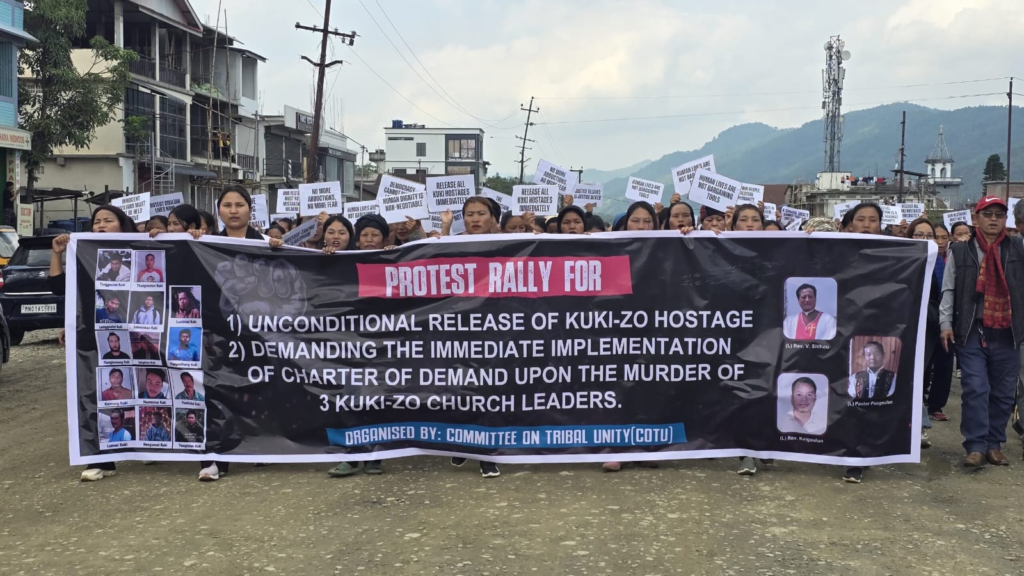
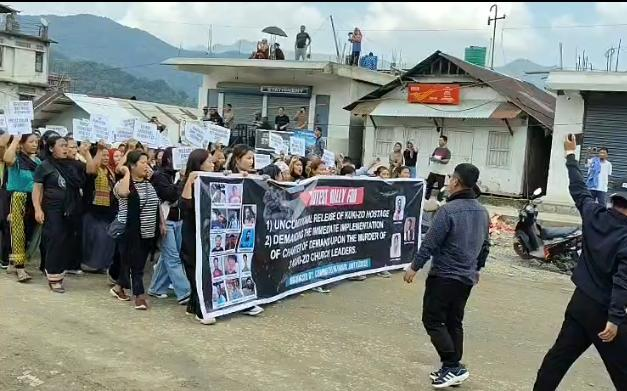
Marching from Motbung Bazar to Charhajare and back, the protesters carried placards and raised slogans condemning what they described as “barbaric killings,” “targeted persecution,” and “constitutional failure” to protect Kuki communities. Organisers said the mobilisation was deliberately kept democratic and constitutional, but stressed that public patience was wearing thin amid what they called an “unimaginable humanitarian crisis.” The shutdown, which began at midnight Friday, brought commercial and vehicular movement in Kuki-inhabited areas of Kangpokpi to a halt, with volunteers enforcing closure across key junctions.
Addressing the gathering, Kuki Inpi Manipur President Ch. Ajang Khongsai, Kuki Inpi Sadar Hills President Thangminlen Kipgen, and CoTU Chairman Lunthang Haokip declared that the continued detention of innocent civilians amounted to “an act of terror against a people.” They said the killings of the three pastors near Kotzim and Kotlen had shaken the moral conscience of the community and demanded that New Delhi treat the incident as a matter of national priority. The leaders reiterated that the Kuki movement would remain non-violent but warned that restraint should not be mistaken for weakness.
The protest gained further intensity when two Kuki youths who said they had escaped captivity in Senapati district recounted their experiences before the crowd. Their testimonies drew audible anger from the gathering and renewed calls for urgent intervention by the Centre and security forces. Organisers said the accounts underscored the vulnerability of civilians traveling through conflict-prone areas and the need for guaranteed safe corridors in Kuki-dominated regions.
Following the rally, KIM and CoTU leaders highlighted a Charter of Demands already submitted to the Government of India. The charter seeks an immediate high-level NIA investigation into the May 13 ambush and killings, prosecution of all perpetrators and conspirators, and permanent security guarantees for Kuki civilians and vulnerable villages. It also calls for the creation of special security zones in conflict-prone areas, formal recognition of what Kuki bodies describe as repeated persecution of their community, and expedited political engagement with Suspension of Operations (SoO) groups to address underlying causes of ethnic insecurity.
Speaking to reporters, KIM Information Secretary Janghaolun Haokip said the coordinated protests in Kangpokpi, Churachandpur, and other Kuki areas were a unified humanitarian and political response to the trauma faced by hostage families. “The suffering of hostage families violates every constitutional and humanitarian principle,” he said, urging central agencies to secure the immediate and unconditional release of all detainees. He added that while the community remained committed to peace, “democratic patience has limits when fundamental dignity, safety, and survival are under threat.”
Haokip also responded to recent claims by Liangmei Naga women’s groups regarding land at Leimakhong Army area, calling them “misleading and historically false.” Citing village chief records and traditional accounts, he asserted that about 70 per cent of the land acquired by the Army in the 1960s belonged to Khunkho-Kuki village, with the remainder from Khunkho-Naga and Makhan villages. Kuki leaders said the clarification was necessary to prevent misinformation from inflaming tensions during the ongoing crisis.
With the extended shutdown set to continue until midnight Sunday, CoTU indicated that public mobilisation in Kangpokpi district would intensify unless all hostages are released and the Charter of Demands is acted upon. KIM described the demonstrations as a direct response to illegal detention, hostage-taking, targeted violence, and a worsening humanitarian situation, stressing that the dignity, security, and justice of the Kuki people remain “non-negotiable.” Organisers said Sunday’s program would include prayer meetings and further marches, signaling that grief in the hills has consolidated into a disciplined mass movement seeking political accountability and lasting peace.