Rights body blames NSCN-IM, ZUF-Kamson for June 5 pre-dawn attack killing chief, pregnant wife, civilian; cites 1,100+ deaths since 1993, 14 hostages; demands arrest of Th. Muivah, ceasefire review, UNHRC intervention
Edited by: Lulun Haokip | Kukiland Express Desk
Songpi, June 6, 2026
The Kuki Human Rights Council (KHRC) on Thursday unequivocally condemned the “barbaric, inhuman attack” on Loibol Khullen village, Saitu-Gamphazol subdivision, Kangpokpi district, Manipur, that allegedly took place at around 4:00 AM on June 5, 2026.
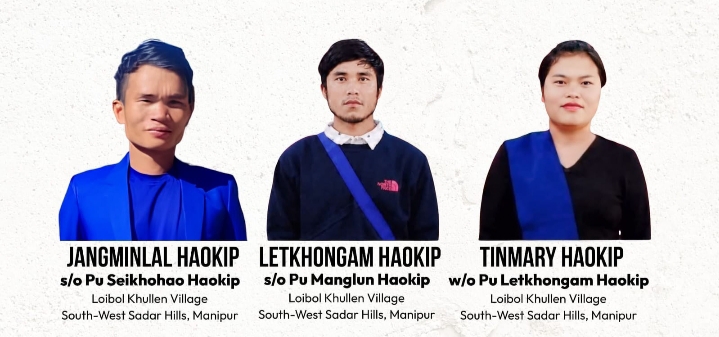
The attack resulted in the killing of three Kuki civilians: village chief Letkhongam Haokip, his wife Tinmary Haokip, who was seven months pregnant, and Jangminlal Haokip.
KHRC said it mourns with the bereaved families and the entire Loibol Khullen community. “The killing of unarmed civilians in their homes while asleep, including a pregnant woman, is a grave violation of human rights, international humanitarian norms, and the fundamental right to life guaranteed under Article 21 of the Constitution of India,” the KHRC stated. It added that the targeting of a village chief and his family is an assault on the traditional governance system and collective dignity of the Kuki people.
According to initial reports from local sources, the attack was allegedly carried out by members of the NSCN-IM and ZUF-Kamson. KHRC said the incident follows a series of targeted attacks on Kuki civilians. On March 12, 2026, two Kuki civilians were allegedly killed by NSCN-IM near Thawai Kuki village. On May 13, 2026, three Kuki pastors — Rev Vumthang Sitlhou, Pastor Kaigoulun Lhouvum, and Pastor Paogoulen Sitlhou — were ambushed and killed near Saheibung Peak while returning from a religious convention.
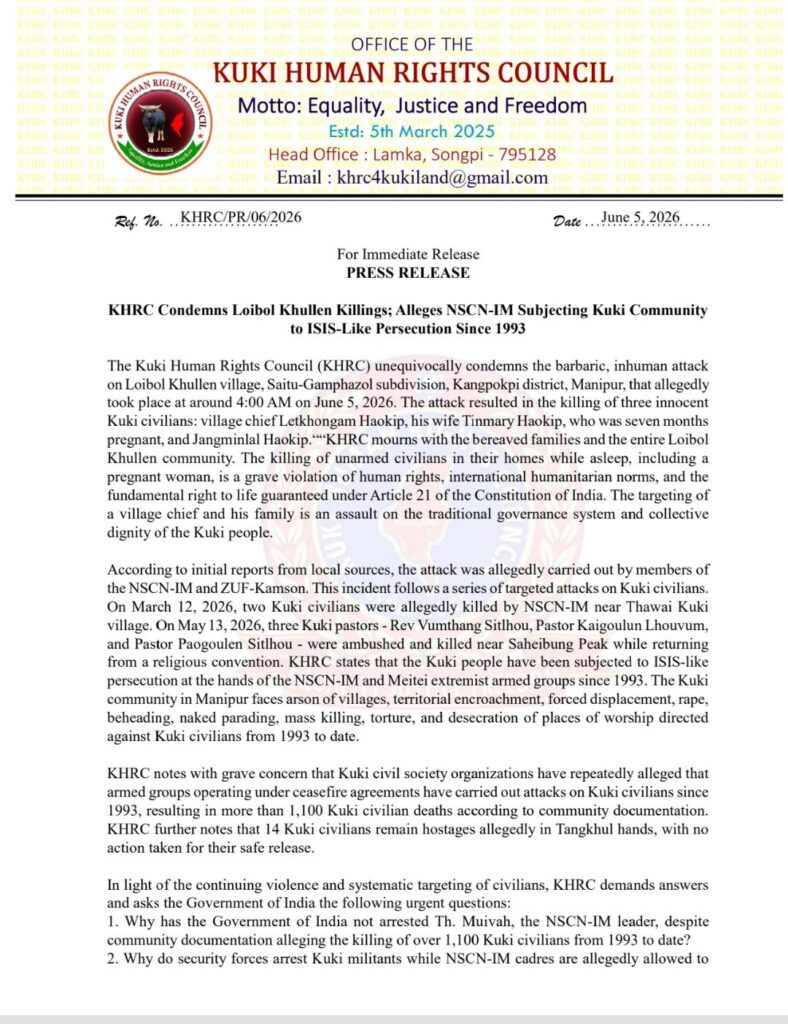
KHRC stated that the Kuki people have been subjected to “ISIS-like persecution at the hands of the NSCN-IM and Meitei extremist armed groups since 1993.” The Kuki community in Manipur faces arson of villages, territorial encroachment, forced displacement, rape, beheading, naked parading, mass killing, torture, and desecration of places of worship directed against Kuki civilians from 1993 to date, it said.
KHRC noted with grave concern that Kuki civil society organizations have repeatedly alleged that armed groups operating under ceasefire agreements have carried out attacks on Kuki civilians since 1993, resulting in more than 1,100 Kuki civilian deaths according to community documentation. KHRC further noted that 14 Kuki civilians remain hostages allegedly in Tangkhul hands, with no action taken for their safe release.
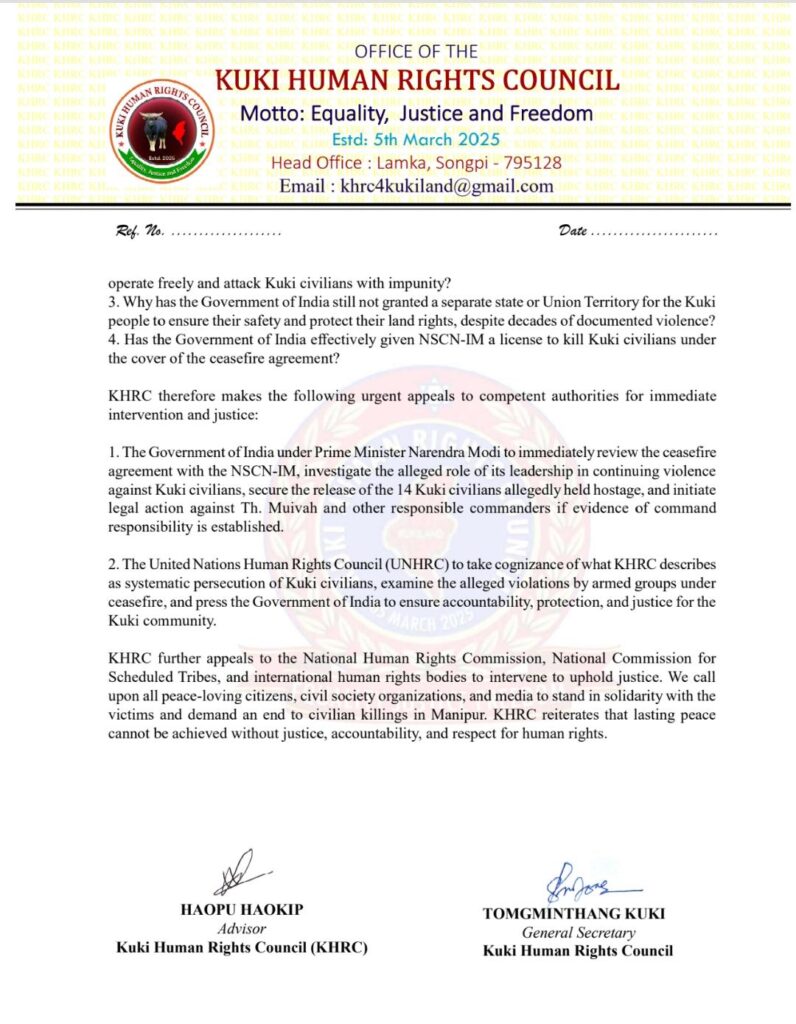
In light of the continuing violence and systematic targeting of civilians, KHRC posed four questions to the Government of India:
- Why has the Government of India not arrested Th. Muivah, the NSCN-IM leader, despite community documentation alleging the killing of over 1,100 Kuki civilians from 1993 to date?
- Why do security forces arrest Kuki militants while NSCN-IM cadres are allegedly allowed to operate freely and attack Kuki civilians with impunity?
- Why has the Government of India still not granted a separate state or Union Territory for the Kuki people to ensure their safety and protect their land rights, despite decades of documented violence?
- Has the Government of India effectively given NSCN-IM a license to kill Kuki civilians under the cover of the ceasefire agreement?
KHRC made two urgent appeals for intervention and justice:
- To the Government of India under Prime Minister Narendra Modi to immediately review the ceasefire agreement with the NSCN-IM, investigate the alleged role of its leadership in continuing violence against Kuki civilians, secure the release of the 14 Kuki civilians allegedly held hostage, and initiate legal action against Th. Muivah and other responsible commanders if evidence of command responsibility is established.
- To the United Nations Human Rights Council (UNHRC) to take cognizance of what KHRC describes as systematic persecution of Kuki civilians, examine the alleged violations by armed groups under ceasefire, and press the Government of India to ensure accountability, protection, and justice for the Kuki community.
KHRC further appealed to the National Human Rights Commission, National Commission for Scheduled Tribes, and international human rights bodies to intervene to uphold justice. It called upon all peace-loving citizens, civil society organizations, and media to stand in solidarity with the victims and demand an end to civilian killings in Manipur. “Lasting peace cannot be achieved without justice, accountability, and respect for human rights,” KHRC reiterated.
The statement was signed by Tongminthang Kuki, General Secretary, Kuki Human Rights Council (KHRC), and Haopu Haokip, Advisor, Kuki Human Rights Council (KHRC).