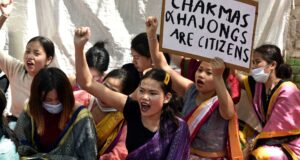
New Delhi: The Kuki Human Rights Council (KHRC), a tribal human rights body based in Songpi Churachandpur), has filed a joint urgent appeal before the National Human Rights Commission (NHRC) of India and the United Nations Human Rights Council, Geneva, seeking immediate intervention and protection for the Chakma and Hajong minority community in Arunachal Pradesh, who are facing grave threats to life and political rights.
The urgent appeal, bearing Reference No. KHRC/AR-SIR/01/2026 and dated 5th September 2026, has been formally addressed to the Chairperson of the National Human Rights Commission, New Delhi – 110023 and to the Special Rapporteur on Minority Issues, Office of the High Commissioner for Human Rights (OHCHR), United Nations, Geneva (Email: sr-minorityissues@ohchr.org). Copies of the same have also been forwarded to the Chief Election Commissioner of India, the Governor of Arunachal Pradesh and the UN Resident Coordinator in India for necessary action.
Giving historical background of the community, KHRC stated that the Chakma and Hajong communities, who are Buddhist and Hindu by faith, were originally displaced due to the construction of the Kaptai Dam in the Chittagong Hill Tracts in 1960. They were subsequently settled in the then North East Frontier Agency, now Arunachal Pradesh, by the Government of India during the period 1964-69 on humanitarian grounds. At present, their population in the state is estimated to be around 65,000, living mostly in Changlang, Papum Pare and Namsai districts.
Citing media reports published by The Hindu and India Today NE, the Council reported that on 3rd and 4th September 2026, cadres of the All Arunachal Pradesh Students’ Union (AAPSU) violently disrupted the statutory Special Intensive Revision (SIR) hearings being conducted by the Election Commission of India at Bordumsa in Changlang district, which is a Chakma-Hajong inhabited area. The disruption was marked by stone pelting, alleged firing and large-scale damage to government property.
As a direct result of the said violence, the electoral exercise was severely hampered. Out of 252 Form 6 applications for inclusion of new voters and 303 applications for correction and other purposes, only 222 Form 6 and 150 other applications could be heard by the Electoral Registration Officer (ERO). The remaining eligible voters, who had come for the hearing, were prevented from entering the hearing venue and were forced to return. Consequently, the ERO was compelled to postpone the remaining SIR hearings, KHRC alleged.
The situation was further aggravated when the President of AAPSU publicly demanded suspension of the entire SIR exercise in Chakma-Hajong areas and also demanded that no First Information Report (FIR) should be registered against the AAPSU members involved in the violence and vandalism of the ERO office on 4th September 2026, which KHRC termed as open intimidation and obstruction of a statutory duty.
Terming the incident as a serious violation of fundamental and electoral rights, KHRC stated that the actions of AAPSU violate several provisions of the Constitution of India, including Article 14 – Right to Equality, Article 15 – Prohibition of discrimination, Article 21 – Right to Life and Personal Liberty, Article 325 – which clearly states that no person shall be excluded from electoral roll on grounds of race or religion, Article 326 – Right to Vote, and Articles 29 and 30 – which protect the cultural and educational rights of minorities.
The Council also invoked the landmark judgment of the Supreme Court of India in the case of NHRC vs State of Arunachal Pradesh 1996 (1) SCC 742, where the apex court had categorically directed the State of Arunachal Pradesh to protect the life and personal liberty of each and every Chakma and to repel any attempts by organised groups such as AAPSU to threaten them by deploying adequate para-military forces. The failure to implement the said direction, KHRC said, amounts to contempt.
Under International Human Rights Law, KHRC pointed out that India is a signatory to the International Covenant on Civil and Political Rights (ICCPR) Articles 2, 25, 26, 27, International Convention on the Elimination of All Forms of Racial Discrimination (ICERD) Article 5, and Universal Declaration of Human Rights (UDHR) Articles 7 and 21, which guarantee right against racial discrimination and right to participate in public affairs through voting.
In its prayer, KHRC humbly urged the NHRC to direct the Chief Secretary and Director General of Police, Arunachal Pradesh to provide Central Armed Police Forces (CAPF) during the remaining SIR hearings and to provide permanent protection to Chakma and Hajong villages; to direct the Chief Electoral Officer, Arunachal Pradesh to hold fresh de-novo SIR hearings under videography and in presence of ECI observers for those prevented on 3rd and 4th September; to order registration of FIR regarding violence and damage to ERO office on 4th September 2026; and to request the UN Special Rapporteur on Minority Issues to issue an urgent communication to the Government of India for compliance with ICCPR and ICERD. The Council concluded by stating, “Minority rights are the soul of democracy.”