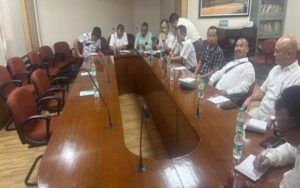
New Delhi: The Kuki National Organisation (KNO) and United People’s Front (UPF), the two umbrella organisations of Kuki armed groups under the Suspension of Operations (SoO) agreement, on Thursday reasserted their demand for a Union Territory with Legislature as the only permanent political settlement for the Kuki people in Manipur.
Speaking at a press conference in New Delhi on September 10, leaders of both groups said the situation in Manipur has fundamentally changed since the outbreak of ethnic violence on May 3, 2023. They cited mass displacement, complete physical separation of communities and a total breakdown of trust as reasons why the old arrangement cannot be restored.
“There can be no return to the pre-May 3, 2023 status quo. The existing state structure can no longer provide adequate security to the Kuki population,” said Dr Seilen Haokip of KNO.
The organisations said their earlier demand for an Autonomous Territorial Council within Manipur has now become obsolete after the violence. “We now demand a Union Territory with a Legislature, modelled on Article 239A of the Constitution of India,” Haokip said.
For Objecting To Noise At Dhaba, Manipur Guitarist Chongtham Vikram Singh Beaten To Death In Delhi
According to the groups, the demand is driven by three core concerns. The first is security and survival, the second is protection of land, identity and customary rights, and the third is the need for a permanent constitutional settlement. They maintained that the demand for a separate Union Territory does not amount to secession and that they remain committed to a solution within the Constitution of India.
On the sensitive issue of the National Register of Citizens (NRC), the KNO and UPF leaders said they strongly oppose any move to prepare or update NRC in Manipur before a full and credible Census is completed. They argued that demographic and citizenship questions must be based on comprehensive and officially verified population data.
The groups particularly rejected the use of 1951 as the sole or primary baseline for determining citizenship or residency in the hill areas of Manipur. “Several remote hill settlements historically had limited access to government institutions and enumeration in 1951 may have been incomplete,” said Aaron Kipgen of UPF.
Relying exclusively on old historical records, they claimed, could result in genuine indigenous Kuki residents being excluded from the list. The leaders also questioned the logic of conducting NRC selectively in Manipur before the national Census is completed and its results are made available.
“Claims of abnormal population growth, demographic change or illegal immigration involving Kuki people must be tested against official Census data rather than political assertions,” Kipgen said.
The groups further reiterated that a constitutionally protected separate administrative arrangement is necessary to safeguard the community’s political, administrative, land and customary rights.
The leaders also sought justice for Kuki women who were allegedly subjected to sexual violence, rape, public humiliation and killings during the conflict. They demanded credible investigations and accountability for serious crimes committed during the violence, including allegations concerning the role of the state.
The KNO and UPF also opposed what they described as collective labelling of Kuki people as “illegal immigrants”. They cited the community’s role in the Anglo-Kuki War of 1917-19 against the British and its contribution to India’s freedom struggle, while insisting that citizenship and migration questions should be determined through individual evidence and due process.
The groups also raised the issue of continuing displacement and insecurity in Kangpokpi district, saying victim accounts and the humanitarian situation there should form part of the political dialogue and any future reconciliation process.
Another key demand was an immediate end to what they called harassment, intimidation and selective targeting of SoO cadres. The groups urged authorities to strictly adhere to the SoO ground rules, ensure safety and lawful treatment of designated cadres and maintain transparent monitoring through the existing Joint Monitoring Mechanism.
The KNO and UPF said they remain committed to the SoO agreement and a peaceful political settlement, but urged the Centre and Manipur government to initiate a time-bound process to address their political and security concerns.