Edited by Nengcha Haokip, Kukiland Express Desk
Songpi: May 8, 2026
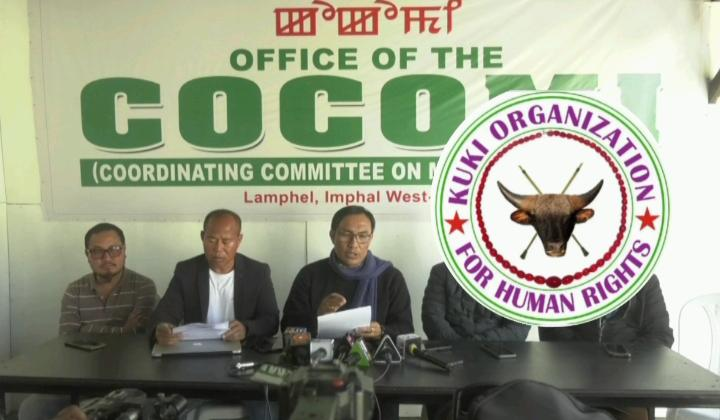
The Kuki Organisation for Human Rights Trust on Thursday released a five-page rejoinder to COCOMI’s May 7 statement on the Kamjong border incident, calling it “factually misleading, ethnographically illiterate, and politically self-serving.” While KOHUR said it welcomes any genuine call for impartial investigation and the protection of civilian life, it argued that COCOMI’s framing of the clash as “cross-border armed aggression by foreign-based groups against Indian citizens” distorts the ground reality and should not shape public discourse.
First, KOHUR stated that “Kuki are not foreigners.” The trust described the Kuki as a trans-border indigenous community whose ancestral homeland straddles the present-day borders of India, Myanmar’s Chin State and Sagaing Region, and Bangladesh. This geography predates the Treaty of Yandabo of 1826 and colonial cartography, with kinship, customary law, language, and clan structures continuing across these borders. To brand Kuki presence on either side as “foreign,” it said, is a denial of identity and history.
KOHUR noted that this logic is not applied to other trans-border indigenous groups in the region, including the Naga people. The selective labelling of Kuki as “foreign,” it argued, reveals a political purpose rather than a factual one, ignoring social and cultural realities that existed long before modern nation-states fixed their borders.
Second, KOHUR challenged COCOMI’s evidentiary basis, calling it “the unverified assertion of one sitting MLA from the affected constituency.” The trust said a single legislator’s claim — himself a politically interested party belonging to the community in confrontation with Kuki villages — cannot be an adequate basis for national-security alarm. “Mature institutions investigate first and label later,” the communiqué stated, warning that executive action based on unverified claims risks repeating the errors that led to the “catastrophic state failures of 3 May 2023.”
Third, KOHUR said COCOMI’s account erases the documented pattern of aggression in the Ukhrul–Kamjong–Tangkhul sector since the conflict began. The recent incident, it maintained, did not begin as a “cross-border invasion” but as a localised altercation — a drunken brawl — that Tangkhul actors escalated into a community-coded conflict. This mirrors a playbook used against Kuki villages in the area for nearly three years, the trust said.
To substantiate the pattern, KOHUR listed 12 Kuki villages that have been attacked, burnt, or forcibly vacated under threat: Litan Sareikhong, Yaolen, Patleijao, Mulam, Songphel, Maokot, and Lanchah were burnt or attacked; Khoikai, Mollen, Gampal, Haijang, and Phungtha were vacated under threat. “Not one of these aggressions has produced a COCOMI press release, nor have they been the subject of the high-level transparent inquiry COCOMI now demands,” it said.
Fourth, KOHUR accused COCOMI of omitting wider context. In the days preceding May 6, NSCN (Eastern Flank) cadres attacked Kuki villages in Ukhrul–Kamjong, torched houses, and displaced civilians, while in adjoining Kangpokpi district, Kuki women cultivators were repeatedly targeted in their fields by the same constellation of armed actors. This NSCN (EF) deployment, KOHUR said, has been corroborated from across the international border.
The trust cited public-domain reports that the Kaishan Rungyond Naga, apex traditional body of the Kaishan Boklum area within the Naga Self-Administered Zone in Myanmar’s Sagaing Division, issued a formal statement acknowledging that NSCN-IM (EF) cadre Cpl Bahnlei Ahlahpya, killed during the Hongbei action, was from Kaishan Boklum, Myanmar. Multiple press statements and videographic evidence show the slain cadre was a Myanmar national deputed across the international boundary by an outfit under a Ceasefire and Suspension of Operations arrangement with the Government of India, and was killed while attacking Indian citizens on Indian soil. “This is the record. It contradicts COCOMI’s foreign-based groups against Indian citizens framing.”
Fifth, KOHUR charged COCOMI with a “selective definition of armed aggression.” Since May 2023, it said, COCOMI has never addressed the looting of thousands of firearms from Manipur Police and IRB armouries by Meitei mobs and the continued non-recovery of those weapons; the unchecked operations of Arambai Tenggol, including the Tronglaobi IED blast and subsequent attack on a CRPF camp; documented violence against Kuki Indian citizens — hundreds killed, thousands of homes destroyed, churches and villages burnt, tens of thousands displaced; and the documented role, until his removal, of a sitting Chief Minister in the architecture of that violence.
“An organisation that locates threats to national sovereignty only at the Indo-Myanmar border, and never in the looted armouries of the Imphal valley, has forfeited the moral standing to lecture the Government of India on territorial integrity,” KOHUR stated. A press release that begins its timeline only when Kuki defenders are alleged to have responded “is not a security analysis; it is a narrative weapon.”
Sixth, KOHUR said it supports in principle a high-level inquiry, but laid out four conditions. Any probe must be independent of the Manipur State machinery, which it called compromised; conducted by a court-monitored agency with a full territorial mandate covering the Imphal valley and the Tangkhul sector; empowered to investigate the May 2023 armoury looting, Arambai Tenggol’s operations, the Tronglaobi blast, the CRPF camp attack, documented NSCN cadre attacks on Kuki civilians — including the confirmed cross-border deployment of Myanmar nationals under NSCN-IM (EF) colours — and the twelve Kuki villages enumerated; and required to publish its findings, not bury them.
Seventh, KOHUR alleged COCOMI is, “in its political character and lineage, a civilian frontal organisation of the banned Meitei armed groups” — RPF/PLA, UNLF/MPA, PREPAK, KYKL, and KCP. These outfits have, for over three decades, operated from sanctuaries inside Myanmar, ambushed and killed Indian soldiers and unarmed civilians, and waged an explicitly secessionist armed war against the Republic of India in the name of Manipur sovereignty. Each stands proscribed under the Unlawful Activities (Prevention) Act, with cadre, training, weaponry and financing credibly linked by the Ministry of Home Affairs and Indian intelligence to Chinese state agencies and Pakistan’s Inter-Services Intelligence. “An organisation whose political and ideological lineage runs through groups that the Indian state itself has banned… has forfeited the moral authority to lecture either the Union of India or the Indian public on Indian nationalism, national security or the territorial integrity of this country,” it said.
Eighth, KOHUR said COCOMI’s use of “sovereignty,” “territorial integrity” and “foreign aggression” is a deliberate effort to internationalise — and thereby criminalise — indigenous Kuki presence in the hill districts of Manipur, and to manufacture pretextual grounds for renewed coercive operations against Kuki villages under the cover of border defence. The trust placed three statements “on the record, and without ambiguity”: “The Tangkhul drew the first blood. The Tangkhul started the first fire. The Kuki–Tangkhul conflict will end when, and only when, the Tangkhul stop attacking Kuki villages.” KOHUR reiterated its “unwavering commitment to peace, the rule of law, and the protection of all civilians regardless of community,” adding it will cooperate with every lawful and impartial process.
It concluded: “We will not, however, accept a discourse in which one community’s political committee — itself a frontal formation of groups proscribed by the Indian state — is permitted to define which Indian citizens are indigenous and which are foreign, which armed groups warrant national-security alarm, and which armed actors warrant their continued silence. The integrity of Manipur cannot be defended by misrepresenting its peoples.”