Edited by Elvish Haokip, Kukiland Express Desk
Songpi, May 5, 2026
The Kuki Organization for Human Rights Trust (KOHUR) has issued a detailed rejoinder to the United Naga Council’s “Clarion Call” dated May 3, 2026, rejecting what it termed the “fiction of Southern Nagalim” and warning that the UNC’s rhetoric mirrors language that fueled violence against the Kuki people since May 3, 2023.
In a press release issued Monday, KOHUR, a body with UN Special Consultative Status since 2016, said it had “carefully studied the communication issued by the United Naga Council (UNC) on 3rd May 2026, addressed to ‘All Tribe Hohos of Nagaland.’” The trust stated it was “constrained to respond with firmness and with restraint to a document that misrepresents geography, distorts the recent past, and deploys language that mirrors, almost word for word, the very rhetoric that has endangered the Kuki people since 3 May 2023.”
‘Southern Nagalim’ a Political Claim, Not Fact: KOHUR
On the UNC’s reference to “Southern Nagalim,” KOHUR said it is “a political claim, not a settled geographical fact.” The territories named in the UNC release — Chandel, Tengnoupal, parts of Ukhrul, Tamenglong, and the undivided Senapati district — “are home to multiple indigenous peoples, including the Kuki, whose ancestral villages, customary land tenure, oral genealogies, and place names long predate the cartographic ambitions of any post-colonial political project.”
“To rename Kuki ancestral homelands as ‘Southern Nagalim’ is not to describe reality; it is to manufacture a claim,” the statement read. “The Kuki have farmed, prayed, and buried their dead upon this soil for centuries. We respectfully but unequivocally reject this nomenclature.”
On UNC’s Claim of ‘Neutrality’ During May 2023 Violence
Addressing the UNC’s assertion that Nagas of Nagaland and some Nagas of Manipur, especially in Senapati, Chandel and Tengnoupal districts, adopted “a position of neutrality and extended humanitarian help without condition or prejudice,” KOHUR said it “honour, by name and in gratitude, every Naga family, pastor, and village that genuinely sheltered displaced Kuki civilians during those terrible months. Such acts were real, and we will not allow them to be forgotten.”
“However,” it added, “the UNC’s totalising claim does not survive contact with the documented record. Roads were blocked. Movements were impeded. In multiple instances, displaced Kuki were denied safe transit through territories the UNC today claims as exclusively Naga. To recast this complicated record as uniform charity is to rewrite a history that many of our families lived through, and many continue to grieve.”
‘Illegal Immigrants’ Rhetoric Condemned
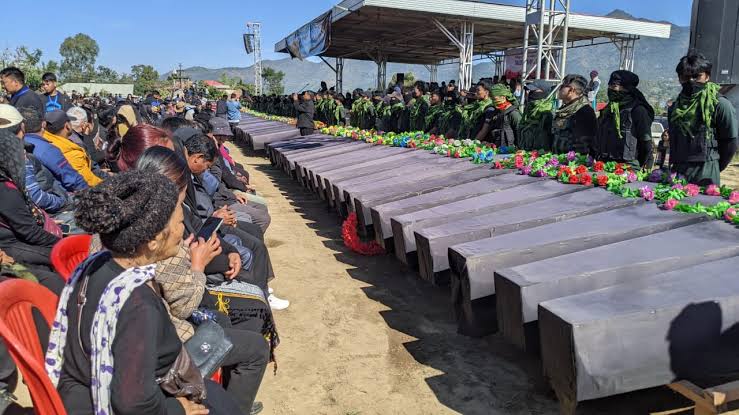
KOHUR strongly objected to the UNC’s reference to Kuki as “illegal immigrants” upon Manipur’s hills. “KOHUR state, plainly, that this is the exact rhetorical machinery that fuelled the targeted violence of May 2023. It is the language of COCOMI. It is the language that justified the burning of churches, the pogrom in Imphal Valley, the destruction of more than three hundred Kuki villages, and the displacement of over fifty thousand of our people.”
The trust said, “That a body claiming the moral authority of an indigenous council should now adopt this very vocabulary – only three years after our community was nearly extinguished by it – is a matter of grave concern. The Kuki are an indigenous people of these hills. Our church records, colonial-era settlement documents, customary chieftainships, and the very toponymy of the land bear a witness that no press release can erase.”
Borderlands and Call for Neutral Fact-Finding
On Sanakeithel, Litan and the borderlands, KOHUR noted these areas “have always been zones of intermingled history – of shared markets, intermarriages, and, at times, contested boundaries.” It said, “Where there has been violence, there must be impartial investigation, not unilateral declarations of victimhood. Kuki villages in these same borderlands have themselves faced harassment, encroachment, and intimidation and killings that the UNC’s communication does not acknowledge. We therefore call for joint, neutral fact-finding by competent constitutional authorities – not the trial-by-press-release that the UNC has invited.”
SoO Agreement and Assam Rifles
KOHUR defended the Suspension of Operations (SoO) framework as “an instrument signed between Kuki political groups and the Governments of India and Manipur.” It said, “To describe its signatories as ‘armed cadres’ waging an ‘undeclared war’ is to defame a peace process to which the Government of India is itself a party. If the UNC has specific, evidenced complaints regarding any individual or incident, those complaints belong before the SoO Joint Monitoring Group – not on a letterhead aimed at mobilising tribal sentiment.”
On allegations of “active collusion’ between Kuki groups and elements of the Assam Rifles, KOHUR called it “a recycling of a charge that originated with Meitei extremist organisations during 2023–2024, deployed precisely to demand the withdrawal of the one force that has stood between civilians and further ethnic massacre.” It added, “The Assam Rifles is a constitutional force of the Indian Union. It does not ‘collude’ with any community. Repeating this allegation – whatever its source – weakens the security architecture upon which all hill communities, Naga and Kuki alike, ultimately depend.”
Appeal to Naga Neighbours, Call for DialogueIn what it called “an earnest appeal to our Naga neighbours of Manipur,” KOHUR said, “The Kuki and the Naga peoples share a long and intricate history – of friendship and of pain, of common cause and of grievous conflict. The wounds of 1992–1997 – Joupi, Janglenphai, and the many villages whose names we still recite at our hearths – have not fully healed in our community. We live with their memory still. It is precisely because we know the cost of ethnic war that we refuse to answer war drums with war drums.”
Addressing the Tribe Hohos of Nagaland, whom the UNC invoked, KOHUR said: “The language of ‘terrorists,’ ‘illegal immigrants,’ and ‘engineered displacement,’ applied to an entire people, is the language that ends in graves. It served no one in 1993, and it will serve no one in 2026.”
‘We Shall Not Abandon Our Soil’
Outlining “the resolve of the Kuki,” the trust declared. “We shall not abandon our soil, because it is not anyone’s to take. We shall not relinquish our identity, because it is not anyone’s to define. We shall not be drawn into a war we did not seek, because peace in these hills is the inheritance our children deserve. But neither shall we remain silent while our people are renamed ‘immigrants’ upon our own ancestral land.”
KOHUR called upon “the Government of India, the Government of Manipur, the Governor’s office, and all responsible civil society organisations of the Northeast to convene a structured, sober, and verifiable process of dialogue between all affected communities – Kuki and Thangkhul Naga. Press releases will not heal these hills. Honest conversation might.”