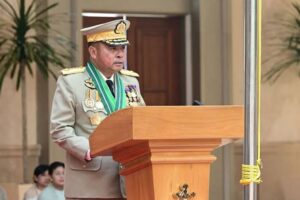
Songpi: Myanmar’s military has sharply escalated attacks on civilians since it reconfigured its command structure in March 2026 and appointed General Ye Win Oo, the new Commander-in-Chief of the Tatmadaw and former spymaster and long-time loyalist of Min Aung Hlaing, according to a new report by the Armed Conflict Location & Event Data Project (ACLED) released Monday. ACLED said civilians have faced worsening repression and an intensified aerial bombing campaign ever since Ye Win Oo formally assumed military leadership.
The transition saw coup leader Min Aung Hlaing move from commander-in-chief to civilian President in April after an election that banned most opposition, handing over the armed forces to Ye Win Oo days before the vote. ACLED said the junta is using the change to consolidate control.
Under Ye Win Oo, the air war has changed. The report notes the regular deployment of specialized groups of two to five jet fighters executing sustained airstrikes against single targets. Because multiple strikes hit the same location, the total number of events appears lower, but the strikes are deadlier and cause extensive damage to civilian infrastructure.
The first half of 2026 has been particularly bloody. ACLED recorded more than a dozen mass killings resulting in over 450 civilian fatalities, around 40% of them in Myanmar’s central dry zone known as the Anyar region. In May, about 700 troops swept through Myit Chay township across from Bagan’s ancient temples, killing at least 40 people.
Civilians who previously faced primarily indiscriminate violence after the military’s territorial losses in late 2023 are now facing a resurgence of direct, targeted attacks including arrests, arsons and abductions. The strategy includes focusing on civilian infrastructure and social gatherings such as weddings and religious festivals to maximize psychological impact.
Schools, hospitals, churches and monasteries frequently used as IDP shelters remain targets, while a new trend in 2026 is the bombing of resistance-run detention centers. ACLED documented at least six such airstrikes that killed 153 people, putting health workers, patients and prisoners of war at risk.
A parallel system of digital repression has expanded. The military has operationalized the Person Scrutinization and Monitoring System (PSMS), alongside AI-enabled surveillance cameras linked to national ID and biometric databases.
This digital network is reinforced by overnight guest-registration checks, mass arrests in urban centres, forced recruitment, and monitoring of social media by pro-military networks. Between 2024 and May 2026, over 20,000 individuals were detained for online content, according to the military’s own data.
The broader context is a protracted civil war since the February 2021 coup, a conflict that has killed some 100,000 people and displaced millions. A UN rights office report has verified a minimum of 702 civilian deaths attributable to the military in recent months, with airstrikes the single largest cause.
Despite the escalation, Min Aung Hlaing has increased regional diplomacy with trips to India and China, and is scheduled to visit Thailand on August 6-7. ACLED warns that reprieve for civilians is unlikely as the junta focuses on consolidating power, noting its tactics in 2026 show shifting modalities rather than any reduction in severity.