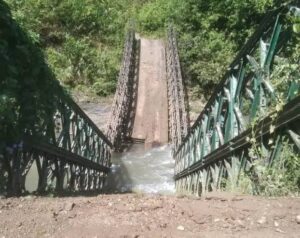
Kamjong: A crucial Bailey bridge over the Namban River in Manipur’s Kamjong district was blown up in a pre-planned act of sabotage, aimed at halting the advance of Indian security forces following the deadly ambush of Assam Rifles personnel in neighbouring Ukhrul district.
Ground reports from eastern Manipur have exposed a deliberate attempt to misattribute the destruction to Kuki groups. A detailed examination of regional demographics, geography, and the timeline of military operations points to the involvement of Kacha Naga insurgents, specifically NSCN-IM cadres, who destroyed the bridge to create a buffer for their border sanctuaries.
The targeted structure was a PMGSY-built Bailey bridge connecting Phange and Chatric Khunou villages. The explosion, accompanied by the burning of a telecom department vehicle bound for Chatric, has completely severed the primary vehicular link between Sahamphung Block and the Kamjong district headquarters. As a result, more than 10 remote border villages along the Indo-Myanmar frontier remain cut off.
Sources in the area said the attempt to frame Kuki groups collapses on geographical facts. The entire Chatric belt – comprising Chatric Khunou, Chatric Hangtong, Phange, and Chahong – is exclusively ancestral Tangkhul Naga territory. There are no Kuki villages or settlements in the entire sub-sector.
Security analysts note that it is logistically and tactically impossible for any outside group to transport high-grade explosives deep inside a homogeneous Naga-dominated border zone, plant them on a major bridge, and escape without any detection or resistance from the local population.
The motive behind the sabotage becomes clear when viewed with the recent military escalation. On July 6, two Assam Rifles personnel were killed in an ambush near Nungshangkhong in Ukhrul district. In response, the Indian Army and Assam Rifles launched intensive search, combing, and area-domination operations across Ukhrul and Kamjong districts, with convoys moving towards border transit routes.
Faced with heavy troop movement towards their transit corridors, NSCN-IM cadres had a clear tactical objective: to block the road. Destroying the Bailey bridge prevents heavy troop carriers, armoured vehicles, and logistics from entering the Sahamphung-Chatric sector, effectively shielding their cross-border routes and temporary hideouts from the ongoing counter-insurgency sweep.
The incident highlights the continued use of infrastructure sabotage as a defensive tactic by insurgent groups operating along the Myanmar border to impede state forces.