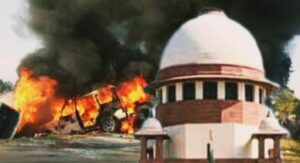
New Delhi: The Supreme Court on Wednesday came down heavily on the Manipur government over its handling of internally displaced persons living in relief camps since the 2023 ethnic violence, flagging serious lapses in reporting unnatural deaths and protecting women inmates. The top court directed the Chief Secretary of Manipur to file a comprehensive affidavit detailing all 25 suspicious deaths reported in the camps, along with post-mortem reports, FIRs and cause-of-death certificates. The bench of Chief Justice Surya Kant, Justice Joymalya Bagchi and Justice Vipul M. Pancholi was hearing a batch of petitions seeking court-monitored investigation into cases of sexual violence and relief camp conditions in the state.
The court’s sharp remarks came after it perused the latest report submitted by the three-member committee headed by former Jammu and Kashmir High Court Chief Justice Gita Mittal, which was constituted to look into humanitarian and rehabilitation aspects of the violence. The committee, in its report, had pointed out that on July 4 it had sought information from the state on 25 alleged unnatural deaths inside relief camps, but the government had failed to furnish a complete reply. The bench noted that the report also highlighted complaints of sexual harassment and lack of safety for women and children inside several camps across eight districts.
Pulling up the state, Chief Justice Surya Kant orally observed, “Tell your Chief Secretary not to force the court to pass a coercive order. We want to know what steps you have taken. These are not mere numbers, these are human lives in your custody.” The bench said that if the state continues to withhold information, the court will be compelled to summon the Chief Secretary. The Manipur Advocate General sought more time to collect district-wise data, submitting that the administration was coordinating with district magistrates and police superintendents to compile the records.
According to the data placed before the court, a total of 640 deaths have been recorded in relief camps across eight violence-affected districts since May 2023. Shockingly, post-mortem examinations were conducted in only 20 of those cases, even though criminal cases were registered in many of them. The committee’s report noted that in several instances, the bodies were handed over to families without proper medico-legal formalities, and compensation ranging from Rs 20,000 to Rs 30,000 was paid without establishing the actual cause of death. The court questioned how the state could close cases as natural deaths without autopsy.
The Supreme Court also expressed grave concern over allegations of sexual harassment and assault inside some relief camps. Citing the Mittal committee’s findings, the court said that women IDPs had complained about lack of privacy, inadequate lighting, absence of separate toilets and presence of unrelated male inmates in some camps. The committee had recommended deployment of women police personnel, installation of CCTV cameras in common areas and regular visits by District Legal Services Authorities. The bench directed the Manipur State Legal Services Authority to immediately take cognizance of all such complaints and ensure that FIRs are registered and statements are recorded under Section 164 CrPC where required.
Directing immediate corrective action, the court ordered the Manipur SLSA to coordinate with the district administration and ensure that in every suspicious death, an FIR is registered, post-mortem is conducted and investigation is taken to its logical conclusion. It further ordered that families of the deceased be provided with copies of post-mortem reports and that compensation be awarded as per the norms fixed by the National Legal Services Authority, not on an ad-hoc basis. The court made it clear that payment of Rs 20,000 cannot be treated as closure of a death case.
During the hearing, Additional Solicitor General Aishwarya Bhati, appearing for the Centre and the state, informed the court that 42 Special Investigation Teams have been constituted across eight districts to probe cases related to the ethnic violence. She submitted that out of 3,020 cases registered, charge sheets have been filed in 302 cases, closure reports have been submitted in 1,583 cases, and investigation is still pending in 1,135 cases. Trials have commenced in 33 cases before the special court designated in Guwahati, Assam, as per the earlier directions of the Supreme Court for out-of-state trial to ensure fair process.
Counsel appearing for the victims and Kuki women groups contended that the special court in Guwahati is functioning only two days a week, leading to slow progress in cases of sexual assault and murder. They urged the court to direct establishment of at least two exclusive special courts for Manipur cases and to ensure day-to-day trial in heinous crimes. They also pointed out that many victims are still living in relief camps without access to legal aid and are unable to travel to Guwahati to depose before the court.
Responding to the submission, Chief Justice Surya Kant observed that even two days a week hearing can help advance trials if utilized properly, but agreed that the volume of cases warrants additional judicial infrastructure. The bench then directed the Union Government to immediately examine the request made by the Gauhati High Court for additional manpower, infrastructure and funding for handling Manipur cases and to take a decision within four weeks. The court said the Centre must not delay sanction of special courts on administrative grounds when fundamental rights of displaced persons are at stake.
The court posted the matter for further hearing after four weeks and directed the Manipur Chief Secretary to file a personal affidavit before the next date. It also asked the Justice Gita Mittal committee to continue monitoring relief camp conditions and submit a fresh status report focusing on health, sanitation, mental health counselling and education for displaced children. The Supreme Court had earlier taken suo motu cognizance of the video of two women being paraded naked in Manipur and has since been monitoring both criminal investigation and humanitarian relief measures in the state.