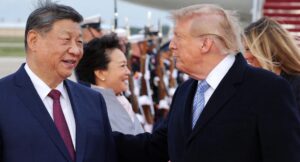
Washington: US President Donald Trump hosted Chinese President Xi Jinping at the White House on Wednesday and Thursday this week, marking Xi’s first official visit to Washington, DC in 11 years and the highlight of a three-day State Visit aimed at stabilizing relations between the world’s two superpowers. The meeting on September 24 in the Cross Hall included full ceremonial honors, with Trump describing the talks as a “great meeting” while acknowledging that core disagreements remain.
Trump said his personal relationship with Xi dates back to his first election in 2016. “From the time of my first election in 2016, President Xi and I have forged a friendship, a truly great friendship, actually, built on mutual respect and the vital interests of our people,” Trump told reporters after Thursday’s session. Despite starting his second term with severe tariffs on Chinese goods that triggered a global trade war, Trump said he now wants greater dialogue and predictable competition with Beijing.
Xi, on his side, urged Washington and Beijing to avoid falling into the so-called “Thucydides Trap,” a concept used by international relations scholars to describe the risk of war when a rising power challenges an existing power. “It should be a race of catching up with one another, not a wrestle in which one either wins or loses,” Xi said, adding that the US and China are deeply interconnected and should keep competition “within bounds” and healthy. Chinese state news agency Xinhua said Xi stressed that confrontation would hurt both nations and global stability.
The pomp of the State Visit, however, could not hide the sharp differences that dominated the closed-door agenda. Three issues were at the top – the US war on Iran and the closure of the Strait of Hormuz, Taiwan, and trade and technology. On all three, officials from both sides said talks were frank but ended without any concrete deal or joint announcement on Thursday.
The war on Iran, launched by the US and Israel in February 2026, was the most urgent global backdrop. The conflict has led to the closure of the Strait of Hormuz, through which a fifth of the world’s oil passes, causing energy prices to surge worldwide. Trump has publicly called on China, as Iran’s largest trading partner and oil buyer, to help isolate Tehran economically and to use its leverage to reopen the strait. Beijing has so far refused to take sides and has called for ceasefire and dialogue.
According to Xinhua’s readout, Xi told Trump that China supports a return to an interim agreement between the US and Iran that was announced in June but collapsed days later. No breakthrough was reported, and the White House has not released its own detailed summary on Iran discussions. US officials said Trump repeated his demand that China stop buying Iranian oil and support US efforts to restore shipping through Hormuz, while Chinese officials said Beijing would not be forced into economic actions that harm its energy security.
On trade, both leaders sought to show progress in cooling tensions, but without announcing new concessions. After Trump announced heavy tariffs on Chinese imports early in 2026, both countries later agreed to extend a temporary truce to prevent full decoupling. The summit was described by experts ahead of time as focused on “stabilising” ties rather than signing big deals. US business groups have warned that prolonged tariff uncertainty hurts American consumers and supply chains, while Chinese firms want relief from export controls.
Technology and Artificial Intelligence added another layer of rivalry. The US has restricted exports of advanced semiconductors and chip-making equipment to China on national security grounds, while China has limited exports of rare earths and critical minerals essential for US defense and tech industries. Both sides have set up working groups, but officials admit these controls are now central to national security strategies and unlikely to be lifted by a single summit.
Taiwan proved to be the most sensitive topic, as expected. China claims Taiwan, a self-governing democratic island, as part of its territory. Xinhua reported that Xi urged Trump to oppose Taiwanese independence and to handle the Taiwan question “prudently” to avoid damaging ties. The White House has yet to publish its own version of the Taiwan discussion, reflecting how delicate the issue remains.
Trump’s recent approach to Taiwan has stirred controversy in Washington. In May, he said he would postpone final approval of a $14 billion arms package for Taipei and described arms sales as a “very good negotiating chip” with Beijing. That transactional language alarmed many in Congress who view US commitment to Taiwan’s defense as a matter of principle and law, not a bargaining tool. Taiwan has expressed concern that such framing could encourage Beijing to pressure Taipei more.
The reaction in the US Congress to Xi’s lavish welcome has been mixed and sharply partisan in tone. Republican Senator Roger Wicker, a defense hawk, said he would have advised against the grand ceremony. “Quite frankly, had the White House asked me for advice, I would have suggested the president not invite Xi Jinping to Washington for such a lavish welcome here in the United States of America based on all of the troubling issues we have with President Xi and the Chinese Communist Party,” he said.
Democratic Senator Chris Van Hollen offered similar criticism from the other side, saying Trump “always deludes himself into thinking that, by ingratiating himself with authoritarians, he’s somehow going to get his way.” The comments reflect a broader bipartisan skepticism toward China in Congress, where concerns over human rights, trade practices, and military expansion in the South China Sea have united many Democrats and Republicans.
Not all lawmakers agreed. Republican Senator Rand Paul defended the diplomacy, writing on social media, “I’m glad this meeting is happening; diplomacy is key. Talk more, war less.” Analysts said that even without deals, direct communication between Trump and Xi is valuable to prevent miscalculation, especially over potential flashpoints like the Taiwan Strait or an accidental clash in the Strait of Hormuz where US and Chinese commercial interests overlap.
Public opinion in the US remains divided on how to manage the two relationships. A May Economist/YouGov poll found that Americans view Taiwan much more favorably as an ally than China. But when asked whether the US should prioritize good relations with Beijing or preventing China from seizing Taiwan, respondents were almost evenly split – 36 percent to 35 percent. Less than 40 percent said the US should be prepared to use military force to defend Taiwan, underscoring political limits on any security commitment.
As the State Visit enters its final day on Friday, both sides are framing the summit as an effort to manage rivalry, not end it. No joint statement is expected, but further meetings with business leaders and a possible press conference are planned. The takeaway from Washington, experts said, is that Trump and Xi have managed to restore personal dialogue after years of tension, but the structural gaps – over Iran, Taiwan, AI and trade – remain unresolved and will require months of follow-up negotiations.