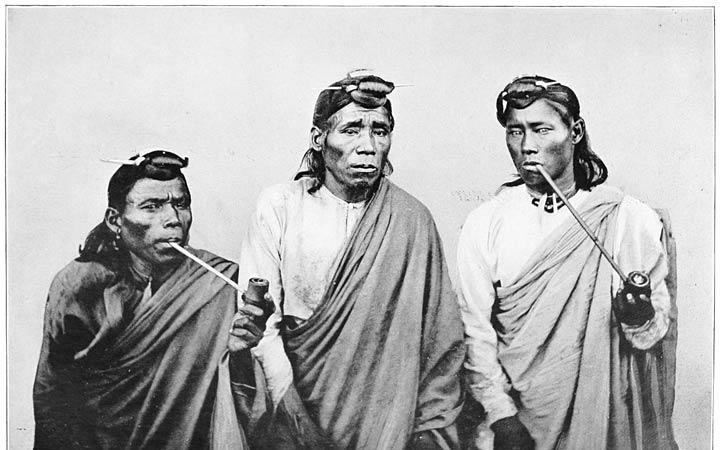
British records from 1835–1929 prove Kuki chiefs governed these hills long before modern borders. The archive shows settlement, not infiltration — and a two-year war an empire fought to break it.
By Thangboi Haokip
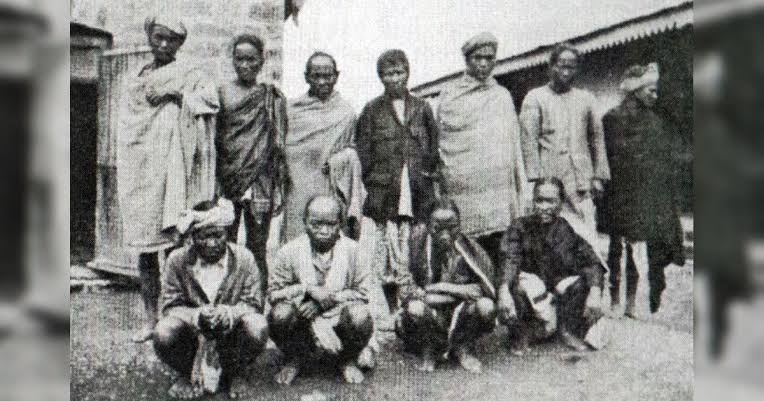
The accusation that the Kukis are “refugees” or “illegal immigrants” in the hills of Manipur has become a weapon in our present conflict. It is meant to wound, and it does. But it has a more serious flaw: it is contradicted by two centuries of official record. This article sets out that record — not to claim every ridge for one people, but to establish what the documents actually prove: that the Kukis are an old, recognized, and rooted people of these hills, and that the label of “refugee” cannot survive contact with the archive.
The record begins before the maps were finished
When Captain R.B. Pemberton compiled his Report on the Eastern Frontier of British India in 1835 — one of the earliest systematic British surveys of this region — the Kuki tribes were already there, recorded in the hills surrounding the Manipur valley. This was decades before the modern administrative boundaries of Manipur, Assam, or Burma took their present shape. Whatever the Kukis were in 1835, they were not newcomers to the British record; they were part of the landscape the record was created to describe.
Twenty-four years later, Lieutenant-Colonel William McCulloch, the Political Agent in Manipur — a man who lived among these hills and dealt with their peoples daily — published his Account of the Valley of Munnipore and of the Hill Tribes (1859). McCulloch documented Kuki villages, chiefs, and customs in detail, and recorded something of lasting significance: the Manipur court itself sanctioned and arranged Kuki settlement in the hills. Kuki presence was not an infiltration; it was woven into the political order of the Manipur state, acknowledged and used by that state.
Alexander Mackenzie’s The North-East Frontier of India (1884), the standard official history of British policy in the region, went further. It records that the colonial government deliberately positioned Kuki villages along frontier tracts as a buffer and stabilizing presence. One does not build frontier policy on a people without a country. The British did so because the Kukis were a substantial, organized presence whose chiefs governed real territory.
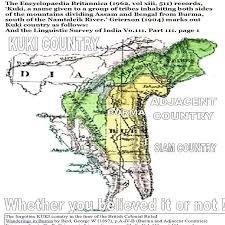
File Photo: 1912 map marking ‘Kuki Country’ from Tortenon, with references to Encyclopaedia Britannica (1964) and Linguistic Survey of India.
By the turn of the century, the documentation had thickened into ethnography and administration: Carey and Tuck’s The Chin Hills (1896) mapped the southern kindred of the Kukis in exhaustive administrative detail, and William Shaw’s Notes on the Thadou Kukis (1929), an official monograph, recorded the clans, village polity, chiefship system, and territories of the Kukis of Manipur as an established fact of governance.
A war is not fought over borrowed land
If any single episode refutes the refugee slur, it is the Anglo-Kuki War of 1917–1919. When the colonial government attempted to conscript hill men for labour in France, the Kuki chiefs rose in a coordinated resistance that took the British Empire — then the largest military power on earth — two campaigning seasons to suppress. The government’s own files on what it called the “Kuki Rebellion” map, valley by valley and ridge by ridge, the extent of the country under Kuki chiefs’ authority.
The commanding officer’s stated objective was to “break the Kuki spirit” and pave the way for administration of their country — his phrase, not ours.
Refugees do not field a confederacy of chiefs across hundreds of villages. Refugees do not hold off an empire for two years. The war is painful history, but it is also incontrovertible evidence: in 1917, the hills in question were, in the eyes of the government itself, Kuki country under Kuki chiefs.
What the Linguistic Survey does — and does not — prove
Sir George Grierson’s Linguistic Survey of India, Volume III, Part III (1904), described the territory inhabited by the Kuki-Chin tribes as extending from the Naga Hills in the north to the Sandoway District of Burma in the south, from the Myittha River in the east almost to the Bay of Bengal in the west. This passage is often quoted, and it deserves to be quoted accurately for what it is: the British government’s own scholarship, recognizing at the start of the twentieth century a vast, contiguous zone of Kuki-Chin settlement, with the Manipur hills firmly inside it.
We should be honest about what it is not. Grierson mapped languages, not land titles, and his companion volumes record Naga languages in these same northern hills. The Survey therefore proves presence — deep, extensive, officially recognized presence — for the Kukis, as it does for our neighbours. That is precisely why it destroys the refugee accusation without needing to prove anything more: a people whose speech the Empire’s cartographers found spread across an entire mountain system in 1904 is not a people that arrived yesterday.
One people, three countries, many names
The deeper truth the archive reveals is that the Kukis of Manipur are one branch of a great hill civilization — the Zo people, as many of us now say — whose homeland is the continuous mountain chain running from the upper Chindwin and the Chin Hills through the Lushai Hills to the Chittagong Hill Tracts, with its northern reaches in the hills of Manipur and the Barak valley. Our kindred are called Chin in Myanmar, Mizo in Mizoram, and by their own tribal names in Bangladesh. Different names, chosen by each community for itself; one ancestry, one mountain world, divided by international borders that none of our ancestors drew and none were consulted about.
This is the answer to “who are you?” We are the northern children of that civilization, in hills our chiefs governed, our dead are buried in, and our people defended in war — all of it written down by the very Empire whose records are now selectively read against us.
An honest history is bigger than the quarrel
Honesty requires one more acknowledgment, and it strengthens rather than weakens our case. The colonial category “Kuki” was always broader and more fluid than today’s battle lines. The tribes the British called “Old Kuki” — Anal, Kom, Chiru, Lamkang, Purum, Chothe — speak languages of our family, yet many of their descendants chose Naga affiliation in the 1950s, as was their right. The hills’ history is one of entangled settlement, shifting names, and neighbours who are also distant kin. Anyone who claims that history awards every inch to one community — any community — is asking the archive to say what it does not say.
That is why the refugee accusation is not merely false but foolish: it applies a standard of exclusive, immemorial ownership that no community in these hills could meet, including those who deploy it. The record shows the Kukis rooted here for as long as records exist. It shows our neighbours rooted here too. Both facts are true, and the future of these hills will be built by people who can hold both — or it will not be built at all.
We do not ask our neighbours to become us, and we will not accept being told we do not belong. The documents have already settled that question. What remains to be settled is whether we can live beside each other as the hills’ oldest records show we always have — as distinct peoples of the same mountains.
Sources:
R.B. Pemberton, Report on the Eastern Frontier of British India (Calcutta, 1835). W. McCulloch, Account of the Valley of Munnipore and of the Hill Tribes (Calcutta, 1859). Alexander Mackenzie, The North-East Frontier of India (Calcutta, 1884). B.S. Carey and H.N. Tuck, The Chin Hills, 2 vols. (Rangoon, 1896). G.A. Grierson, Linguistic Survey of India, Vol. III, Part III (Calcutta, 1904). Government records of the Anglo-Kuki War (“Kuki Rebellion”), 1917–1919. William Shaw, Notes on the Thadou Kukis (Calcutta, 1929).