The article contends that development packages and policing cannot resolve Manipur’s crisis. It urges constitutional safeguards, administrative autonomy, and recognition of ethnic history and boundaries as the path to political dignity and lasting peace.
By Hoiboi Touthang, Kuki human rights activist
Manipur’s crisis cannot be reduced to a law and order problem. For over three years, the state has witnessed sustained violence, displacement, and the breakdown of trust between communities. What began as specific grievances has hardened into a broader political contest involving the Kuki, Naga, and Meitei communities. Each group is asserting distinct political demands, historical narratives, and claims to land and identity. When a conflict reaches this stage, police action and security operations alone cannot restore normalcy because the core issues are political, not criminal.
The Kuki community has consistently argued that coexistence within the current state structure is no longer possible after years of violence. Their demand has centered on political separation, either through a separate administration, Union Territory with legislature, or statehood. The Naga perspective is shaped by decades of political movement for integration and self-determination, and any settlement in the hills directly impacts Naga territorial and political aspirations. The Meitei community, largely based in the valley, views the integrity of Manipur as a single administrative unit as non-negotiable and sees threats to it as an existential issue. These are not law and order demands. They are competing visions of the political future of the state.
Because the conflict is political, the response must also be political. Security operations can contain violence in the short term, prevent attacks, and protect civilians. But they cannot resolve questions of recognition, autonomy, representation, and historical grievance. When communities no longer trust common institutions, and when armed groups act with political backing, a purely enforcement approach risks deepening alienation. It treats symptoms while the underlying dispute over who decides and under what arrangement remains untouched.
A political settlement therefore requires direct dialogue between all stakeholders, with the Union Government as mediator and guarantor. That means acknowledging the distinct political demands on the table instead of subsuming them under development packages or security measures. Any durable solution will have to address territorial arrangements, constitutional safeguards, administrative autonomy, and protection of identity and land rights for all three communities. It will also require confidence-building measures so that displaced people can return and institutions can function across ethnic lines again.
Until that happens, Manipur will remain in a cycle of flare-ups and shutdowns. Framing the issue only as law and order delays the necessary work of political negotiation. Peace will depend on whether Kuki, Naga, and Meitei leadership, along with the Centre and State, can arrive at a settlement that gives each community political dignity and security within a new framework. Without that, operations on the ground will manage the conflict, but they will not end it.

File Photo: Traditional dress of Kuki, Meitei, and Naga women, showcasing the distinct heritage of each community.
The human cost of this conflict has been devastating. For over three years, Manipur has seen hundreds of lives lost, thousands injured, and more than 60,000 people displaced from their homes. Villages have been burnt, families separated, and entire communities forced into relief camps with no clear timeline for return. The death toll is not just a statistic. It represents lost futures, children out of school, and a generation growing up with trauma. When large-scale loss of life continues, it cannot be dismissed as mere unrest. It points to a deeper political failure.
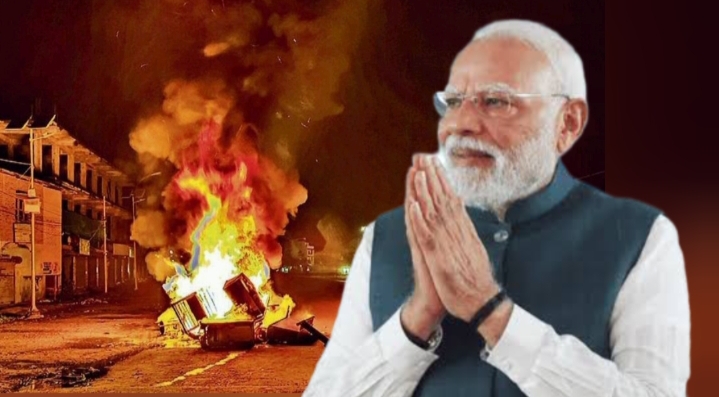
Many in the affected communities hold the Modi-led BJP government of India responsible for prolonging this three-way ethnic violence. The central leadership is seen as siding with the state BJP government in Manipur, instead of acting as a neutral mediator. Critics argue that this perceived alignment is a key reason the conflict continues. When the Centre is viewed as a party to the dispute rather than an arbiter, trust collapses further. Without the Union Government stepping in decisively and impartially, local actors have little incentive to de-escalate, and the cycle of retaliation continues.
If India continues to ignore the political nature of this conflict and treats it only as a security issue, there will be more violence and more bloodshed. The only way forward is for India to immediately pursue a political solution grounded in the ethnic-based history, boundary, and culture of the region. That means recognizing the distinct aspirations of Kuki, Naga, and Meitei people and working toward arrangements that protect identity, land, and autonomy for all. Delaying this will not make the problem disappear. It will only deepen mistrust and cost more lives.