INA veteran Haojathang Haokip’s journey from British jails to jungles embodies the Kuki community’s historic sacrifice for India. His life is proof that the Kukis, as true freedom fighters, have earned the right to a separate state or Union Territory.
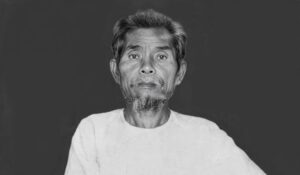
Haojathang Haokip, an Indian National Army veteran and recipient of the Government of India’s Freedom Fighters’ Pension, dedicated his youth to the fight against British rule. Born in 1925 at Girihang village in the then Manipur East District, son of Late Ngamhao Haokip of Bethel, Churachandpur, he represents a generation of Kukis who chose armed resistance over submission and fought in the decisive Manipur-Burma theatre of World War II.
His path to patriotism began inside a British formation itself. According to his autobiography, Haokip joined the Village Force raised by the British Army in January 1939 under Captain Barnard and Captain Moren. After seven months of service, his conscience revolted against serving a foreign power. Driven by anti-colonial conviction, he deserted the force and in August 1939 joined the Indian National Army, where he was attached to No. 3506 “C” Company, 4 Platoon, Khikari Khikan.
Posted in the India-Burma sector, Haokip participated in combat across the treacherous hills and jungles of the Manipur-Burma frontier. This was the heart of Netaji Subhas Chandra Bose’s “Dilli Chalo” campaign, where the INA, alongside its allies, attempted to break British defences and enter India. His service placed him at the forefront of one of India’s boldest military campaigns for independence.
The price of this patriotism was heavy. In July 1944, during operations in the Homalin sector of Burma, he was captured by Captain Barnard — the same British officer he had once served under. He was imprisoned at Homalin Jail for six months and 15 days under harsh conditions before being released in January 1945. Even after release, he remained a wanted man in Manipur and spent another month living in exile in the jungles, separated from his home and family.
Haojathang Haokip was not an exception. His story was part of a larger, deliberately forgotten history of Kuki participation in India’s freedom struggle. While colonial records claimed the Northeast opposed the INA, the INA records collected by the National Archives of India from Southeast Asia prove the opposite — that local people “partly or wholly supported the INA, especially so with the Kukis of the region,” who had not forgotten the brutal British reprisals during the Kuki Rising of 1917-1919. When Netaji’s army marched, Kuki tribals served as its eyes and feet — guides, spies, porters and foot soldiers.
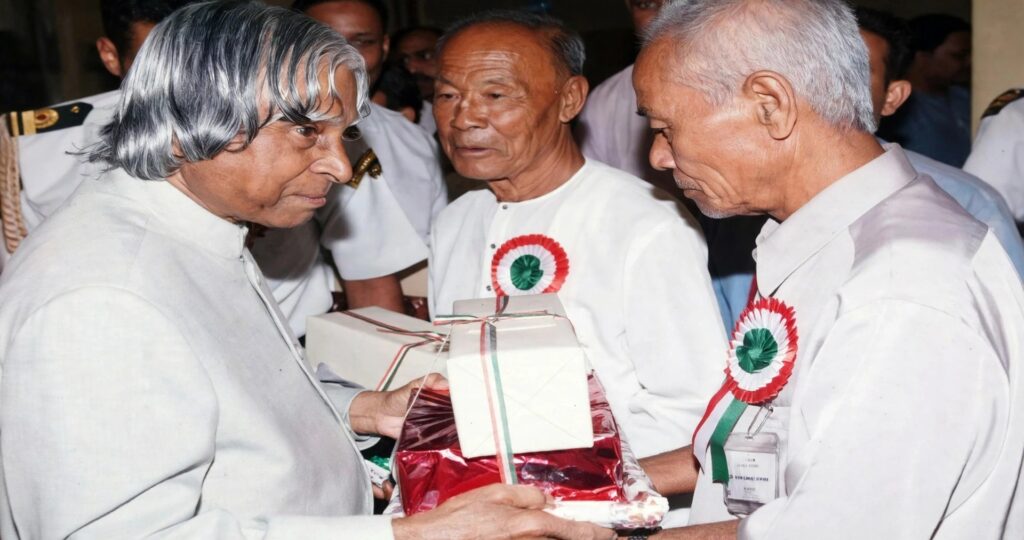
File Photo: Former (late) President of India Dr. A.P.J. Abdul Kalam presenting a gift to (late) INA veteran and freedom fighter Shri Haojathang Haokip at the At-Home Function, Rashtrapati Bhavan, New Delhi, on 9th August 2003.
The scale of that contribution is staggering. Historians record that up to 6,000 Kukis provided provisioning, intelligence and logistical support during the 1944 Imphal Campaign, turning the hills into a lifeline for liberation. The Government of India itself recognised 148 Kukis with INA pensions. The 1986 publication of the Freedom Fighter Cell of the Manipur Pradesh Congress Committee listed 148 living freedom fighters of the state, of whom 78 were Kukis. Leaders like intelligence officer Jamthang Haokip, who defected from British service to draft clandestine maps and lead Kuki youth across the Indo-Burma border, show that this was a community-wide commitment to India.
After Independence, Haokip continued to serve the nation he had helped free. In 1960, he was elected as a member of the Block Development Committee from the Phungyar Phaisat TD Block in Manipur East District and served till 1966. During his tenure, he was deputed to New Delhi as part of a tribal delegation to meet Prime Minister Jawaharlal Nehru to apprise him of the hardships of Manipur’s tribal communities — a transition from freedom fighter to nation-builder.
In recognition of his sacrifice, he was granted the Freedom Fighters and their Families Pension on December 27, 1980. In his autobiography, he wrote with hope that the freedom won through immense hardship would endure forever, ending with the immortal war-cry of his generation: “Jai Hind.” His life closed the circle from rebellion to recognition.
That recognition must now be complete. The Kukis are not newcomers seeking favour; they are freedom fighters who won India’s independence. A community that fought the British in 1917-19, that gave 6,000 sons to Netaji in 1944, that has guarded India’s most sensitive international frontier ever since, cannot be left without security and self-governance in its own ancestral hills. If history is the measure of national loyalty, the Kukis have already proved it in blood. Honouring INA veteran Haojathang Haokip and his 148 fellow Kuki pensioners means honouring their final wish — a separate state or Union Territory under the Constitution of India where their freedom can truly endure.