The debate over nomenclature and identity in Manipur and the larger Northeast has intensified since May 2023, creating confusion both within the community and in official discourse. For decades, terms like Kuki, Zo, Zomi, and the more recent composite Kuki-Zo have been used interchangeably in media reports and public rallies. While they reflect cultural proximity, they do not carry the same weight in law and administration. In a democracy, political rights flow from legal recognition, and this article examines why Kuki fulfills that test.
The demand for clarity is practical. Citizenship, land rights, reservation in education and employment, and political representation flow from statutory recognition under Article 342, not from social media consensus. Any settlement within the Constitution – whether ADC strengthening, Sixth Schedule, or Union Territory – requires an identity legible to the Constitution, the Registrar General, and the Ministry of Home Affairs.
Understanding Zo and Zomi: Distinct Political Terms, Not a Pan-Regional Umbrella
The term “Zo” is a Mizo political term with its roots and political usage confined to Mizoram state politics. It emerged as a political and cultural assertion of the Mizo people, particularly during the Mizo nationalist movement of the 1950s and 1960s. It does not historically include the Kukis of Manipur and Nagaland, the Chins of Myanmar, or the Bawms of the Chittagong Hill Tracts as a legally recognised umbrella. There is no Presidential Order, Gazette of India, or Census notification that defines “Zo” as an official umbrella for all Chin-Kuki-Mizo communities. As a derivative political term of Mizo politics, its administrative relevance is limited to Mizoram.
Similarly, “Zomi” is a political nomenclature asserted by sections of the community, particularly in and around Churachandpur and parts of Tedim in Myanmar, to claim a distinct heritage. The term gained political currency in the 1990s with the formation of Zomi Re-unification Organisation in 1993. Organisations like Zomi Council have themselves, as reported by NDTV and The Hindu in 2024, rejected the composite “Kuki-Zo” formulation, asserting Zomi as a separate identity. This proves the term is a contested political construct, not a settled, constitutionally notified category.
For a pan-regional political demand before the MHA, the question is therefore simple: Does the nomenclature have a consistent, continuous entry in the Presidential Order for 70 years?
Kuki: The Historical Record – From Rajmala to British Archives
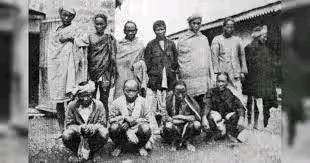
Contrary to the claim that Kuki is a recent British invention, the term appears in British administrative records as early as 1777, when the Bengal administration referred to “Kukis” as hill tribes on the Chittagong frontier. By 1792, and through the 19th century, ethnographers like T.H. Lewin, C.A. Soppitt, and E.T. Dalton consistently documented Kukis as a distinct hill people governed by hereditary chiefs, known as Haosa.
Community historians also cite the Tripura Rajmala the royal chronicle of Tripura compiled in the 15th century, as an early indigenous source. According to interpretations by researchers, groups identified as Kirata and later as Kuki in the chronicle are associated with ancestors of present-day Kuki groups. A frequently cited reference is from the reign of King Dhanya Manikya (1490-1515), mentioning hill chiefs participating in regional alliances. While mainstream historians note that Rajmala blends mythology with history and that ‘Kirata’ was a broad term for several Tibeto-Burman groups, these references are cited as an indication of early presence predating British maps.
The colonial period solidified the name legally. G.A. Grierson in the Linguistic Survey of India (1904) classified “Kuki-Chin” as a distinct linguistic family. The 1874 Statistical Account of Bengal and Encyclopaedia Britannica 1911 marked Kuki-inhabited areas from the Naga Hills to the Chittagong Hill Tracts. This is the basis of the 1904 Map of Kuki Country often cited by historians – not as a legal boundary, but as documentary proof that the identity was administratively recognised long before Zo or Zomi appeared as political terms.
Kuki: The Constitutional Proof Under Article 342
The only identity that confers enforceable rights is one recognised under Article 342.
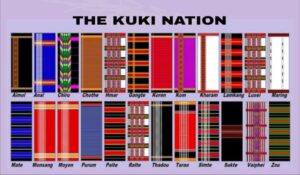
Under Article 342, Scheduled Tribes are notified by the President of India and only Parliament can amend the list. For Manipur, the Constitution (Scheduled Tribes) Order, 1950, Part X, as amended by the Act of 2002 (Act No. 10 of 2003), lists “Any Kuki Tribes” at Serial No. 28, 29 and 33 among the 34 recognised tribes of Manipur. This includes Thadou, Gangte, Hmar, Paite, Simte, Vaiphei, Zou and others who retained the Kuki umbrella for administrative purposes.
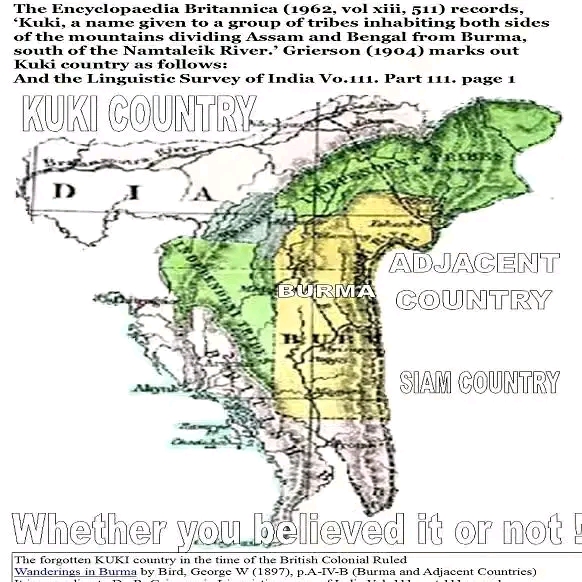
File Photo: The 1904 Linguistic Survey of India by G.A. Grierson (Vol. III, Part III) and Encyclopaedia Britannica (1962, Vol. XIII, p.511) references ‘Kuki country’ as inhabiting both sides of the mountain ranges dividing Assam and Bengal from Burma, south of the Namtaleik River. The map shown is from Wanderings in Burma by George W. Bird (1897) marking ‘Burma and Adjacent Countries’ and is cited by community historians as a colonial-era administrative reference. Map interpretations vary among scholars and it is presented here as a historical artefact, not as a modern legal boundary. Source: Public Domain / Archival Record.
This entry is the sole basis for ST certificates in Churachandpur, Kangpokpi, Tengnoupal and Chandel, reservation under Article 16(4), and protection under the SC/ST (Prevention of Atrocities) Act, 1989.
In contrast, there is no entry for “Zo” and no entry for “Zomi” as a stand-alone umbrella in the Manipur ST list. The list does contain “Any Mizo (Lushai) Tribes” at Sl. No. 13 and “Zou” at Sl. No. 33, which are legally distinct tribes, not synonyms for Zo. The Supreme Court in State of Maharashtra vs Milind (2000) has held that courts cannot add synonyms or umbrella terms to the ST list – only Parliament can.
Therefore, without constitutional recognition, an un-notified political nomenclature has no political right, no land right, and no legal safeguard under Article 342. Kuki is not just a name, it is our only constitutional and political identity within India.
The Way Forward
What is needed is not a new name every decade, but a strong, documented political identity that can protect land, rights and future in a court of law and in Parliament.
A sustainable identity needs three things: historical documentation, legal recognition, and administrative acceptance. Only Kuki fulfills all three: it is in government gazettes, in the 1950 Order, in British administrative records, and in Census reports for over a century.
For political survival and realisation of our aspirations within India, we must stand united under one recognised nomenclature – Kuki. Any unrecognised and fabricated nomenclature confined to one state’s politics will only divide us and weaken our legitimate movement.
History provides context, but the Constitution provides protection. We are Kuki by Constitution, by History, and by Map.
Disclaimer: This is an opinion piece based on the author’s interpretation of historical records and constitutional provisions. It presents one perspective. Constitutional status is determined by the President of India under Article 342.