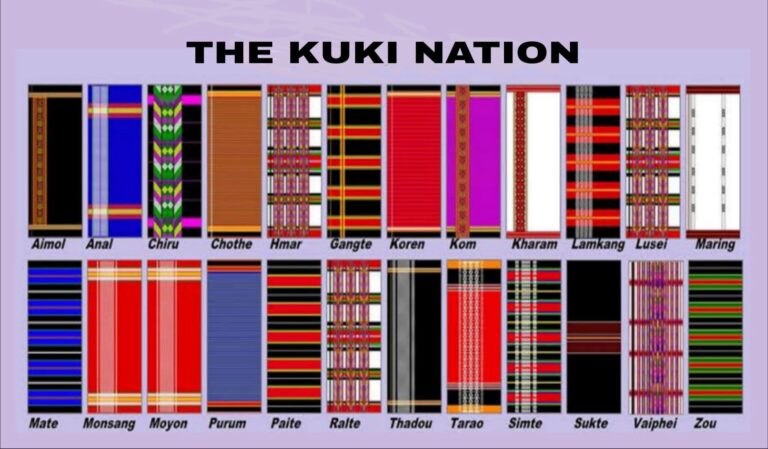
For too long, the world has been told a convenient and politically motivated lie — that Kukis are Manipuri and that the Kuki area is an integral part of Manipur. This falsehood was carefully constructed in textbooks, amplified daily on television channels controlled from the valley, and enforced through decades of Imphal-centric governance that treated the hills as colonies. That manufactured lie collapsed completely on 3rd May 2023. On that day, Kukis were systematically hunted in the Imphal valley, our houses were burnt down in broad daylight in front of the police, more than 250 of our people were brutally butchered, our women were raped and paraded naked on the streets, and tens of thousands were chased out of a capital that once claimed to be ours. On that day, the illusion of one Manipur broke forever into two irreconcilable realities.
Do not say Kukis are Manipuri, because Kukis are not Manipuri and have never been. We have our own distinct history that predates the formation of the present state, our own ancient system of chieftainship, our own customary laws and village administration, and our own ancestral land that we have protected with our blood. The term Manipuri is a valley-centric identity that was never given to us and that we never accepted at any point in history. We are Kuki by blood, by identity, by culture and by nation. Our forefathers were never subjects of the Maharaja of Kangleipak. They ruled our own hills as independent chiefs until the advent of the British, and when the British tried to subjugate us, we rose in the Anglo-Kuki War of 1917-1919, the longest war against the British Empire in this region.
Do not think the Kuki area is Manipur, because administratively drawing a line on a map does not change ground reality. On paper, some bureaucrats in Delhi merged our hills inside Manipur in 1972 for administrative convenience, but on the ground it was never Manipur and was never governed as Manipur. Songpi is not Imphal, Moreh is not Kakching, and Saikul is not Thoubal. The difference is not just in names but in every aspect of life, law and ownership. Our land is constitutionally protected by Article 371C, by the Hill Areas Committee provision and by the authority of our Chiefs who own the land. For decades we tolerated this arrangement for peace, but after the state-sponsored ethnic cleansing of 2023, the mask has completely fallen off.
Kuki and Meitei are two separate entities with separate lands, different historical trajectories and completely distinct identities. This reality holds true for the past, defines the present and will determine the future. We have never shared a common language, a common religion, a common social system or a common ancestral origin. The Meitei trace their history and civilisation to the Kangleipak kingdom in the valley, with its monarchy, its Sanamahi faith and later its adoption of Vaishnavism. The Kuki trace our lineage to independent hill chieftainships spread across the hills, governed for centuries by our own customary laws and today united by Christianity and our clan system. We lived separately in history, and that separation is deeper now than ever before.
As of today, Kuki and Meitei are totally separated neighbours, and acknowledging this fact is the only honest starting point for any discussion on peace. We are no longer brothers living under one roof, because that house was set on fire and has burned to ashes. We are now two peoples, two lands and two completely different political and physical realities, divided by a buffer zone guarded round the clock by central security forces. The scale of separation is absolute. There is not a single Meitei left in any Kuki-inhabited area, and not a single Kuki left in the Imphal valley. This is not administrative separation; this is demographic and territorial separation enforced by survival.
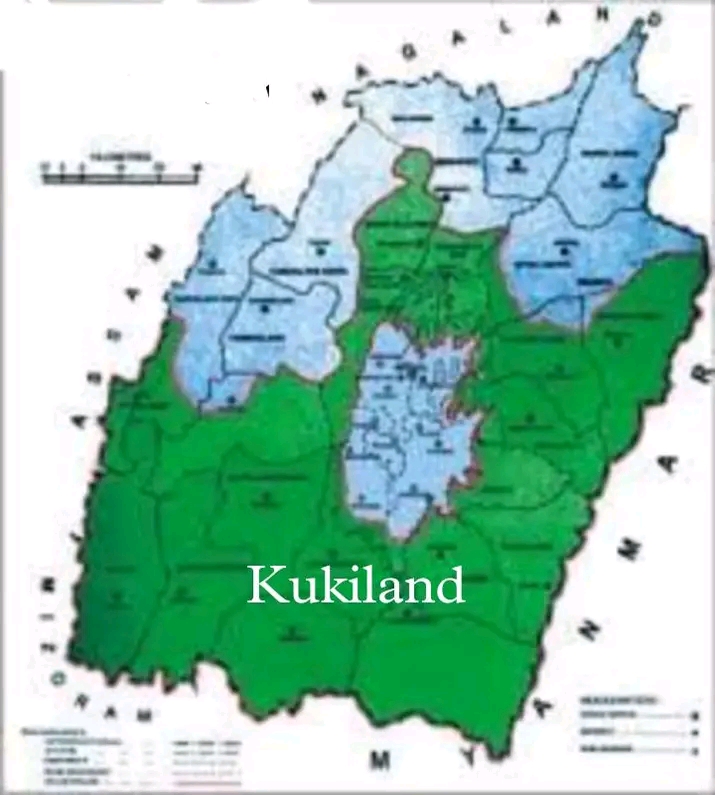
File Photo: Proposed Kukiland map – Green area marks Kuki ancestral territory demanding separate administration.
We must now learn to exist as neighbours, in the same way that Myanmar and India are neighbours and in the same way that Mizoram and Manipur are neighbours. The fundamental principle of being neighbours is that one neighbour cannot rule over another, and one neighbour cannot claim ownership of another neighbour’s ancestral house and land. The Meitei want the Imphal valley to develop according to their aspirations, and they have full control over it. Similarly, the Kuki want our own hills, our own separate administration and the freedom to secure our future under the direct protection of Delhi.
Our political demand is clear, democratic and constitutional — a separate state or a Union Territory with Legislature for the Kuki people. This demand is not against India, it is not secessionist, and it is not an act of hostility against any community. It is a demand fully within the framework of the Indian Constitution, just like the creation of other states and Union Territories before us. Separate does not mean enemy. Seeking a separate administration does not mean we want war. As the old saying goes, good fences make good neighbours, and only clear boundaries can bring lasting respect.
The sooner the Central Government in Delhi, the state government in Imphal and the international community accept this simple and practical truth — do not call us Manipuri, do not call our land Manipur, but respect us as a separated neighbour with our own distinct status — the sooner real and lasting peace will return. Without accepting this ground reality, any peace talks conducted in Delhi, any plan for free movement across the buffer zone and any narrative about the unity and integrity of Manipur will remain nothing but political theatre. Such exercises will never succeed because they are built on a fiction that no longer exists on the ground.
The present reality on the ground proves beyond doubt that this separation is permanent and irreversible. More than three years have passed since the conflict began, yet over 60,000 Kuki people remain displaced and unable to return to their homes. Hundreds of villages, churches, schools and homes were burnt to ashes and continue to lie in ruins. Our people still survive in overcrowded relief camps without a future. No Kuki can travel to Imphal to pursue education, to get critical medical treatment or even to catch a flight. No Meitei can enter Kuki lands. Even the deployment of central forces is done separately for each area. This is no longer one state; this is two states living under one name on the official map only.
Therefore, the only honest, practical and just solution is political separation. Let the Meitei build the Manipur of their dreams in the Imphal valley, with full autonomy to preserve their culture and identity. Let the Kuki build our future in our hills, under a separate administration directly governed by Delhi, where we can protect our land, our culture and our generations to come. Let us live as neighbours with mutual respect, not as enemies forced to live together under compulsion. History has proven time and again that a forced union never lasts, but respectful separation built on recognition does.