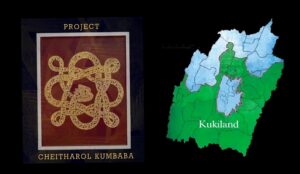
The claim that Kukis came to Manipur after 1951 is false. The strongest evidence against this claim comes from the Meiteis’ own royal chronicle, the Cheitharol Kumbaba. If history is to be the judge, the Meitei Ningthourol itself stands as the strongest witness in favour of the Kuki people.
The Cheitharol Kumbaba is the primary source of Meitei kingship history. It is to the Meiteis what the Buranji is to the Assamese. Maintained by the royal court, it records the list of kings, their coronations and their alliances. It proves beyond doubt that Kukis were not newcomers, but co-founders and allies of Kangleipak from its inception.
According to the chronicle, Kangleipak was founded in 33 AD when Nongda Lairen Pakhangba, the first king of the Ningthouja dynasty, ascended the throne at Kangla. He did not establish the kingdom alone. He unified different clans and principalities of the hills and the valley. To mark this unification, he organized the first historic Sagol Kangjei, the polo match, which was played between chiefs of different regions.
The chronicle is clear about who these chiefs were. In 33 AD, two Kuki chiefs named Kuki Ahongba and Kuki Achouba were allies and friends of King Pakhangba. They participated in his coronation and in the administration of the newly formed kingdom. This is not a footnote. It is on the first page of Kangleipak’s history.
The relationship went beyond alliance. In 186 Saka Era, which corresponds to 264 AD, a Kuki named Taothingmang became the King of Kangleipak. He ruled as sovereign. This proves Kukis were not living on the periphery, but were at the very centre of political power in ancient Manipur.
This continuity is seen in later centuries. King Naophangba, who ruled from 428 to 518 AD, and King Naofangba, who ruled from 624 to 714 AD, both had formal Friendship Treaties with Kuki Chiefs to the east of Imphal. These were treaty-level engagements between rulers, duly recorded in the court chronicle.
Similarly, King Irengba, who ruled from 1107 to 1127 AD, maintained active contacts with Kuki villages to the north of Imphal Valley. This shows that Kuki villages were settled and recognized entities around the valley more than 900 years ago. The names preserved are Kuki Ahongba, ally in 33 AD, Kuki Achouba, ally in 33 AD, and Taothingmang, King in 264 AD.
What does this prove today? If Kuki chiefs were allies of the first Meitei King in 33 AD, they were here 1,918 years before 1951. One cannot selectively believe the Cheitharol Kumbaba. If we believe that Pakhangba founded Kangleipak in 33 AD, we must also believe what the same book says on the same page about his Kuki allies. To deny one is to deny the other.
British records confirm this antiquity. In 1887, C.A. Soppitt in his book A Short Account of the Kuki-Lushai Tribes listed Thadou as the most numerous Kuki clan in this frontier. This was 64 years before 1951 and proves a large and established presence long before independence.
Therefore, the demand for NRC with 1951 as the base year to brand Kukis as foreigners is against history, against the Meitei Ningthourol itself, and against constitutional justice. History cannot be rewritten to suit present politics. The chronicle that legitimizes Meitei kingship also legitimizes Kuki indigeneity. According to the Meiteis’ own record, Kukis have been here since the first day Kangleipak was born.