Introduction: The Kuki demand for statehood is not a new slogan. It is rooted in 160 years of resistance and service to India, from the 1860 revolt in Tripura to the 1917 war against the British, from the INA in 1944 to the 1962 war, and from the loss of more than 1000 lives in the 1990s to the displacement of 60,000 people in May 2023.
The Kuki Revolt in Tripura 1860: The First Organised Resistance in the East
The first major Kuki uprising against colonial oppression did not happen in Manipur but in the kingdom of Tripura, then known as Hill Tippera. Historical records preserved by British administrators and cited in the Cambridge journal Modern Asian Studies show that on 31 January 1860, a large body of Kuki warriors led by Ratan Puia and other chiefs descended from the hills along the river Fenny and entered Chhagalnaiya in the plains. Contemporary British reports recorded that they burnt or plundered 15 villages, killed 185 persons and carried off about 100 captives. Later academic studies published in the International Journal of Creative Research Thoughts explain that this was not a mere raid for plunder. The Tripura administration had imposed heavy taxes on hill tribes, the Riang community was suffering the most, moneylenders had trapped peasants in debt, and disgruntled members of the royal family itself encouraged the Kukis to rise. Thus, a tribal raid turned into a public revolt against a feudal and colonial system. The British had to dispatch troops and policemen from Noakhali, Tipperah and Chittagong to suppress it. The event is now recognised as the Kuki Uprising of 1860 to 1861, one of the earliest tribal revolts in Northeast India, decades before the Indian National Congress was even formed. It proves that Kuki political consciousness was born out of resistance to injustice on their own ancestral land and not imported from elsewhere.
Anglo-Kuki War 1917 to 1919: Three Years of War Against the British Empire
If 1860 was a revolt, 1917 to 1919 was a full-scale war against the largest empire in the world. When the British government ordered all Kuki chiefs to supply labourers for World War I in France, the Kuki chiefs refused and performed the traditional oath of Sajam Lhah, eating the mithun meat and declaring that they would never bow to a foreign power that treated them as slaves. What followed was called by the British as the Kuki Rebellion, but by the Kukis as the Anglo-Kuki War. It lasted two years and three months and is considered one of the longest tribal wars against the British in India. In this war, over 150 Kuki warriors and more than 70 British soldiers died on the battlefield, with many more wounded on both sides. To fight the Kukis, the British deployed more than 5,400 troops drawn from Assam Rifles, Burma Military Police and regular British Indian Army. Official documents say the British burnt 126 Kuki villages, forced 16 villages to desert their homes, coerced 140 villages to surrender and confiscated 1,158 guns. The cost to the British exchequer was about Rs 28 lakhs, a massive amount at that time. More than 20 Kuki chiefs were arrested and imprisoned in Sadiya in Assam and Taungyi in Burma. Monoliths erected in Songpi village near Churachandpur today carry the names of those chiefs. The war is taught in the University of London as an example of frontier resistance and its documents are preserved in the British Library.
Kuki Contribution in the Second Phase of British Resistance
The importance of the Anglo-Kuki War lies not only in its military scale but in its political message. Even British officers like J C Higgins admitted that the Kukis were fighting for their freedom and their land and that they were more sinned against than sinning. The war ended only after a scorched earth policy that destroyed granaries and livestock and displaced thousands of families into the jungles. Yet, the memory of that war never died. In 2017, the centenary of the war was observed across Manipur with the unveiling of monoliths at Songpi, gun salutes by chiefs and cultural programmes. The message was that a community that fought the British Empire for three years, long before 1947, cannot be treated as a community without a political identity. When India became independent, the Kukis believed that their sacrifice would be recognised and that they would be given protection under the new Constitution. That promise remains unfulfilled even after 75 years of independence.
Contribution to the Indian National Army Under Netaji Subhas Chandra Bose
When Netaji Subhas Chandra Bose brought the Indian National Army to the Northeast in 1943 and 1944, the Kukis once again chose India. According to Professor Jangkhomang Guite writing in the Indian Historical Review in 2010, at least 6,000 Kukis helped the INA and Japanese forces because they resented the British demand for 11,000 Kuki men as labourers for road repairs and war work. The Indian Express in a detailed article noted that hundreds of Kukis deserted the British V Force to join Netaji. At the INA Memorial Complex in Moirang, where Colonel Shaukat Malik hoisted the Tricolour for the first time on Indian soil on 14 April 1944, the Government of India inscribed 198 names of freedom fighters from Manipur in golden ink on marble. Out of those, 170 names are of Kuki origin and only 26 are from other communities of the valley. This official figure itself proves the scale of Kuki participation. Leaders like General Tintong Haokip, who was a key strategist, and intelligence officer Jamthang Haokip who left British service, recruited 25 youths, made secret maps of British positions and guided INA columns through the thick jungles of Burma are still remembered by elders. Jamthang Haokip later received the Tamrapatra from Prime Minister Indira Gandhi.
Legacy of INA Service in Kuki Villages
The Kuki role in the INA was not limited to 80 men alone as some early estimates suggested. It was a mass participation of entire villages. Villagers carried food on their heads for months to feed INA soldiers, risked execution by the British who declared Moirang as enemy soil, and composed war songs called Japan Gal La, the Songs of the Japanese War, which are still sung in villages today. The house of Hemam Nilamani in Moirang was converted into INA headquarters and the house of Koireng Singh provided grains from his father’s granary for three months. The British Political Agent ordered that Koireng and others be shot on sight. The fact that the Government of India honoured these freedom fighters at Moirang shows that the Indian state itself has recognised Kuki sacrifice for freedom. Yet, that recognition has not translated into political security in independent India.
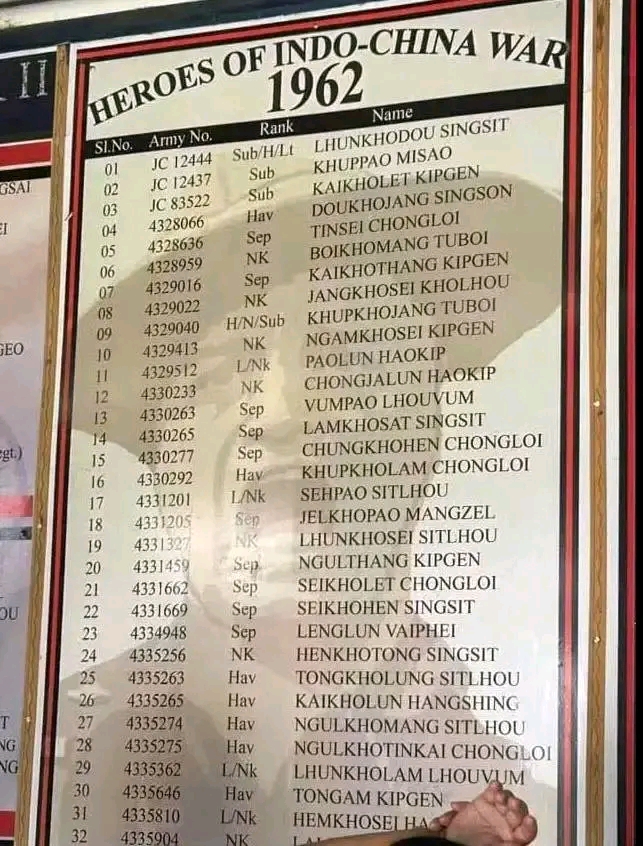
File Photo: Heroes of Indo-China War 1962: Memorial board in a Kuki village listing 32 Kuki soldiers with Army numbers and ranks who fought in the 1962 Sino-Indian War in Tawang, Walong and Ladakh. The list includes Subedar Lhunkhodou Singsit, Khuppao Misao, Kaikhoholet Kipgen, Doukhojang Singson, Tinsei Chongloi and 27 others from Assam Rifles and Indian Army. Such boards are found across Churachandpur, Kangpokpi and Tengnoupal districts, proving that when India faced China in 1962, Kuki villages sent their sons to the Himalayan frontline.
Sino-Indian War 1962: When Kuki Villages Sent Their Sons to the Himalayas
The village memorial boards that you see today in Manipur are the most direct evidence of Kuki participation in the Sino-Indian War of 1962. When China attacked NEFA, which is today Arunachal Pradesh, and Ladakh, the Indian Army was heavily outnumbered and under-equipped. In Walong, Namti, Kibithu and Tawang, the 6 Kumaon, 4 Sikh, 2/8 Gorkha and 4 Dogra battalions held off Chinese brigades for nearly three weeks from 23 October to 16 November 1962. Official accounts say that of 200 men who went to Tri-Junction near Walong, only 90 returned. The Assam Rifles, which has always recruited heavily from hill tribes including the Kukis, lost 47 men in Tawang alone while resisting the Chinese advance. On 20 October 2025, the 5th Battalion Assam Rifles at Tengnoupal in Manipur organised a ceremony with 161 personnel to honour those 47 martyrs of 1962. Tengnoupal is a Kuki-dominated area, and many of those soldiers were from Kuki villages. The memorial boards found in villages show multiple names from a single village who served in 1962. This shows that when the rest of the country was worried about the fall of Tawang and Bomdila, Kuki families in Manipur were already sending their sons to the frontline.
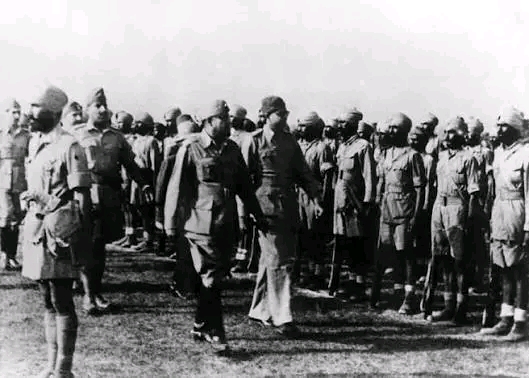
File Photo: Netaji Subhas Chandra Bose inspecting Indian National Army soldiers in Burma in 1944. Among the soldiers in the ranks were hundreds of Kuki volunteers who had deserted British V Force to join the INA. At Moirang, 170 of the 198 Manipuri freedom fighters honoured by the Government of India in gold are Kuki.
Continuity of Service After 1962
After 1962, this service never stopped. Today, Churachandpur district alone has more than 10,000 ex-servicemen from the Kuki community. Veterans have shared how they fought in Kargil in 1999, in Operation Parakram and in Kashmir. One decorated veteran, Subedar Major Kimkhankap, Sena Medal winner, recalled killing militants in Kupwara. Another recalled fighting for three nights without sleep on the heights of Kargil. In 2025 and 2026, two soldiers from Churachandpur, Subedar P H Moses of 1 Assam Rifles and Rifleman Manglem Sang Vaiphei of 3 Assam Rifles, were awarded the Shaurya Chakra by President Droupadi Murmu at Rashtrapati Bhavan for exceptional courage on the India-Myanmar border. Their villages celebrated for days. Even Army Chief General Upendra Dwivedi said in 2024 that the Army is a melting pot where soldiers serve in the same unit with harmony. This continuous line from 1860 to 1962 to 2026 shows a community that has never hesitated to defend India, even when India has hesitated to defend it.
The 1990s Tragedy: More Than One Thousand Kuki Civilians Killed and Justice Still Pending
The most painful chapter in recent Kuki history is the systematic violence unleashed by NSCN-IM militants led by Thuingaleng Muivah from 1992 to 1997. According to reports published in The Indian Express, Scroll and The Hindu, and according to the Kuki Inpi Manipur, the apex body of the community, the conflict began after the Kuki National Army served a quit notice in Moreh in 1992 following the killing of Kuki villagers. In retaliation, NSCN-IM issued a quit notice to the Kukis from what it called the land of the Nagas, effective from 15 September 1993. Two days before that date, on 13 September 1993, NSCN-IM cadres attacked Joupi and Janglomphai villages and massacred 87 fleeing Kuki villagers. That day is now observed as Black Day. In total, Kuki organisations say more than 1,000 civilians including women and children were killed, more than 350 villages were uprooted and burnt, and more than 100,000 people were internally displaced. The Indian Express reported that security was tightened every September ahead of Black Day because the wounds remain fresh.
Unfinished Justice for the 1990s Victims
The Kuki Inpi Manipur has submitted more than 60 memorandums to the Central and State governments asking that justice be delivered before any final Naga peace deal is signed, but no compensation or resettlement package has been finalised to this day. The victims were not militants, they were farmers, teachers, pastors and children. Their villages remain abandoned. This history is not folklore, it is documented in police records, press reports and academic books. The fact that a community that gave 170 freedom fighters to the INA and many soldiers to 1962 had to face ethnic cleansing in independent India without justice shows the failure of the present administrative arrangement in Manipur. Without a separate political unit, the Kukis have no power to protect their land, their villages and their lives. This is why the demand for statehood is not about privilege but about survival and dignity under the Constitution.
Violence of May 3, 2023: A Repeat of Displacement
While the wounds of the 1990s had not healed, the violence of May 3, 2023, opened them again. According to official government figures cited by national media, the violence that began after a tribal solidarity rally in Churachandpur against the Meitei demand for Scheduled Tribe status led to the death of at least 258 people as of November 2024, with more than 60,000 displaced, more than 1,000 injured and 32 missing. Unofficial figures are higher. The Indigenous Tribal Leaders Forum reported that in the first months alone, about 4,500 houses in 160 villages were burnt down, rendering about 36,000 people homeless. More than 253 churches were burnt down according to a memorandum submitted to Governor Anusuiya Uikey on 13 June 2023, and later reports put the number of churches and Christian institutions damaged at more than 350. The methods included arson, vandalism, looting and attacks on religious structures. Prior to May 3, policies of the state government headed by Chief Minister N Biren Singh, who openly vilified Kukis as poppy cultivators, forest encroachers and illegal immigrants, and the patronage given to valley-based groups like Arambai Tenggol and Meitei Leepun, had created an atmosphere of fear. The Kuki villages that had once sent soldiers to Tawang in 1962 were now burning, and families of ex-servicemen were living in relief camps in Lamka.
Why Statehood or Union Territory is the Only Constitutional Solution
All the above facts point to one constitutional conclusion. The Kukis are not asking for something outside the Indian Constitution. They are asking for protection within it. Article 2 and Article 3 of the Constitution empower Parliament to create new states. In the past, states like Nagaland in 1963, Mizoram in 1987, and Telangana in 2014 were created to address distinct historical, cultural and administrative needs. The Kuki case is stronger than many of those cases because it combines historical distinctiveness, documented sacrifice for India, repeated persecution, and present administrative failure. The Kukis have a distinct language family belonging to the Tibeto-Burman group, a distinct customary law, a distinct chieftainship system and a clearly defined contiguous territory comprising Churachandpur, Kangpokpi, Pherzawl, Tengnoupal and parts of Chandel and Senapati districts. They dominate five of the sixteen districts of Manipur. Their demand is not for secession but for a full-fledged statehood that will give them a legislative assembly, a budget, a police force and control over land and forest, which are the very issues that have led to repeated conflicts.
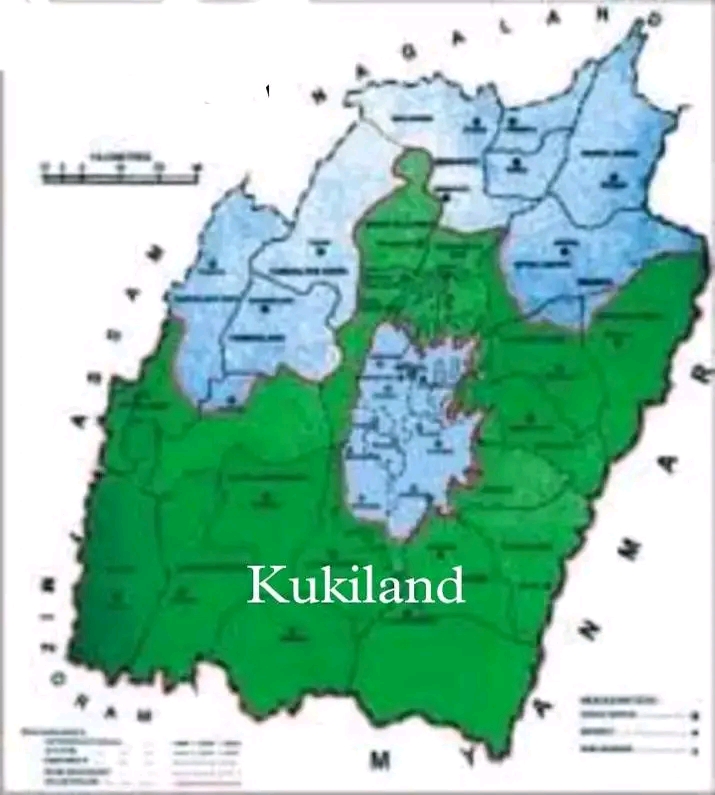
File Photo: Proposed map of Kukiland: The green-shaded area shows the contiguous Kuki-dominated territory comprising Churachandpur, Kangpokpi, Pherzawl, Tengnoupal and parts of Chandel and Senapati districts. The Kukis dominate five of the sixteen districts of Manipur and are demanding full-fledged statehood or Union Territory with legislature under Article 2 and Article 3 of the Indian Constitution.
Conclusion: Statehood or Union Territory Must Be Granted
When the Government of India can spend Rs 28 lakhs in 1919 to crush the Kukis, it can certainly spend resources today to secure their future through a democratic state. The records of their bravery are already in the University of London, in the British Museum and in the Moirang INA Memorial. What is missing is political justice in New Delhi. Granting statehood will not be a favour, it will be a correction of a historical wrong. If full statehood is delayed due to political reasons, the Central Government must at least grant a Union Territory with legislature for the Kuki areas. A Union Territory will give immediate protection, direct funding from Delhi, and a separate administration to rebuild burnt villages and churches. In the long term, that Union Territory must be upgraded to a full-fledged state. The Kukis are not engaging in baseless politics. Their history is written in blood and documented in world libraries. People already know it. The question is whether the Government of India will finally deliver justice. Statehood or Union Territory is not a gift, it is a constitutional right and a debt the nation owes to a community that has bled for the Tricolour for more than a century.