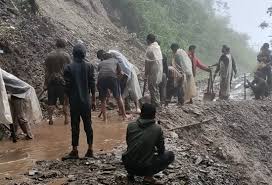
Itanagar: The Ministry of Home Affairs has rushed two Rapid Action Force companies to Arunachal Pradesh’s East Siang district after violent protests against the proposed 11,200-MW Siang Upper Multipurpose Project escalated into arson and vandalism in Pasighat, officials said on Sunday. The companies, comprising about 250 specially trained anti-riot personnel, were airlifted from Navi Mumbai on an IAF transport aircraft on Saturday night following a directive from the MHA and are expected to be fully deployed in Pasighat and adjoining areas by Sunday evening.
According to Arunachal Pradesh Police, the violence broke out after a 12-hour bandh called by Adi organizations under the aegis of ABKU across Siang, Upper Siang and East Siang districts on Friday. While the bandh remained largely peaceful during the day, mobs gathered after its conclusion and went on a rampage till 3.30 am on Saturday, torching the NHPC office handling the Siang project surveys, setting ablaze a police station, and vandalising residences of three political leaders including state BJP chief. At least four women were injured in a clash with police during the shutdown.
Chief Minister Pema Khandu called the Pasighat incidents regrettable and said that while the right to peaceful protest is an essential part of democracy, it must remain within the bounds of law. Officials said multiple CRPF units already stationed in the state, part of the permanent deployment of 2-3 battalions in Arunachal, had managed to contain the violence from escalating further. CRPF personnel were among several security personnel injured since Friday. The RAF, the blue-uniform anti-riot wing of CRPF, has been specifically sought for its expertise in crowd control.
The project at the heart of the unrest is the Siang Upper Multipurpose Project, proposed as India’s largest hydel project with an installed capacity of 11,200-MW on the Siang River, which becomes the Brahmaputra in Assam. The Centre argues it is a strategic necessity to counter China’s 60,000-MW mega-dam on the Yarlung Tsangpo in Tibet, just upstream of Arunachal, which could have severe implications for India’s water security, ecology and flood management. Locals, however, fear large-scale displacement, loss of fertile land and cultural identity of the Adi tribe, leading to detention of 10 anti-dam activists earlier this week which triggered the bandh.
What makes the security situation in Arunachal uniquely sensitive this week is the parallel development on the international border. In a significant public confirmation, ITBP Director General Shatrujeet Singh Kapur said on Thursday at the force’s investiture ceremony in Alwar, Rajasthan, that face-offs between Indian and Chinese troops have been continuing at multiple locations in Arunachal Pradesh and still continue. “In the past few days, a situation arose where face-off happened at several locations in Arunachal and it still continues,” Kapur said.
According to defence sources and reports quoted in The Hindu, the ongoing standoff is centred on Taksing Circle in Upper Subansiri district, particularly around Asaphila and Longju, two pockets where India and China have differing perceptions of the Line of Actual Control. The friction began in July during routine patrolling near Maja. After a brief confrontation, PLA troops returned in larger numbers a few days later and pitched tents at an elevated position roughly 6-7 km inside India’s perception of the LAC. The site has remained active since then, with both sides maintaining reinforced positions.
Kapur said the ITBP’s newly raised Shaurya Commando platoons have played a key role in holding ground during these confrontations. The 3,488-km LAC is primarily guarded by the ITBP. The DG noted that the standoff persisted even during the mid-September BRICS Summit in New Delhi attended by Chinese President Xi Jinping, underlining the disconnect between diplomatic engagement and ground reality. He also announced an aggressive modernisation push, with 70% of the recent Rs 400 crore modernisation budget earmarked for drones, creation of drone platoons in every battalion, and construction of reinforced underground shelters and bunkers to protect troops from artillery, aerial bombardment and harsh winters.
The Ministry of External Affairs on Friday responded to the ITBP chief’s disclosure, stating that the situation along the border gets disturbed when Chinese forces deviate from established patrolling patterns. MEA spokesperson Randhir Jaiswal said both sides continue to use diplomatic and military mechanisms including flag meetings, hotline communications and Corps Commander-level talks to prevent escalation. He noted that Wacha and Damai talks were held in Arunachal last month after the Taksing face-off. The MEA reiterated that maintenance of peace and tranquillity along the LAC is essential for overall development of bilateral relations.
The dual developments have triggered political reactions. Congress general secretary Jairam Ramesh accused the Prime Minister’s Office of maintaining a “deafening silence” on the Arunachal face-offs while making calibrated concessions to China. He alleged loss of patrolling points as in Ladakh, pointed to China’s renaming of places in Arunachal and its upstream dam, and flagged the record India-China trade deficit of USD 112 billion in 2025-26. The government has not officially commented on the specific PLA tent locations, with the Ministry of Defence yet to issue a detailed statement.
On the ground, officials are managing two different but overlapping security challenges in the same state. In the Siang Valley, the state government is attempting to build trust through dialogue while ensuring that NHPC assets and government property are protected, with RAF deployment seen as a stabilising measure before any further talks on the hydel project. In the high Himalayas of Upper Subansiri, the Army and ITBP remain in a high-altitude eyeball-to-eyeball posture, with patrols carefully calibrated to avoid a Galwan-like escalation.
The Centre’s assessment is that the Siang dam is not just a power project but a strategic counter. Without storage capacity in Arunachal, China could potentially weaponise water flow after its 60,000-MW dam becomes operational, causing either lean-season drying or sudden flood surges in Arunachal and Assam. This strategic rationale, however, is yet to convince local communities who cite the memory of the 1950 earthquake and fragile Siang geology. The coming weeks will test whether the MHA’s rapid deployment can restore order in Pasighat while the military and diplomatic channels stabilise the LAC in Taksing.