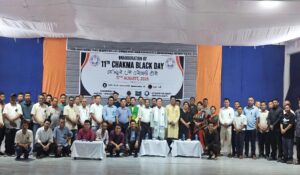
Mizoram: The Chakma community observed Black Day on Monday at the CADC Art and Culture Hall in Kamalanagar, headquarters of the Chakma Autonomous District Council, to mark the anniversary of the decision in 1947 that placed the Chittagong Hill Tracts in East Pakistan.
The programme was jointly organised by the Chakma National Council of India Mizoram State Committee, Central Young Chakma Association, Central Mizoram Chakma Students Union and Chakma Mahila Samiti. CADC members, village council presidents, representatives of political parties and community bodies attended. The day has been observed annually since 2016 when CNCI adopted the resolution at its Guwahati national convention.
Addressing the gathering, CADC Chief Executive Member and CNCI National President Nirupam Chakma said August 17 marks the broadcast of the Radcliffe Boundary Commission Award on All India Radio. The award assigned the tract to East Pakistan despite its 98.5 percent Buddhist and Hindu population. British records classified it as an Excluded Area with no representation in the Bengal Legislative Council.
He cited minutes of a meeting held in New Delhi on August 16, 1947, attended by Lord Mountbatten, Jawaharlal Nehru and Muhammad Ali Jinnah. Nehru argued that on religious and cultural grounds the Chittagong Hill Tracts should remain with India. The population had also expressed preference for joining India. On August 15, 1947, leaders including Sneha Kumar Chakma hoisted the Indian Tricolour at Rangamati. On August 21, troops of the Baluch Regiment removed the flag after the award became known.
Speakers traced the deeper history of the Chakmas, the largest among 13 tribes of the tract. Known as Jumma for their Jhum cultivation, their origins are linked to migration from Arakan, now Rakhine in Myanmar, during the 15th and 16th centuries. Their language belongs to the Indo-Aryan family with early script related to Burmese. Oral tradition claims Kshatriya descent, a narrative reinforced in the 19th century under strong Hindu influence at court.
The Chakmas maintained a kingdom across the tract and parts of Chittagong. After paying tribute to the Mughals from the mid 17th century, they resisted the British East India Company in 1777 and 1780 before an agreement in 1787. Full British administration began in 1860 with the Chittagong Hill Tracts Regulation, which barred outsider settlement and protected customary governance.
A major transformation occurred under Rani Kalindi, who ruled as regent from 1832 to 1873. She invited Theravada monks from Arakan to reform Chakma religion, shifting from older animist practices to Pali based Theravada Buddhism. She supported the first book on Buddhism in Bengali, Bauddharanjika, and established Pali schools. Her 1844 estate claim as a Hindu widow in the Chittagong Court of Wards remains a landmark legal case.
After 1947, the special protection was gradually removed. In 1964 Pakistan abolished the 1900 Regulation and opened the tract for Bengali settlement. The construction of the Kaptai Hydroelectric Dam on the Karnaphuli River between 1959 and 1962 submerged 655 square kilometres, including 22,000 hectares of cultivable land and parts of Rangamati town including the palace of the Chakma Raja.
The reservoir displaced around one lakh people, 70 percent Chakmas. Called the Lake of Tears, it forced large scale movement. In 1964-65 about 14,888 Chakmas and Hajongs entered the then Lushai Hills and were later resettled in Tripura and NEFA, now Arunachal Pradesh. After Bangladesh independence in 1971, autonomy demands led to formation of Parbatya Chattagram Jana Samhati Samiti in 1972 and its wing Shanti Bahini. Conflict in the 1980s caused further exodus, with 45,000 arrivals reported in Tripura within a fortnight in 1986.
The 1997 Chittagong Hill Tracts Peace Accord ended insurgency but land restoration and demilitarisation remain partly implemented. Present estimates place five to six lakh Chakmas in Bangladesh, 80,000 to one lakh in Mizoram, 60,000 to 70,000 in Arunachal Pradesh, 40,000 to 50,000 in Tripura and about 30,000 in Assam. The community follows Theravada Buddhism and maintains traditions of Pinon Hadi weaving, Biju dance and folk music.
Nirupam Chakma clarified that Black Day is not against any community or against the people of Bangladesh. It is intended to preserve historical memory and to document facts. He urged youth to study primary records, including Radcliffe papers and Mountbatten documents, and to focus on education, economic self reliance and protection of rights under the Sixth Schedule.
Other speakers included CADC Chairman Kali Kumar Tongchangya, CNCI vice president Amarsmriti Chakma, CYCA religious secretary Santosh Chakma, Chakma Mahila Samiti senior vice president Dangubi Indu Moti Dewan and student union president Parbesh Chakma. They stressed unity, cultural preservation and pursuit of aspirations through peaceful and constitutional methods.
The programme ended with a resolution to continue documentation of partition records, support research by students, and strengthen language preservation initiatives across Chakma inhabited areas in India and beyond.