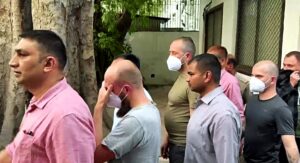
New Delhi: A Special NIA Court in New Delhi on Wednesday, September 23, 2026, granted default bail to all six Ukrainian nationals who were arrested by the National Investigation Agency (NIA) earlier this year on allegations of illegally crossing into Myanmar to impart combat training to ethnic armed organisations operating near the Indo-Myanmar border. The court directed that they be released on furnishing a personal cash bond of Rs 1 lakh each. In a parallel relief, the court also discharged the Ukrainians from the offences under the newly enacted Immigration and Foreigners Act, 2025, after the Foreigners Regional Registration Office (FRRO) compounded the violations.
Special Judge Prashant Sharma passed the order after hearing detailed arguments on the default bail plea and the discharge application moved through counsel Nitin Saluja. The court observed that the investigating agency had failed to file a complete chargesheet within the statutory period of 90 days for offences under the general penal law, and therefore the accused were entitled to default bail under Section 187 (3) of the Bharatiya Nagarik Suraksha Sanhita (BNSS). The prosecution had initially arrested them under the stringent Unlawful Activities (Prevention) Act (UAPA), but the subsequent chargesheet did not invoke any terror charges.
The six Ukrainians who have now secured default bail have been identified as Hurba Petro, Slyviak Taras, Ivan Sukmanovskyi, Stefankiv Marian, Honcharuk Maksim, and Kaminskyi Viktor. According to the NIA case diary, they were apprehended in March 2026 from different airports and locations across the country on inputs that they had travelled to restricted areas along the Indo-Myanmar border without valid permits and had crossed over to Myanmar for alleged training activities. The agency had claimed that their presence in a sensitive border zone posed a threat to national security.
The NIA’s chargesheet, filed earlier this month before the Special Court, however, did not press any charges under the UAPA. Instead, it confined itself to Sections 21 and 23 of the Immigration and Foreigners Act, 2025, which deal with violation of visa conditions, entry into restricted areas without a valid Restricted Area Permit (RAP), and overstay and illegal cross-border movement. Both these sections are compoundable at the level of the Foreigners Regional Registration Officer (FRRO) upon payment of a penalty, unlike the anti-terror law which is non-compoundable and involves prolonged custody.
Last week, the FRRO exercised its powers and compounded the offences after imposing a penalty of Rs 5.5 lakh on each of the six Ukrainian nationals and the US national Matthew VanDyke, who is the seventh accused in the same case. The compounding was done after examining their visa documents, entry stamps, and statements regarding their travel to the border areas. Once the compounding order was issued, counsel Nitin Saluja moved a formal application before the Special Court seeking discharge from the immigration offences, arguing that after compounding, no criminal liability under that Act survives.
Accepting the submission, Special Judge Prashant Sharma discharged all six Ukrainians from offences under the Immigration and Foreigners Act, 2025, noting that the law itself provides that once an offence is compounded by the competent authority on payment of penalty, the proceedings under that Act shall stand closed. The discharge, however, does not bar the NIA from continuing investigation under other laws if fresh material emerges. Special Public Prosecutor for NIA, Rahul Tyagi, informed the court that the larger conspiracy and terror-related aspects are still under investigation and the agency may file a supplementary chargesheet if evidence regarding training of armed groups is established.
The court also took up the bail modification plea of US national Matthew VanDyke, who was granted default bail last week on September 16, but with stringent conditions that included not leaving the jurisdiction of the trial court without prior permission and furnishing both a bail bond and a surety bond of Rs 1 lakh each. VanDyke, through his counsels Rohit Dandriyala and Rohit Gour, moved an application seeking relaxation of the surety condition, stating that as a foreign national with no local roots, he was unable to secure an Indian surety and was willing to comply with any other condition imposed by the court, including a higher cash bond.
Allowing the plea on Wednesday, Judge Sharma exempted VanDyke from furnishing a surety bond of Rs 1 lakh and directed that he be released solely on a personal cash bond of Rs 1 lakh. The court noted that insisting on a local surety for a foreign national in such circumstances would effectively frustrate the right to default bail already granted. The court, however, retained the condition that he shall not leave the territorial jurisdiction of the trial court without its permission, and shall provide his contact details, address of stay in Delhi, and shall cooperate with the investigation as and when required by the NIA.
VanDyke’s separate plea seeking permission to travel back to the United States and to collect his passport, which is currently in the custody of the investigating agency, is scheduled to be heard on Friday, September 26. His counsels argued that after discharge from immigration offences and grant of default bail, continued seizure of passport amounts to unreasonable restriction on his personal liberty and right to return to his home country, especially when the NIA has not invoked UAPA charges in the present chargesheet. The prosecution has sought time to file a reply on that plea.
The case has drawn attention due to its international ramifications and the invocation of UAPA at the time of arrest. The NIA, in its initial press release in March, had stated that it had received intelligence that a group of foreign nationals, including Ukrainians and an American, had entered India on tourist and business visas but had subsequently travelled to the Northeast and crossed over to Myanmar to provide tactical and weapons training to certain ethnic insurgent groups involved in the ongoing conflict in Myanmar. The agency had arrested them under UAPA, Immigration Act, and relevant provisions of the BNSS.
Defence lawyers, however, contested the terror narrative, arguing that their clients were in India as tourists and adventure enthusiasts, and that there was no concrete evidence to show that they imparted military training to any banned organisation. They pointed out that the fact that the NIA itself did not charge them under UAPA in the chargesheet filed after nearly 90 days of custody vindicates their stand that the initial allegations were exaggerated. They also argued that the Indo-Myanmar border region, particularly in Manipur, Mizoram and Nagaland, has ambiguous demarcation and many foreigners stray into restricted areas due to lack of awareness about RAP requirements.
Legal experts view the court’s order as significant on two counts: first, it reaffirms that default bail is an indefeasible right once the statutory period for filing chargesheet expires, even in cases initially projected as national security threats; and second, it clarifies the effect of the new Immigration and Foreigners Act, 2025, which came into force this year replacing the 1946 Act, and gives wide powers to FRRO to compound visa and entry violations upon payment of penalty. The NIA has indicated that its investigation into the alleged Myanmar training angle will continue, and if it finds material attracting UAPA or other penal offences, it will file a supplementary chargesheet. Till then, all seven foreign nationals are set to walk out on bail.