New Delhi: A Delhi court has granted default bail to United States national Matthew Aaron VanDyke in a high-profile case investigated by the National Investigation Agency (NIA) concerning alleged drone warfare training related to the conflict in Myanmar. The Rouse Avenue Court granted the relief on a personal bond of Rs 1,00,000 along with one surety of the like amount, directing the accused to remain in the national capital and to cooperate with the investigation as and when required by the investigating officer. The order has brought fresh focus on the handling of foreign nationals allegedly involved in activities linked to Myanmar-based armed groups operating close to India’s northeastern border.
The case pertains to the arrest of seven foreign nationals, including VanDyke and six Ukrainian citizens, who were apprehended in March this year and have been lodged in Tihar Jail since April. According to the NIA, the accused had entered India through Mizoram before proceeding to Myanmar, where they had allegedly participated in pre-scheduled training modules related to drone warfare, including drone operations, assembly, maintenance and jamming technology. The agency had further alleged that the accused were connected to ethnic armed groups based in Myanmar and that drones and related components were transported through Indian territory as part of a larger conspiracy.
Initially, the NIA had booked the accused under Section 18 of the Unlawful Activities Prevention Act, which deals with conspiracy for terrorist activities, indicating that the agency viewed the matter as having serious implications for national security. However, in a significant development, the agency filed its chargesheet without invoking any provisions of the UAPA. Instead, the chargesheet was filed only under Sections 21 and 23 of the Immigration and Foreigners Act, 2025. The NIA informed the court that its investigation under the UAPA remains open and that a supplementary chargesheet could be filed in future if further investigation establishes an offence under the anti-terror law.
The shift in legal provisions became the central ground for the grant of default bail. VanDyke’s counsel had argued before the court that since the NIA had failed to file a chargesheet under the UAPA within the statutory period and had ultimately dropped UAPA charges, the accused was entitled to default bail as a matter of right. The court accepted the argument, noting that the investigation had not resulted in UAPA charges despite the initial invocation. The court also observed that the six Ukrainian nationals who are co-accused in the same case would also have the right to seek bail if they file appropriate applications, as reported by ANI.
According to court records and submissions made by the agency, the NIA had relied on digital evidence and witness statements to point towards a wider conspiracy involving drone warfare and armed groups in Myanmar. The agency told the court that the accused were involved in imparting and receiving training in drone technology that could have implications for security in the border region. Despite these claims, the agency’s decision to not press UAPA provisions in the present chargesheet raised questions, including from the defence, about the strength of the initial allegations relating to terrorism and conspiracy affecting India’s national security.
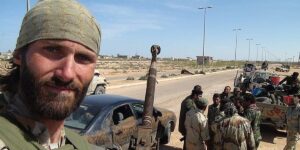
The case has drawn attention due to the profile of the main accused. Matthew Aaron VanDyke identifies himself on his website as the founder of Sons of Liberty International, a non-profit organization that claims to provide military advising and training to communities threatened by insurgency and terrorism. His website states that he participated in the 2011 Libyan Civil War, fighting alongside Libyan rebels, and was captured by forces loyal to Muammar Gaddafi, spending about five and a half months in prison before escaping after the fall of a prison in Tripoli. He also describes himself as a documentary filmmaker, journalist, war correspondent and commentator, with a master’s degree in Security Studies from Georgetown University and a bachelor’s degree in Political Science from the University of Maryland, Baltimore County.
The Rouse Avenue Court, while granting bail, imposed conditions to ensure the presence of the accused during the ongoing investigation. VanDyke has been directed to remain in Delhi and to be available for questioning whenever summoned by the investigating officer. The court order allows him to remain out on bail while the investigation continues, even as the NIA continues its open UAPA probe. The agency has said that if further material emerges, it may file an additional chargesheet invoking UAPA provisions. For now, however, the case proceeds only under immigration-related offences.
The development has significant implications for India’s handling of foreign nationals allegedly involved in Myanmar-related activities. The northeastern states of Mizoram and Manipur share a long and porous border with Myanmar, and Indian security agencies have been closely monitoring the movement of people, arms and technology across the border, especially since the escalation of conflict in Myanmar following 2021. The alleged transportation of drones and components through India and the alleged training of ethnic armed groups have been viewed with concern by security establishments, given the potential for spillover effects on India’s internal security, particularly in Manipur and Mizoram where ethnic ties across the border are strong.
Legal experts note that default bail is a statutory right that accrues to an accused when the investigating agency fails to complete its investigation and file a chargesheet within the time prescribed by law. Since the NIA did not file a chargesheet under UAPA within the extended period available under that law and instead filed a chargesheet only under the Immigration and Foreigners Act, the court held that the accused was entitled to bail. The court’s observation regarding the entitlement of the six Ukrainian co-accused also suggests that the same principle would apply to them, potentially leading to more bail applications in the coming days.
As of now, VanDyke and the six Ukrainian nationals remain under investigation, with the NIA stating that its UAPA probe is still active. The agency had earlier conducted searches and collected digital devices, which it claimed contained evidence of drone-related training and links to armed groups. The outcome of the supplementary investigation will determine whether more serious charges under UAPA are reintroduced. Meanwhile, the grant of bail to VanDyke marks a crucial turn in a case that sits at the intersection of immigration law, national security and India’s evolving policy towards the Myanmar conflict and its impact on the northeastern region.