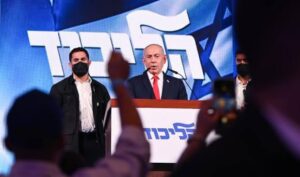
Tel Aviv: Israel’s Central Elections Committee on Thursday published the final results of the October 27 general election, confirming a deadlocked parliament and setting the stage for complex coalition negotiations. With all votes counted, Prime Minister Benjamin Netanyahu’s bloc secured 53 seats in the 120-member Knesset, while the opposition bloc led by Gadi Eisenkot won 48 seats. Two Arab parties — Ra’am and the reconstituted Joint List — won a combined 19 seats, leaving neither major bloc with the 61 seats required to form a government.
The final tally was announced after the count of special double-envelope ballots, which includes votes cast by soldiers, diplomats, and voters away from their home polling stations. The committee said 5,716,665 votes were cast, with a turnout of 77.9%. Of the 12,644 regular polling stations, 5,589,836 votes were recorded, with 5,564,764 valid and 25,072 invalid. An additional 24,713 double-envelope votes were entered after verification. The 26th Knesset is scheduled to be sworn in on November 10, with official results to be submitted to President Isaac Herzog on November 4.
The result makes Arab parties the potential kingmakers. Netanyahu’s Likud remains the single largest party, but his traditional right-wing and ultra-Orthodox allies together could not cross the majority threshold. Eisenkot’s bloc, which includes Yashar, Beyachad (Together) led with Yair Lapid as number two, and other center-left parties, also falls short. Leaders on both sides have begun intensive talks, with opposition figures Gadi Eisenkot and Naftali Bennett meeting in Ra’anana to discuss forming what they called “a good government as quickly as possible.”
The post-election period has been dominated by allegations of irregularities. Likud has claimed that the election was “stolen” through bribery and voter intimidation by Arab parties, calling the affair “Ra’amgate” and describing it as an “earthquake” and an “attack on democracy.” Prime Minister Netanyahu said foreign entities attempted to influence the vote to lead to a “foreign takeover of the Knesset” and the “Islamization of Israel.” His son Yair Netanyahu alleged on social media that Qatar, Turkey and other Arab states poured millions of dollars to boost Arab turnout to topple his father.
Central Elections Committee Chairman Justice Noam Sohlberg took the unusual step of directing Shin Bet chief David Zini to investigate suspicions of improper foreign influence through funding provided by foreign entities acting against Israeli interests. In his letter, Sohlberg said he could not attest to the substance of the suspicions but that they warranted a thorough probe to ensure public trust. He gave the agency a week to report findings. Shin Bet has since met with both Netanyahu and Eisenkot, stating it had begun looking into the matter even before election day.
Election administrators and security officials have pushed back against claims of systemic fraud. Acting Central Elections Committee Director General Dean Livne said in a letter to lawmakers that the elections were conducted lawfully and that there was no known evidence of systematic violations. He described complaints received from Likud as “a list of claims, not evidence.” Police Commissioner Daniel Levy pledged that every complaint would be examined impartially, while Channel 12 cited sources familiar with the Shin Bet probe who said the alleged interference had been “completely blown out of proportion” and that the gap between headlines and reality was enormous.
Qatar categorically denied the accusations. Foreign Ministry spokesperson Majed Al Ansari said in a statement that Qatar had not interfered in Israeli elections or funded any activities to influence their outcome. He accused certain Israeli politicians of launching “yet another disinformation campaign” to use Qatar as a “scapegoat for political failures” and said the claims were “ridiculous and dangerous in equal measure.” He stressed that Qatar has no involvement in Israel’s internal political competition.
Arab parties have also rejected the allegations and accused Likud of delegitimizing Arab voters. Ra’am chairman Mansour Abbas said his party had no link to alleged foreign funding and would fully cooperate with law enforcement, after police arrested four Ra’am activists over suspected voter bribery linked to three Bedouin men arrested on election day. The Joint List said Netanyahu’s accusations showed “fear” of Arab political power and accused the right-wing of refusing to accept that Arab voters had turned out in unprecedented numbers, achieving a historic result of 19 seats.
The political maneuvering now turns to President Herzog’s role in government formation. After receiving official results, the President consults with all parliamentary factions, who recommend a candidate to form the next government. The chosen lawmaker has 28 days to build a coalition, extendable by 14 days, and must then win a Knesset vote of confidence. President Herzog has called for a full investigation into election allegations but also warned against targeting the wider Arab community, saying “the integrity of elections is a paramount value in a democracy” while cautioning against tarnishing an entire community for exercising its right to vote.
Within the blocs, unusual offers have emerged. According to Ynet, a senior official from United Torah Judaism, a long-time Netanyahu ally, offered to support Eisenkot as prime minister in exchange for legislation exempting ultra-Orthodox men from compulsory military service. The official was quoted as saying: “Gadi has the option of forming a government with Netanyahu, but then Netanyahu would be prime minister and he would be a senior minister. We are offering him the premiership.” Former Defense Minister Yoav Gallant, meanwhile, called for a broad Zionist unity government and warned against relying on Arab parties.
Opposition leaders have framed the election as a referendum on Netanyahu’s leadership, the first national vote since the October 7, 2023 Hamas attack. Yair Golan, leader of the Democrats party, said Ra’am could legitimately join the next coalition, noting Netanyahu himself had previously negotiated with Mansour Abbas. Balad leader Sami Abou Shehadeh said his party is “a legitimate elected leadership of the national minority” and called exclusion of Arab parties “racism.” Eisenkot accused Netanyahu of leading an “illegitimate influence operation” to delay results and create “fictitious delegitimization” of the 26th Knesset.
For now, Netanyahu remains caretaker prime minister until a new government is formed or, if all attempts fail, the Knesset is dissolved for fresh elections. Security forces also dealt with logistical challenges on election day, with the IDF airlifting ballot boxes from Eilat and Arava bases by helicopter after severe flooding blocked roads. The final certification on November 4 will clarify whether Israel faces a unity government, a narrow coalition dependent on Arab support, or a fifth election cycle in recent years.