Guwahati: The Kuki History and Identity Protection Committee (KHIPC) has issued a strong and detailed rebuttal to the press statement issued by Thadou Inpi Manipur (TIM) on 17th November, 2026, in which TIM claimed that the Anglo-Kuki War / Kuki Rebellion of 1917-1919 was a “Thadou War” and that the heroes of the war were Thadou chiefs alone. In its press release Ref. No. KHIPC/PR/2026/012, KHIPC said the claim is baseless, historically false, and a direct insult to the Kuki community and its forefathers who sacrificed their lives for freedom, dignity and ancestral land. The committee said that to re-label those martyrs today as “Thadou only” is totally false, unacceptable, and amounts to stealing Kuki history and dishonouring Kuki martyrs.
KHIPC, which is based at Lamka Town in Songpi District and works under the motto “History Unforgotten, Identity Unshaken, Heritage Unbroken”, said the TIM statement has hurt the sentiments of the entire Kuki nation. The committee stated that history is not a matter of present-day political convenience, and no organisation in 2026 can rewrite a 100-year-old record to suit a new political agenda. It appealed to the media, researchers, scholars and the public to treat the TIM claim with caution and to verify it against colonial records, gazetteers and Government of India documents before giving it any space or legitimacy.
The central point of the KHIPC rebuttal is the official name of the war. The committee said the 1917-1919 uprising is recorded in British colonial records, gazetteers and Government of India records as the Anglo-Kuki War, Kuki Rebellion and Kuki Rising. It was never recorded as “Thadou War” by the British who fought the war. KHIPC argued that if the British themselves, who were the opposing side and who maintained detailed administrative and military records, did not call it a Thadou War, then no one today has the authority to rename it. The name Anglo-Kuki War, the committee said, reflects the collective character of the resistance.
KHIPC explained that the war was not the work of one clan or one village, but a widespread Kuki uprising against British colonial forced Labour Corps recruitment. The British attempt to forcibly recruit Kuki men for labour service during the First World War period triggered anger across Kuki villages and hills. Chiefs from different areas rose together, refused to submit, and fought to protect their people, their land and their freedom. That collective resistance, KHIPC said, is why the British called it a Kuki Rebellion and not a clan rebellion.
On the question of identity, KHIPC stated clearly that Thadou is a clan within the Kuki community. It described Thadou as one of the youngest clans in the Kuki community. The committee said the 1956 Manipur Government recognition of the Thadou clan as a separate tribe is totally false, and was a divide-and-rule policy intended to distort Kuki history and to disunite or to break the Kuki nation. According to KHIPC, that colonial-style administrative decision should not be used today to separate Thadou from Kuki or to claim Kuki history as the exclusive property of one clan.
KHIPC gave the names of the freedom fighters to prove the collective nature of the war. It said Pu Kilkhong Thadou, Chief of Jampi, and Pu Lunkholal Thadou, Chief of Chongjang, are from the Thadou clan and are respected as Kuki heroes. But it said they did not fight alone. Like them, Pu Tintong Haokip, Chief of Laijang, Pu Ngulkhup Haokip, Chief of Lonpi, Pu Chengjapao Doungel, Chief of Aisan, and many other chiefs from different clans fought the British colonial forces during 1918-1919. All of them, KHIPC said, were Kuki chiefs and Kuki warriors. They fought as Kukis, for the Kuki nation.
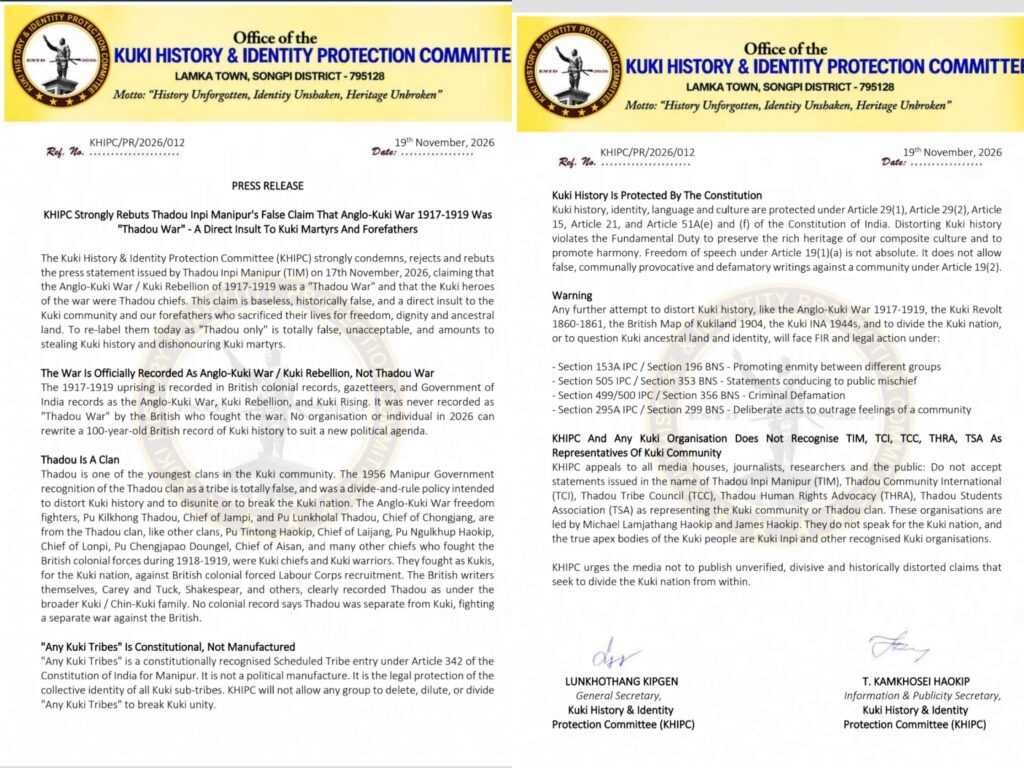
File Photo: KHIPC’s press release rebutting TIM’s “Thadou War” claim, signed by Lunkhothang Kipgen, General Secretary, and T. Kamkhosei Haokip, Information & Publicity Secretary.
The committee also cited British writers to support its position. It said British writers themselves, including Carey and Tuck, Shakespear and others, clearly recorded Thadou as under the broader Kuki / Chin-Kuki family. No colonial record, KHIPC said, says Thadou was separate from Kuki, fighting a separate war against the British. The colonial ethnographic and administrative writings, gazetteers and tour diaries placed Thadou within the larger Kuki family. KHIPC argued that TIM’s attempt to separate Thadou from Kuki today goes against even the British records it claims to rely on.
KHIPC then turned to the constitutional issue of “Any Kuki Tribes”. The committee said “Any Kuki Tribes” is a constitutionally recognised Scheduled Tribe entry under Article 342 of the Constitution of India for Manipur. It is not a political manufacture. It is the legal protection of the collective identity of all Kuki sub-tribes. KHIPC said it will not allow any group to delete, dilute or divide “Any Kuki Tribes” to break Kuki unity. The entry, the committee said, was created precisely to protect the collective identity and to ensure that no clan is left out or separated by administrative manipulation.
The committee further said that Kuki history, identity, language and culture are protected under Article 29(1), Article 29(2), Article 15, Article 21, and Article 51A(e) and (f) of the Constitution of India. Distorting Kuki history, KHIPC said, violates the Fundamental Duty to preserve the rich heritage of the composite culture of India and to promote harmony. It said freedom of speech under Article 19(1)(a) is not absolute. It does not allow false, communally provocative and defamatory writings against a community under Article 19(2). The committee argued that historical distortion is not free speech, but an attack on the dignity of a community.
In a strong warning, KHIPC said any further attempt to distort Kuki history will face FIR and legal action. It listed not only the Anglo-Kuki War 1917-1919, but also the Kuki Revolt 1860-1861, the British Map of Kukiland 1904, the Kuki INA 1944, and any attempt to divide the Kuki nation or to question Kuki ancestral land and identity. The committee said such attempts will not be treated as academic debate, but as deliberate acts to create division, enmity and confusion within the Kuki nation and in the wider public.
For legal action, KHIPC cited four provisions. It named Section 153A IPC / Section 196 BNS for promoting enmity between different groups, Section 505 IPC / Section 353 BNS for statements conducing to public mischief, Section 499/500 IPC / Section 356 BNS for criminal defamation, and Section 295A IPC / Section 299 BNS for deliberate acts to outrage the feelings of a community. The committee said these provisions apply when false and communally provocative writings are circulated in the name of history. It said it is prepared to pursue legal remedies if such distortion continues.
KHIPC also made a clear statement on representation. It said KHIPC and any Kuki organisation does not recognise TIM, TCI, TCC, THRA and TSA as representatives of the Kuki community. It appealed to all media houses, journalists, researchers and the public not to accept statements issued in the name of Thadou Inpi Manipur (TIM), Thadou Community International (TCI), Thadou Tribe Council (TCC), Thadou Human Rights Advocacy (THRA) and Thadou Students Association (TSA) as representing the Kuki community or the Thadou clan.
The committee said these organisations are led by Michael Lamjathang Haokip and James Haokip. It said they do not speak for the Kuki nation. According to KHIPC, the true apex bodies of the Kuki people are Kuki Inpi and other recognised Kuki organisations. The committee said the media should verify the credentials and mandate of any organisation before publishing its statements as if it speaks for the whole community. Publishing unverified claims, it said, only helps to divide the community from within.
KHIPC urged the media not to publish unverified, divisive and historically distorted claims that seek to divide the Kuki nation from within. It said journalists have a responsibility to check colonial records, government gazetteers and constitutional provisions before publishing claims about history and identity. The committee said responsible reporting can protect harmony, while irresponsible reporting can create misunderstanding, enmity and long-term damage to inter-community relations.
The press release was signed by Lunkhothang Kipgen, General Secretary, and T. Kamkhosei Haokip, Information and Publicity Secretary, of the Kuki History and Identity Protection Committee. KHIPC concluded by saying it will continue to protect Kuki history, identity, language, culture and ancestral land through peaceful, constitutional and legal means, and it called upon all Kuki people to remain united and to honour the sacrifices of their forefathers who fought as Kukis for the Kuki nation.