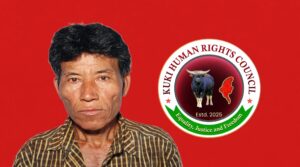
New Delhi: The Kuki Human Rights Council (KHRC) has strongly condemned the abduction of a 71-year-old Kuki farmer from his paddy field in Kangpokpi district, describing it as a grave human rights violation, a crime against humanity and part of a continuing pattern of targeted violence against the Kuki community with complete impunity. The Council said the incident reflects the extreme vulnerability of Kuki villagers who continue to live and cultivate in their own ancestral lands despite prevailing insecurity and repeated attacks from multiple sides.
According to the press release issued by its Information and Publicity Wing on 4th October, 2026 vide Ref. No. KHRC/PR/11/2026, the victim has been identified as Shri Hemjang Haokip, 71, a resident of Khunkho Village, Leimakhong, Kangpokpi District. The KHRC stated that he was abducted from his own paddy field at around 3:00 PM on 3rd October, 2026 by armed cadres of NSCN-IM and ZUF-Kamson faction. After abducting him, the armed groups set ablaze and burnt down his field hut, destroying his shelter, grains and farming tools. His whereabouts remain unknown till the time of filing this report.
Local villagers and family members said the incident came to light only in the evening hours. Due to rainfall on 3rd October, most farmers of Khunkho village had not gone to their fields in the morning. Shri Hemjang Haokip, who often spent the night in his field hut to guard his paddy crop from animals and theft, did not return home as expected. Alarmed, villagers rushed towards the fields and found his hut burning. A search operation was immediately launched in the surrounding jungle and hill areas, but it had to be called off after dark due to serious security concerns and the risk of further attacks.
In its statement, the KHRC said this abduction is not an isolated incident but part of a systematic and ongoing campaign of violence against Kukis. The Council claimed that in 2026 alone, NSCN-IM and ZUF-K have killed more than 28 Kuki civilians, including three pastors and two pregnant women. It said the targeted killing of innocent civilians, religious leaders and women constitutes a grave crime against humanity and a serious violation of international humanitarian law and human rights norms, which demands urgent attention from national and international bodies concerned with protection of civilians.
The Council further traced the history of violence and alleged that since 1990, the NSCN-IM, which it described as India-sponsored and enjoying ceasefire agreement with the Government of India, has killed more than 1,100 Kuki civilians. For over three decades, the KHRC stated, the Kuki people have endured killings, displacement, torture, burning of villages and destruction of churches without justice or accountability. It said despite repeated memorandums, press statements and appeals to the Government of India, no accountability has been fixed and perpetrators continue to enjoy impunity while victims and survivors await justice.
The most significant part of the KHRC statement is its description of the present three-sided siege of the Kuki community. In the title of its own press release, the Council summarized the situation as – “Indian Army Arrests Our Volunteers While NSCN-IM and ZUF-K Attack Us in the Hills and Meitei Militants and State Forces Attack Us in the Valley”. The KHRC stated that today the Kuki community is under attack from all sides. In the hills, Kuki villages are being attacked by NSCN-IM and ZUF-K. In the valley, Meitei militants and state forces have killed more than 250 Kuki civilians since May 2023, besides burning hundreds of villages and churches.
On the third front, the Council raised serious concern over the arrest of Kuki village volunteers by the Indian Army. According to the KHRC, these volunteers had taken up arms only to defend their ancestral land, their women, children and elderly when state protection completely failed. The Council questioned the discriminatory approach of the security forces, stating that while armed groups under ceasefire agreements are allowed to abduct a 71-year-old farmer from his paddy field and burn his hut with impunity, those who volunteer to defend their own villages are being branded as militants, arrested and jailed under stringent laws.
The KHRC has placed two clear and immediate demands before the authorities. Its first demand is the immediate and safe return of Shri Hemjang Haokip to his family without any harm and with dignity. Its second demand is that stringent legal action be taken against those responsible for his abduction and the burning of his field hut. The Council urged that all allegations of killings, abductions and human rights violations against Kukis must be properly investigated according to law and those responsible must be dealt with through lawful, impartial and time-bound processes irrespective of their organisational affiliation or ceasefire status.
In the concluding part of its release, the KHRC made an urgent international appeal. It called upon world leaders, the United Nations Human Rights Council and all international human rights organizations to intervene urgently. The Council said the Kuki community in India urgently needs help and protection, the killings must stop and justice must prevail. It said justice is non-negotiable. The Council also reiterated its political demand, stating that separate administration is imperative, as the only way to protect the lives, land and identity of the Kuki people is through a separate state or union territory under the Indian Constitution to ensure lasting peace and security.
As of Sunday morning, 4th October, there is no official statement from the police, state administration or the security forces regarding the whereabouts of Shri Hemjang Haokip or any arrests made in connection with his abduction. His family members in Khunkho Village, including his children and grandchildren, continue to wait in deep distress and trauma, while villagers and Kuki civil bodies have appealed to all concerned to ensure his safe and dignified return at the earliest. They have also warned that continued silence and inaction will only deepen the trust deficit and worsen the humanitarian crisis in Manipur.