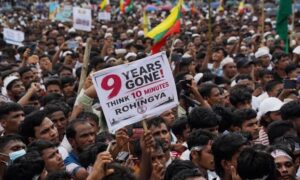
Bangladesh: On Tuesday, August 25, 2026, tens of thousands of Rohingya refugees gathered under heavy monsoon skies in the sprawling camps of Ukhiya and Teknaf in Cox’s Bazar to mark nine years since their mass expulsion from Myanmar’s Rakhine State. What they call “Rohingya Genocide Remembrance Day” was marked by rallies, special prayers for the dead, and emotional testimonies from survivors of the 2017 crackdown.
According to the UNHCR, as of April 13, 2026, some 1,189,213 Rohingya are now sheltering in Bangladesh, making Cox’s Bazar the world’s largest refugee settlement spread over 8,000 acres. Nearly all of them fled after August 25, 2017, when Myanmar’s military, or Tatmadaw, launched brutal “clearance operations” following attacks by the Arakan Rohingya Salvation Army. The refugees brought harrowing accounts of mass killings, systematic sexual violence, and the burning of hundreds of villages, often with families locked inside.
Organizers from the United Council of Rohingya and other camp-based groups said the commemoration was not just about mourning but about renewing political demands. Speaking to a large gathering at Kutupalong, organizer Master Syed Ullah said, “We do not want to remain refugees forever. We want to return to our own land in Rakhine, Myanmar.” Other leaders echoed that any future return must be voluntary, safe and dignified, with guarantees of full citizenship, freedom of movement, security, and return to original villages, not to fenced camps.
The frustration is growing because no large-scale repatriation has succeeded in nine years. Bangladesh attempted to start repatriation at least twice, in 2018 and 2019, but no refugee agreed to board the buses, citing lack of safety guarantees and citizenship. Dhaka has reiterated it will not force anyone to return. “We have been waiting for nine years. A generation of our children is growing up in the camps,” said Rohingya leader Master Shoaib. Many children born after 2017 have never seen Myanmar and know their ancestral homeland only through stories.
Myanmar Meitei Kathe Body MIDA Rejects Links to Manipur, Slams Junta-Allied Meitei Militants
Life in the camps has become increasingly precarious. Humanitarian funding cuts in 2025-26 reduced food rations, while insecurity, fires, floods, and restricted education and livelihood opportunities have left the youth in limbo. Recent fighting between Myanmar’s military and the Arakan Army in Rakhine has further complicated any prospect of return, with reports that Rohingya remaining inside Myanmar are again caught in the crossfire and facing fresh displacement.
The anniversary comes just seven months after a landmark moment for justice. From January 12 to 29, 2026, the International Court of Justice (ICJ) in The Hague held full merits hearings in the case filed by The Gambia in November 2019 accusing Myanmar of violating the 1948 Genocide Convention. It was the first genocide case heard in full by the World Court in more than a decade.
The Gambia’s Justice Minister Dawda Jallow told the court, “It is not about esoteric issues of international law. It is about real people, real stories and a real group of human beings. They have been targeted for destruction.” Gambia presented documentary evidence, expert testimony, and for the first time in an interstate ICJ proceeding, closed-door testimonies from Rohingya victims themselves, including survivors of sexual violence supported by the NGO Legal Action Worldwide.
Myanmar, now ruled by the military junta that overthrew Nobel laureate Aung San Suu Kyi in 2021, continued to deny genocide. Its delegation led by the Minister of International Cooperation told the court that the 2017 operations were a legitimate counter-terrorism operation against militants and did not amount to genocidal intent. In 2019, Aung San Suu Kyi herself had appeared in The Hague and called Gambia’s claims “incomplete and misleading.”
Legal experts say the case could set major precedents. A UN fact-finding mission in 2018 had already concluded there were reasonable grounds to believe genocidal acts, crimes against humanity and war crimes had been committed. In January 2020, the ICJ had ordered provisional measures directing Myanmar to prevent genocidal acts and preserve evidence, and in July 2022 it rejected Myanmar’s jurisdictional objections. Eleven states have intervened in support of Gambia’s interpretation.
In April 2026, Bangladesh’s Foreign Minister Khalilur Rahman said the government expects a verdict soon, noting that written and oral hearings have been completed. The outcome will not only determine Myanmar’s responsibility, cessation of persecution, and reparations, but is also being closely watched for its implications for other ongoing ICJ cases, including South Africa’s genocide case against Israel over Gaza.
For now, in Cox’s Bazar, the demand remains unchanged. Refugees shouted slogans demanding justice and citizenship, holding placards reading “We want to go home” and “Citizenship is our right.” Mother-of-two Janifa Begum, who testified before the European Parliament via video link earlier this year, said from Kutupalong, “We want to see whether the suffering we endured is reflected during the hearing. We want justice and peace.”
As prayers concluded on Tuesday evening, community elders warned that without a political solution inside Rakhine, recognition of Rohingya as an ethnic group of Myanmar, and international guarantees for protection, the world’s largest refugee camp will enter its tenth year — with a new generation growing up stateless.