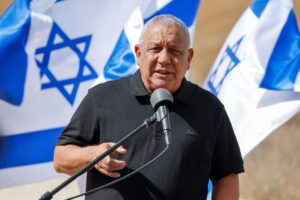
Songpi/Tel Aviv: Israel has entered a new and uncertain political phase after President Isaac Herzog formally asked Gadi Eisenkot, the main challenger to Prime Minister Benjamin Netanyahu, to attempt to form the country’s next government. The decision, announced on Saturday, came after days of consultations following the October general election, the first national vote since the Hamas attack of October seven, twenty twenty-three. Neither Netanyahu nor Eisenkot secured enough seats to govern alone, leaving the country facing the prospect of prolonged negotiations or even another election if talks fail.
Netanyahu, Israel’s longest-serving prime minister, remains the leader of the single largest party. His Likud party won twenty-seven seats in the one hundred and twenty-member Knesset. His wider religious-nationalist bloc, however, fell short of power, winning only fifty-three seats in total, eight seats below the sixty-one needed for a majority. The result was a major blow to a coalition that had governed with a comfortable majority before the election, and it signalled growing public dissatisfaction with his leadership, his handling of the war in Gaza, and his alliance with far-right partners.
Eisenkot, a sixty-six-year-old former chief of staff of the Israel Defense Forces, emerged as the central figure of the opposition. His new centrist party, Yashar, won twenty-one seats, making it the second-largest party in parliament. Together with three other Jewish-led parties ranging from the centre-left to the right, his bloc won forty-eight seats. While that total is still short of a majority, he received the highest number of recommendations from newly elected lawmakers, largely because Arab parties decided to back him as the candidate most likely to end Netanyahu’s rule.
The role of the Arab parties has become one of the most striking features of this election. Two parties representing Israel’s Arab minority, who make up about one-fifth of the population, won a combined nineteen seats, an unprecedented result. Their leaders have said they are deeply opposed to Netanyahu and his far-right allies, whom they accuse of pursuing racist policies. Although Eisenkot has ruled out a formal coalition with Arab parties, their decision to nominate him gave him the momentum to be chosen first by the president.
In accepting the mandate, Eisenkot said the moment demanded a broad national emergency government. In a short message posted on X, he promised to do everything possible to prove worthy of the task. He now has twenty-eight days to negotiate a coalition, with the possibility of a fourteen-day extension if he shows progress. If he fails, the president can ask another lawmaker to try, and parliament itself can nominate a candidate. The entire process can last about one hundred days before Israel would be forced to hold yet another election.
Eisenkot faces three main but difficult paths to power, none of which analysts consider likely at present. The first is to lead a minority government that relies on Arab parties for support on key votes without formally including them in the cabinet. The second is to strike a deal with ultra-Orthodox parties, groups he and his allies have avoided in the past over issues of military service and state funding. The third is to form a unity government with Netanyahu himself, an option Eisenkot has repeatedly rejected in public.
The former general is a relatively new figure in politics, having entered parliament only in twenty twenty-two. He is known as reserved and media-shy, a sharp contrast to Netanyahu’s decades of polished political campaigning. He briefly served in Netanyahu’s wartime cabinet after the October seven attack, but later left to join the opposition, where he became one of the prime minister’s fiercest critics. He accused Netanyahu of failing to manage the war in Gaza effectively and of putting his own political survival ahead of national security.
Eisenkot’s personal story has also shaped his public image. He is the son of Moroccan Jewish immigrants and would become Israel’s first prime minister from the Mizrahi community, Jews whose families came from the Middle East and North Africa. His family has paid a heavy price in the current war. His son and two nephews were killed while fighting in Gaza, a loss that has given his criticism of the war’s conduct a particular moral weight in the eyes of many Israelis.
On security, Eisenkot is no dove. As a military commander during the two thousand and six war with Hezbollah in Lebanon, he advocated the so-called Dahiyeh doctrine, the use of overwhelming and disproportionate force in response to attacks on Israel. During the election campaign, he emphasised that experience as proof he could protect the country. At the same time, he has sharply criticised violence by Jewish settlers against Palestinians in the West Bank, which has increased sharply since twenty twenty-three and damaged Israel’s relations with Western allies.
He has also positioned himself firmly against Netanyahu’s far-right coalition partners, Itamar Ben-Gvir and Bezalel Smotrich, both of whom have faced sanctions from some Western countries for inciting violence against Palestinians. Whether Eisenkot can turn his personal standing and the desire for change into a working government remains uncertain. For now, Israel faces weeks of bargaining that will test whether its deeply divided parliament can produce a stable coalition or whether voters will soon be asked to return to the polls once again.