Songpi: The Haokip Youth Organisation (HYO-GHQ) has issued a detailed response to the press release of the Thadou Tribe Council dated 16th November 2026, which was itself a reply to HYO’s earlier statement of 15th November 2026. In its latest statement, Ref No: HYO/GHQ/PR-08/2026, dated 17th November 2026, HYO said it had carefully read the Council’s full release and was responding in a spirit of truth, respect for elders, and brotherhood. It said there is no hatred in its response, and that it carries the true history of the forefathers. The organisation said the Council had tried to justify the projection of Thadou as a tribe by citing government gazette notifications, census figures, and colonial writings. That justification, HYO said, is rejected completely. Identity, lineage, and history cannot be decided by a government order or by the writings of outsiders. Identity comes from forefathers, from oral history, genealogy, and clan tradition preserved for generations. The response, it said, is issued to place the truth on record and to prevent further confusion, division, and disunity among brothers and sisters.
HYO asserted in clear terms that Thadou is one hundred percent a clan, not a tribe. This, it said, is the original historical record from the forefathers, not a story created by government or by foreign writers. In the Shongthu lineage, Thadou is the youngest clan. This order of lineage has been known, taught, and respected by elders from generation to generation. It is preserved in folk tales, genealogical accounts, clan names, village histories, and customary practices. To call Thadou a tribe, HYO said, is to erase this lineage and to distort the true structure of the people. A clan cannot become a tribe merely because it is written in a book or notified in a gazette. A government gazette cannot create a tribe, nor can it change a clan into a tribe. The forefathers knew who they are, and HYO said it stands by their record. It has a unique and independent historical record of its own, and that record is the true foundation of identity.
The organisation rejected the colonial record as the final authority on identity. The Council, it noted, cites Carey and Tuck, Grant Brown, Hodson, Shakespear, Shaw and Hutton, Webster, and Reid to claim that Haokips were placed under Thadou. These writers, HYO said, were outsiders. They came for administration, for war, for census, and for revenue. They did not sit with elders to learn genealogy. They heard one name and wrote it for all. They grouped many different clans under one convenient name for administration. Counting people together for census does not make them one tribe. A census counts administrative groups, not genealogy. The census figures from 1881 to 1931 only prove that the British needed one name for administration. When they wrote that Haokip is merely a family of Thadou, they were writing their own misunderstanding, not history. Elders never said Haokip is under Thadou. Elders said Haokip is the elder brother, and Thadou is the younger brother. No foreign book can reverse the order of brothers.
On the question of Elmun and Thadou, HYO said the claim that Thadou is the youngest clan is not a controversy, it is truth. In the true Shongthu genealogy preserved by Haokip elders, Thadou is the youngest clan. Haokip and Kipgen are the elder brothers of Thadou. This is clear, consistent, and taught for generations. If some lineages today recite a different order, that is because of confusion created by British writings and by government listing. Confusion created in the last one hundred years cannot erase truth preserved for hundreds of years. Thado and Thadou are the same, the difference is only in pronunciation. Elmun and Thadou are the same. Thadou is Elmun and Elmun is Thadou. Foreign writers did not know this, HYO said, and that is why they wrote Elmun and Thadou as if they were two different things, creating confusion in genealogy.
HYO further pointed out that the Council itself admits there is another earlier Thadou, and that Thadou would include many other groups. This admission, it said, proves that the word Thadou has been used in many confused ways by writers. The Council mixes two Thadous, the earlier ancestor and the later youngest clan, and that confusion cannot change the Shongthu order. Genealogy, according to HYO, proves that the elder Thadou died with no children. The younger Thadou has six sub-clans. They are Singson, Lhouvum, Sitlhou, Lhoujem, Thomsong and Singsit. HYO asked how it is possible that the name of a person with no children can be used as a genealogy name and as a tribe.
On the Kipgen declaration of 2020, HYO said the Council’s claim that Kipgen declared themselves Thadou cannot be accepted as genealogy. That acceptance, it said, was not genealogy, it was the political game of some militant leaders and some MLAs. One public notice by some persons cannot change genealogy. Genealogy is not decided by notice. Genealogy is not decided by militant leaders. Genealogy is not decided by MLA politics. Genealogy is decided by forefathers. This kind of change, HYO said, is totally false and against genealogy. Kipgen is Kipgen. Haokip is Haokip. Thadou is Thadou. Each has its own place.
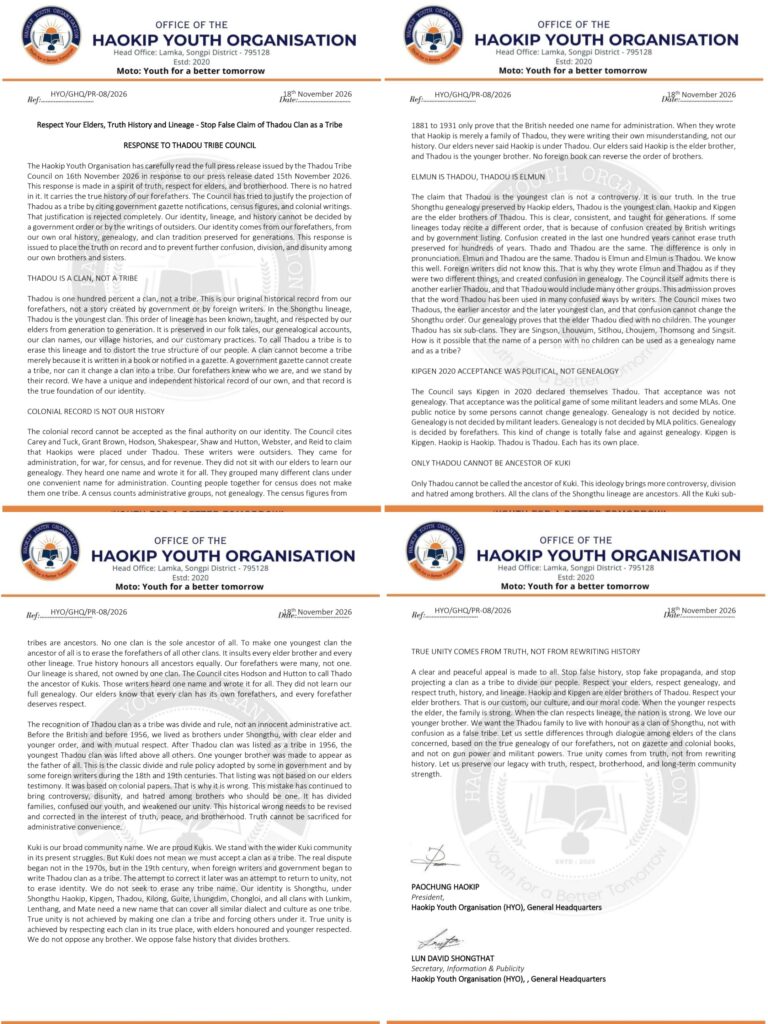
File Photo: Haokip Youth Organisation (HYO), General Headquarters, Lamka, issues a 4-page press release dated 18th November 2026 — Ref: HYO/GHQ/PR-08/2026 — t itled “Respect Your Elders, Truth History and Lineage – Stop False Claim of Thadou Clan as a Tribe” in response to the Thadou Tribe Council’s press release of 16th November 2026.
Haokip Youth Organisation (HYO), General Headquarters, Lamka, issues a 4-page press release dated 18th November 2026 — Ref: HYO/GHQ/PR-08/2026 — titled “Respect Your Elders, Truth History and Lineage – Stop False Claim of Thadou Clan as a Tribe” in response to the Thadou Tribe Council’s press release of 16th November 2026.
Haokip Youth Organisation (HYO), General Headquarters, Lamka, issues a 4-page press release dated 18th November 2026 — Ref: HYO/GHQ/PR-08/2026 — titled “Respect Your Elders, Truth History and Lineage – Stop False Claim of Thadou Clan as a Tribe” in response to the Thadou Tribe Council’s press release of 16th November 2026.
HYO also rejected the idea that only Thadou can be called the ancestor of Kuki. This ideology, it said, brings more controversy, division and hatred among brothers. All the clans of the Shongthu lineage are ancestors. All the Kuki sub-tribes are ancestors. No one clan is the sole ancestor of all. To make one youngest clan the ancestor of all is to erase the forefathers of all other clans. It insults every elder brother and every other lineage. True history honours all ancestors equally. Forefathers were many, not one. Lineage is shared, not owned by one clan. The Council cites Hodson and Hutton to call Thado the ancestor of Kukis. Those writers, HYO said, heard one name and wrote it for all. They did not learn the full genealogy. Elders know that every clan has its own forefathers, and every forefather deserves respect.
The organisation said the recognition of Thadou clan as a tribe was divide and rule, not an innocent administrative act. Before the British and before 1956, people lived as brothers under Shongthu, with clear elder and younger order, and with mutual respect. After Thadou clan was listed as a tribe in 1956, the youngest Thadou clan was lifted above all others. One younger brother was made to appear as the father of all. This, HYO said, is the classic divide and rule policy adopted by some in government and by some foreign writers during the 18th and 19th centuries. That listing was not based on elders’ testimony. It was based on colonial papers. That is why it is wrong. This mistake has continued to bring controversy, disunity, and hatred among brothers who should be one. It has divided families, confused youth, and weakened unity. This historical wrong needs to be revised and corrected in the interest of truth, peace, and brotherhood. Truth cannot be sacrificed for administrative convenience.
HYO said Kuki is the broad community name. It said, “We are proud Kukis. We stand with the wider Kuki community in its present struggles.” But Kuki, it added, does not mean accepting a clan as a tribe. The real dispute began not in the 1970s, but in the 19th century, when foreign writers and government began to write Thadou clan as a tribe. The attempt to correct it later was an attempt to return to unity, not to erase identity. HYO said it does not seek to erase any tribe name. Its identity is Shongthu, under Shongthu Haokip, Kipgen, Thadou, Kilong, Guite, Lhungdim, Chongloi, and all clans with Lunkim, Lenthang, and Mate need a new name that can cover all similar dialect and culture as one tribe.
True unity, HYO argued, is not achieved by making one clan a tribe and forcing others under it. True unity is achieved by respecting each clan in its true place, with elders honoured and younger respected. It said it does not oppose any brother. It opposes false history that divides brothers.
In its concluding appeal, HYO called for an end to false history, fake propaganda, and the projection of a clan as a tribe to divide the people. It urged all to respect elders, respect genealogy, and respect truth, history, and lineage. Haokip and Kipgen are elder brothers of Thadou. Respect your elders. That is custom, culture, and moral code. When the younger respects the elder, the family is strong. When the clan respects lineage, the nation is strong. HYO said it loves its younger brother and wants the Thadou family to live with honour as a clan of Shongthu, not with confusion as a false tribe.