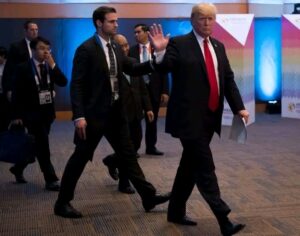
Manila: President Donald Trump touched down in Manila on Tuesday morning, kicking off a high-stakes three-day tour of Asia that the White House hopes will shift attention away from a difficult stretch at home. Air Force One landed at Ninoy Aquino International Airport, where Trump inspected an honor guard, pumped his fist, and waved small American and Philippine flags handed to him by a child. A marching band played “YMCA” as he walked toward a waiting helicopter, setting a celebratory tone for a visit packed with summits, trade signings, and delicate diplomacy. It is his first trip abroad since his party suffered heavy losses in the midterm elections.
Manila is only the first stop. After the Philippines, Trump is scheduled to travel to China for what could be one of the most consequential meetings of his presidency — a historic three-way nuclear discussion with Chinese President Xi Jinping and Russian President Vladimir Putin. Trump has also hinted at a possible meeting with North Korean leader Kim Jong Un. The trip comes at a moment when Washington is still reeling from the sudden departure of Nvidia chief Jensen Huang last week, following his admission of an affair with an alleged Chinese government agent. Beijing has denied any involvement, but the scandal has rattled markets and raised fresh questions about technology, security and U.S.-China trust.
Trump’s arrival in the Philippines was choreographed to showcase America’s oldest treaty alliance in Asia. On Tuesday, he was to be feted as guest of honour at a gala dinner for the annual summit of the Association of Southeast Asian Nations. The evening will include a cocktail reception and dinner with regional leaders, offering Trump a stage to project strength and friendship. For the Philippines, the visit is a chance to reaffirm a partnership that has grown more important as tensions rise in the South China Sea, where Chinese and Philippine coast guard and naval forces have clashed repeatedly over disputed shoals.
At the heart of the ASEAN discussions is a long-running effort to secure a non-aggression pact with China in the contested waterway, one of the world’s most vital trade routes. Beijing claims virtually the entire South China Sea, a claim Washington rejects. The United States has repeatedly said it is obligated to defend the Philippines if Filipino forces come under armed attack. ASEAN leaders are hoping to use this week’s summit to push for deeper trade and security ties, while also addressing other regional crises, including years of violence in Myanmar and the growing rivalry between major powers in the Indo-Pacific.
Trump’s first official meeting on Tuesday was with leaders of the Quad — the United States, Australia, India and Japan. The grouping, which aims to counter China’s influence in the Asia-Pacific, was meeting for the first time since Trump returned to the White House last year. The session was expected to focus on maritime security, supply chains, critical minerals and technology cooperation. For Trump, the Quad offers a platform to show that Washington’s Indo-Pacific strategy remains active, even as he pursues direct talks with both Xi and Putin in the days ahead.
Trade was also high on the agenda. Trump was scheduled to sign a trade deal with Thailand, the kind of agreement he has championed since launching his tariff-led trade war last year. Under a framework announced last October, Thailand agreed to remove tariffs on most American goods and open its markets to U.S. autos, food products and pharmaceuticals. In return, Thailand pledged to spend more than 18 billion dollars on U.S. aircraft and buy American farm goods and liquefied natural gas. The deal comes after the U.S. Supreme Court overturned Trump’s 19 percent tariff on Thai goods in February, and after Washington imposed a new 12.5 percent tax in July over forced labour concerns.
Before the gala dinner, Trump was set to join a special summit with ASEAN leaders, where trade, security and regional conflicts were expected to dominate. The leaders were to discuss ways to deepen economic integration, strengthen defence cooperation and find a path to peace in Myanmar. The South China Sea dispute, in particular, remains a flashpoint, with smaller Southeast Asian nations caught between their economic ties to China and their security partnership with the United States. Trump’s presence at the table was seen as a signal that Washington intends to remain engaged in the region.
Not everyone in Manila welcomed the visit. About 1,500 left-wing protesters gathered in a noisy rally at Liwasang Bonifacio square ahead of Trump’s arrival, waving red flags and holding a large streamer that read, “Resist U.S. war and plunder!” Riot police with shields and wooden truncheons stood nearby as demonstrators planned to burn an effigy of Trump. Protest leader Teddy Casiño called on the Marcos administration to stop being a puppet of Washington and uphold an independent foreign policy. He described Trump as a loser and urged Philippine leaders not to take their foreign policy cues from the United States.
On Wednesday, Trump is set to receive a full red-carpet welcome and military honours from President Ferdinand Marcos Jr. at Malacanang presidential palace, followed by a state banquet. The two leaders are expected to reaffirm their countries’ longstanding treaty alliance and discuss defence, trade and regional security. Officials are also arranging a possible brief reunion with former first lady Imelda Marcos, now 97 and using a wheelchair, if her doctors allow it. Trump has long asked about her health, and Marcos Jr. once carried a note from his mother thanking Trump for his strong backing of the Philippines.
Before leaving for Shenzhen, China, for the Asia-Pacific Economic Cooperation summit, Trump is also expected to announce a series of commercial deals and investments in aviation, defence, energy and technology. The announcements are meant to show that the trip is delivering concrete results for American workers and businesses. Yet the real test will come in China, where nuclear talks with Xi and Putin could reshape global security. For now, Manila has given Trump the warm welcome, the pageantry and the diplomatic stage he wanted — a brief pause from troubles at home and a chance to write a new chapter in Asia.