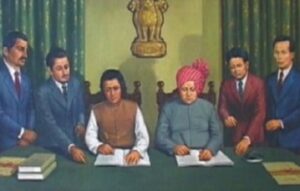
On 21 September 1949, Maharaja Bodhchandra Singh of Manipur signed the Manipur Merger Agreement at Shillong with V.P. Menon, Advisor to the Government of India, Ministry of States. The agreement stated that the Maharaja ceded to the Dominion Government “full and exclusive authority, jurisdiction and powers for and in relation to the governance of the State,” effective 15 October 1949. He retained his personal properties, titles, and religious rights and received a privy purse of Rs 3 lakh per year. The signing ended Manipur’s status as a princely state under British paramountcy since 1891.
The merger agreement covered the territory under the Maharaja’s direct rule. That territory was the valley area of Manipur, measured at 700 sq. miles or 26,500 paris/hectares. The hill areas surrounding the Imphal valley were occupied, ruled, and administered by tribal chiefs. The powers and authorities of the tribal chiefs were supreme in the land of the tribes. They were the lords of the soil within the territory they occupied. They collected taxes and levies from their subjects independently. The Maharaja of Manipur was not a tribal representative, and the hill communities were not his subjects.
The Instrument of Accession signed on 11 August 1947 and the Merger Agreement signed on 21 September 1949 did not cover the hill areas, which had been administered as a separate entity. After the Anglo-Manipur War of 1891, the British reorganised the administration. The Manipur State Darbar exercised authority in the valley, while the hills were placed under the Political Agent.
The 1907 “Rules for the Management of the Hill Tribes” and the “Manipur State Hill Peoples Regulation, 1947” vested land, forest, and village administration in chiefs under the supervision of the President of the Manipur State Darbar. This created a dual administrative structure within the princely state. The Manipur State Constitution Act, 1947 established an elected legislature, but Section 9 reserved “Hill Administration” as a special responsibility of the Maharaja acting with the Hill Commissioner. Hill governance functioned under a separate framework.
The text of the 1949 Merger Agreement does not record survey boundaries of “the State.” Records compiled in
Territorial Rights of Outer Manipur Tribals state that the area of Manipur under the merger was 700 sq. miles. Annexure-Y records the hill areas as a separate entity at the time of accession. The Government of India’s 1950 White Paper on Indian States listed Manipur’s area as 8,628 sq. miles, which includes both valley and hills.
Chieftainship in the hill areas was hereditary and tied to land. Chiefs collected lousal or house tax, managed jhum cultivation, and allotted village land. British records such as the Judicial Files of 1917 and the Robertson Tour Diary of 1933 documented the chiefs’ rights. The merger agreement extinguished the Maharaja’s authority, rights, and privileges over the territory he ceded.
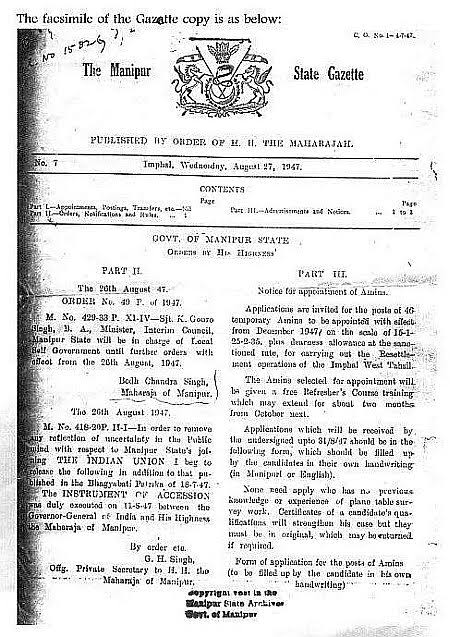
File Photo: The Manipur State Gazette 27 August 1947, recording the Instrument of Accession signed between the Maharaja of Manipur and the Governor-General of India on 11 August 1947
On 21 September 1949, Maharaja Bodhchandra Singh of Manipur signed the Manipur Merger Agreement at Shillong with V.P. Menon, Advisor to the Government of India, Ministry of States. The agreement stated that the Maharaja ceded to the Dominion Government “full and exclusive authority, jurisdiction and powers for and in relation to the governance of the State,” effective 15 October 1949. He retained his personal properties, titles, and religious rights and received a privy purse of Rs 3 lakh per year. The signing ended Manipur’s status as a princely state under British paramountcy since 1891.
From 15 October 1949, the Government of India administered Manipur as a Part-C state under a Chief Commissioner. The States Reorganisation Act, 1956 made Manipur a Union Territory. Article 371C was inserted by the 27th Amendment in 1971, creating a Hill Areas Committee in the Manipur Legislative Assembly. The Manipur Land Revenue and Land Reforms Act, 1960 states in Section 158 that it shall not apply to the hill areas except as directed. These provisions were applied to the hill areas after 1949.
The records show two administrative frameworks existed before 1949: the Maharaja’s direct rule in the valley and chieftainship in the hills under British supervision. The sovereignty and independence of Manipur as a princely state ended on the date the Maharaja signed the agreement.