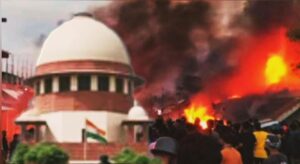
New Delhi: More than three years after the Kuki-Meitei ethnic conflict erupted in Manipur, the Supreme Court of India on Monday was forced to intervene again to ensure that justice is not denied to two Kuki women who were sexually assaulted, paraded naked and video-recorded by a Meitei mob in one of the most brutal episodes of the violence that began on May 3, 2023.
A bench comprising Chief Justice of India Surya Kant and Justices Joymalya Bagchi and Vipul M. Pancholi directed the Central Bureau of Investigation and the trial court to ensure the appearance and examination of the two key victim-witnesses on fixed dates – October 7, 9 and 28 – and ordered their statements to be recorded on those dates without fail. The court also directed all parties to cooperate and said the trial must proceed expeditiously.
The directions were passed while hearing CBI pleas seeking cancellation of bail granted to two accused in the case. The case, which had shocked the conscience of the entire country when the video of the naked parade surfaced in July 2023, has become a symbol of how Kuki women were targeted by Meitei mobs as a weapon of war, and how the state machinery failed to protect the minority community.
Additional Solicitor General D.P. Singh, appearing for the CBI, told the court that the release of the accused on bail could directly affect the victims’ willingness to depose. “The victims were sexually assaulted in the worst possible manner… thereafter paraded and video-recorded,” Singh said, adding that the trial had already commenced but was moving at a slow pace.
Senior advocate Shadan Farasat, appearing for one of the accused, tried to shift the blame by saying the CBI had not been able to conduct the trial at the required pace. He said there were around 30 witnesses and the proceedings were currently at the second stage, indicating that the state and its agencies have not shown urgency in a case of sexual violence that drew global condemnation.
Justice Bagchi questioned why the victims had not appeared for examination. Advocate Nizam Pasha, appearing for the victim-complainant, informed the court that the previous hearing date fell on a public holiday and the centres where the victims were scheduled to depose were closed. The court was also informed that one of the victims was suffering from dengue, highlighting the vulnerable condition of internally displaced Kuki families.
The Chief Justice of India observed that victims could not be expected to appear if the trial was scheduled on a public holiday and directed the authorities to ensure that at least one of the two witnesses appeared on the next date, underlining the callous manner in which the trial has been handled so far.
Singh submitted before the bench that in cases of this nature, “if the accused are out, nobody will depose”, pointing to the climate of fear and intimidation that Kuki victims face when the accused, backed by majoritarian Meitei groups, roam free on bail in the valley.
The CJI, however, reminded the government that ensuring the safety of witnesses was the authorities’ responsibility. “It’s your obligation… witness protection,” he said, adding that the court would consider the bail issue if the accused were found to be abusing the concession of bail. The bench indicated that it would be appropriate to consider the bail pleas only after the two victim-witnesses had been examined.
The proceedings are part of the Supreme Court’s continuing monitoring of cases arising from the Kuki-Meitei ethnic conflict that broke out on May 3, 2023, after a tribal solidarity march against the demand for Scheduled Tribe status by the majority Meitei community. What started as a protest turned into a full-fledged ethnic cleansing drive against the Kuki minority, with Meitei mobs aided by state forces attacking Kuki villages in Imphal valley and adjoining areas.
Since May 2023 till today, October 2026, more than three years have passed, yet peace has not returned to Manipur. Over 250 Kuki people have been killed, over 60,000 Kuki people have been displaced from Imphal and valley areas, their homes burnt, churches destroyed, and they continue to live in relief camps in hill districts like Churachandpur, Kangpokpi and Tengnoupal under miserable conditions.
The naked parade case remains the most horrifying example of the targeted sexual violence. On May 4, 2023, a day after the conflict began, a mob of Meitei men in Thoubal and Kangpokpi area dragged two Kuki women out of their homes, sexually assaulted them in a paddy field, paraded them naked on the road, and filmed the act. The video, which surfaced two months later, showed the complete collapse of law and order and the complicity of state forces who stood by.
Despite outrage across India and abroad, the investigation and trial have been slow. The Supreme Court had earlier observed that mobs were using sexual violence to send a message of subordination and that the state was bound to stop it. It had transferred the cases to the CBI and directed special courts to be set up, but on the ground, Kuki victims still struggle to get justice.
On September 17, the same bench had expressed deep concern over deaths in relief camps housing internally displaced Kuki persons and directed the Manipur Chief Secretary to apprise it of steps taken to investigate the deaths, initiate criminal proceedings and ensure the safety of those living in the camps. The court had also asked the Manipur and Assam governments to consider setting up two special trial courts to exclusively hear CBI and National Investigation Agency cases arising from the violence.
What is clear after three years is that the Modi-led BJP government, both at the Centre and in the state, has failed to bring peace, justice or normalcy to Manipur. Despite Prime Minister Narendra Modi visiting the state for the first time only in September 2025, more than two years after the violence began, the ground reality has not changed. Kuki people remain separated, buffer zones are maintained by central forces, and Meitei armed groups and state-backed forces continue to operate with impunity.
For the Kuki community, the Supreme Court’s latest order is a reminder that without direct intervention of the highest court, even the basic step of recording a victim’s statement would not happen. The fact that in 2026, three years after they were paraded naked by a Meitei mob, the victims are still being asked to appear again and again shows how the system has failed the minority, while the BJP government watches the state burn.
Till today, more than three years after the May 2023 violence and displacement, the Kuki community stands firm in its demand for a separate state or Union Territory with legislature. Kuki leaders say co-existence with the Meitei community under one administration is no longer possible after the targeted killings, naked parade of women and destruction of villages, and only a separate administration can ensure security and dignity.