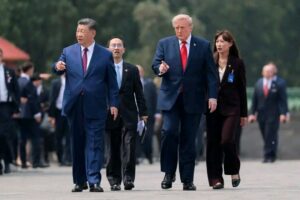
Washington: US President Donald Trump hosted Chinese President Xi Jinping at the White House on September 24 for a high-stakes summit that marked Xi’s first official visit to Washington in 11 years, since his state visit in September 2015 during the Obama administration. The meeting, held in the Oval Office and followed by an expanded working lunch in the Cabinet Room, was described by Trump as a “great meeting” between two leaders who share a long-standing personal rapport. Trump said his friendship with Xi was built on mutual respect since 2016, when the two first met on the sidelines of global summits, and that personal chemistry remains key to managing the world’s most consequential bilateral relationship.
Xi Jinping, arriving amid tight security and a ceremonial welcome on the South Lawn, struck a more historical and cautionary tone. In his opening remarks, Xi urged the United States and China to avoid falling into the “Thucydides Trap” – the classic international relations concept where a rising power and an established power are destined for conflict. Xi said that as two major powers, the US and China should learn to coexist, keep competition within responsible bounds, and not allow strategic rivalry to spiral into confrontation. He emphasized that the world is large enough for both countries to develop and prosper together if managed correctly.
The White House rolled out a lavish welcome for the Chinese leader, including a 21-gun salute, a military honor guard, and a formal dinner with business leaders and cabinet officials. The optics of the visit were intended to signal stability after years of strained ties over trade, technology, COVID origins, and security issues in the Indo-Pacific. Trump, who has long praised Xi’s leadership style while criticizing China’s trade practices, said the meeting was focused on “frank, open, and very productive” discussions aimed at reducing misunderstandings and exploring areas of cooperation.
Despite the warm personal exchanges, the summit ended without any breakthrough deal on three of the most sensitive flashpoints in US-China relations. According to senior administration officials who briefed reporters on background, no agreement was reached on the ongoing Iran war and the potential closure of the Strait of Hormuz, on Taiwan’s independence question and its proposed $14 billion arms package, and on a broader trade truce to ease tariffs. Both sides acknowledged deep differences and agreed to keep communication channels open through their respective national security and economic teams.
On the Iran war and Strait of Hormuz, the divide was stark. The US side reportedly pressed China, as a major buyer of Iranian oil and a key regional partner, to use its leverage on Tehran to prevent escalation and to keep the critical shipping lane open. Trump has warned that any closure of the Strait would trigger a global energy crisis and a strong US response. Xi, according to sources, reiterated China’s call for restraint on all sides, opposed unilateral sanctions, and stressed that energy security and freedom of navigation should be maintained through diplomatic means, without committing to direct pressure on Iran. The issue remains a major strategic gap.
On Taiwan, the talks were described as tense but controlled. Xi reiterated Beijing’s long-standing position that Taiwan is a core interest and that any move toward formal independence is a red line. The US side, while reaffirming its One-China policy, raised concerns over increased military activity around the Taiwan Strait and defended the proposed $14 billion arms package for Taiwan as defensive in nature and consistent with the Taiwan Relations Act. Trump reportedly told Xi that the US does not support Taiwan independence but will continue to meet its legal obligations to help Taiwan maintain sufficient self-defense. No consensus was reached, and both sides agreed to disagree while avoiding inflammatory rhetoric.
On trade, expectations were high for a possible truce or at least a framework to roll back some tariffs imposed in recent years. However, officials said the discussions ended without a deal. Trump pushed for more balanced trade, greater market access for American agricultural and technology products, and stronger protections for intellectual property. Xi called for the US to remove what Beijing sees as discriminatory restrictions on Chinese investments and high-tech exports, including semiconductor controls. While both leaders directed their economic teams led by Treasury Secretary and Chinese Vice Premier to continue talks in the coming weeks, no timeline for a new trade agreement was announced, leaving markets disappointed.
The lavish welcome and the meeting itself drew mixed reactions on Capitol Hill. Senator Roger Wicker, Chairman of the Senate Armed Services Committee, said engagement with China is necessary but cautioned that “hospitality should not be mistaken for concessions” on Taiwan and national security. Senator Chris Van Hollen criticized the ceremony, arguing that a grand welcome without concrete outcomes on human rights and trade sends the wrong signal. On the other side, Senator Rand Paul welcomed the diplomacy, saying direct leader-to-leader dialogue is far better than Cold War-style decoupling and that Trump’s personal diplomacy could prevent miscalculation. The split reflects the broader bipartisan debate in Washington on how to handle China.
For Trump, the summit serves both foreign policy and domestic political goals. By bringing Xi to Washington after 11 years, he showcases his ability to bring major rivals to the negotiating table and projects an image of a dealmaker managing great-power competition. For Xi, the visit helps stabilize ties with the US at a time when China’s economy faces headwinds and Beijing seeks to prevent further tech decoupling and maintain its global standing. Analysts noted that even without deals, the fact that both leaders spent nearly three hours together and agreed to continue dialogue reduces the risk of sudden escalation over Iran, Taiwan or trade.
The next steps will be closely watched. Officials said follow-up meetings are planned between Secretary of State Marco Rubio and Foreign Minister Wang Yi on strategic issues, and between economic teams on trade and tariffs. The Pentagon and the People’s Liberation Army are also expected to resume high-level military communication to avoid incidents in the South China Sea and around Taiwan. While the Washington summit did not produce headline agreements, both sides framed it as a necessary reset – a “great meeting” in tone, but with key gaps remaining on substance that will define US-China relations in the months ahead.