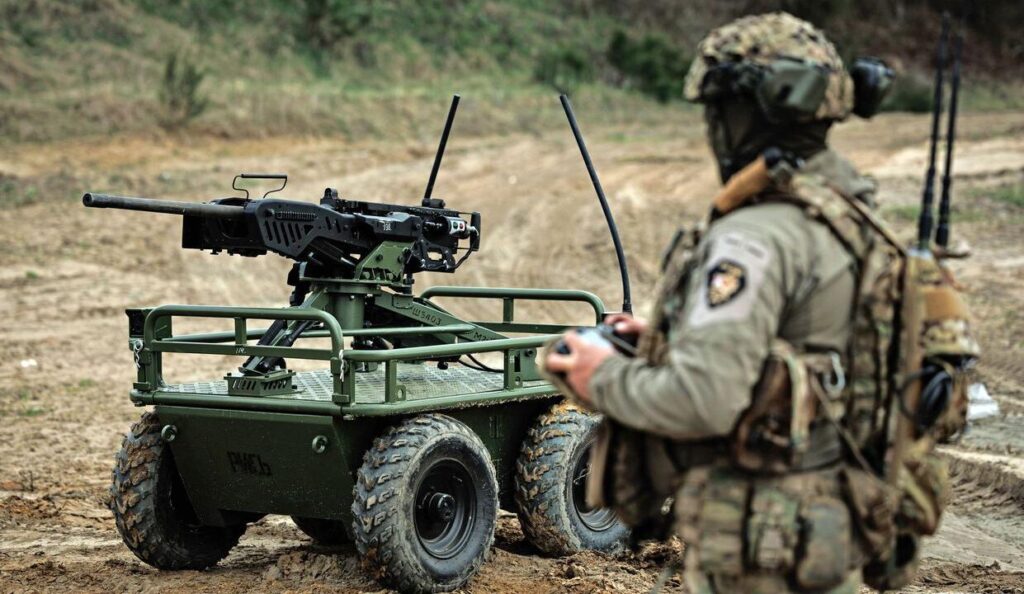
By: Kukiland Express DeskUpdated: April 20, 2026The moment looked like every battlefield surrender in history. Two soldiers, arms raised, stepping slowly under shouted orders from their captors. But the front line near Kharkiv last summer held one crucial difference: no human troops were in sight. The two Russian soldiers were yielding to Ukrainian land robots and an overhead drone, all steered by a pilot operating from a bunker miles away.For Mykola “Makar” Zinkevych, commander of the “NC13” unit in Ukraine’s Third Separate Assault Brigade, the operation marked a turning point. “The position was taken without a single shot being fired,” he told CNN. Zinkevych’s team handles ground-based robotic strike systems, and he claims the mission was the first time an enemy trench was stormed and prisoners taken by land robots and drones alone, with no infantry involved. While independent verification is difficult in wartime, the claim reflects Kyiv’s growing confidence in unmanned warfare.What began as an experiment has become routine. Zinkevych said missions where robots replace infantry are now “daily bread and butter” for his unit. The shift is driven by necessity as much as innovation. Ukraine’s military is far smaller than Russia’s, and after more than four years of war, commanders are under pressure to reduce casualties while still holding a 1,000-kilometer front.The sky above eastern Ukraine has been thick with aerial drones since 2022, making any movement near the front lines lethal. In response, Ukrainian engineers pushed development of land drones — tracked or wheeled vehicles ranging from small carts to car-sized platforms — that can crawl through shell craters and tree lines where humans would be spotted instantly. Early models ferried ammunition and dragged wounded soldiers to safety. Now they carry machine guns, grenade launchers, and anti-tank weapons.Land drones have clear advantages over both soldiers and aircraft. They are harder to detect than armored vehicles, immune to rain and fog that ground aerial drones, and can haul payloads of several hundred kilograms. Battery life is another edge. The Third Army Corps reported late last year that a single machine-gun-equipped robot held off repeated Russian probes on one position for 45 days, requiring only minor maintenance and a battery swap every 48 hours.“We must understand that we will never have more personnel, and we will never have a numerical advantage over the enemy,” Zinkevych said. “So, we need to achieve this advantage through technology.” His unit’s target for 2026 is blunt: replace one-third of frontline infantry with drones and robots.President Volodymyr Zelensky put numbers to the trend last Tuesday. In a speech highlighting Ukraine’s military tech sector, he said drones and robots had carried out more than 22,000 missions in the past three months. “Lives were saved more than 22,000 times when a robot went into the most dangerous areas instead of a warrior,” Zelensky said, framing the program as both tactical and humanitarian.Military analysts say the shift is real, but with limits. Robert Tollast, a land warfare expert at the Royal United Services Institute in London, said Ukraine’s advances “will fuel a furious debate about whether these robots are the future of warfare or not.” He doubts ground drones can hold territory alone, comparing it to sending tanks in without infantry. Yet he stressed they are “regularly saving the lives of soldiers in casualty evacuation, dangerous resupply missions, mine clearance and increasingly, fighting.”Tollast added that the conditions in Ukraine — constant aerial surveillance and artillery — make near-front movement “almost deadly” for humans. “Even imagining a future where NATO doesn’t fight quite like Ukraine, it’s almost certain these systems will find many uses in other forces,” he said.Ukraine’s push into robotic warfare accelerated after Mykhailo Fedorov was appointed defense minister in January. Fedorov previously ran the Ministry of Digital Transformation and oversaw Ukraine’s drone warfare rollout. Since taking the defense portfolio, he introduced what the ministry calls a “war plan” to “force Russia into peace” through technology and data. Hundreds of private firms now work under government programs to build, test, and mass-produce aerial and ground drones.On Sunday, Fedorov said his goal is for ground-based robotic systems to handle all frontline logistics eventually — ferrying ammo, food, fuel, and evacuating casualties without risking drivers. The broader strategy blends defense and offense: real-time identification of every aerial threat, a 95% intercept rate for missiles and drones, and a “kill zone” 15 to 20 kilometers deep along the front where unmanned systems operate continuously.The defense ministry said last week that roughly 1,000 crews are already active under this unified program. Each crew can control multiple platforms, meaning the number of robots in the field is several times higher. Zinkevych said scale is now the decisive factor. Russia is behind in ground robotics, he noted, but is adapting quickly and investing heavily to close the gap.“On the battlefield, the decisive factor is not who invented the technology and figured out how to apply it, but who has managed to scale it up over the long term,” Zinkevych said. Ukraine’s edge, for now, comes from a decentralized ecosystem of small manufacturers iterating designs in weeks based on frontline feedback — a speed traditional defense contractors struggle to match.Analysts say the impact is already visible. The Institute for the Study of War, a US-based conflict monitor, assessed recently that Ukraine’s drone superiority is “likely contributing to the stalling of Russian advances and recent Ukrainian counterattacks.” It added that while neither side has a decisive advantage, “Ukraine’s mid-range strike campaign has allowed Kyiv to regain the upper hand.”The challenge, ISW warned, is staying ahead. “The challenge now for Ukraine will be to stay one step ahead as Russia responds,” its analysts wrote. Moscow has showcased its own ground combat robots and is expanding electronic warfare to jam Ukrainian drone links. The war is becoming a test bed for attrition between machines as much as men.For Ukraine, the calculus is stark. With a smaller population and no prospect of matching Russian manpower, commanders see automation as the only path to survive and resist. As Zinkevych put it: “Robots don’t bleed.” For the soldiers who once had to clear trenches themselves, the rise of the machines means fewer funerals — and a new kind of war where the first thing to come over the parapet may not have a pulse.Edited By: Elvish HaokipCopyright ©2026 Kukiland Express – All Rights Reserved.