Songpi: In a historic and deeply emotional first, the Kuki community living in the United Kingdom visited the Pitt Rivers Museum, University of Oxford on 3rd August 2026 for exclusive sessions with their own ancestral collection. The landmark event, held under the theme ‘Mapping Connections: The Kukis in UK and Pitt Rivers Museum, Oxford,’ brought together diaspora members, academics and museum curators in a shared effort to reconnect a living community with its material heritage housed far from home.
The significance of the visit is amplified by the sheer scale of what the museum holds. According to the official event report, the Pitt Rivers Museum houses approximately 1,165 Kuki items, making it the largest Kuki collection anywhere in the world. For decades, these objects – textiles, weapons, musical instruments, photographs and everyday artefacts – have been preserved in Oxford, largely inaccessible to the community that created them. Monday’s visit, for the first time, inverted that relationship by placing the Kuki people themselves at the centre of interpretation and storytelling.
Mapping Connections: A Community-Led Engagement at Oxford
The initiative was convened and facilitated by anthropologist S. Seigoulien Haokip of the Department of Anthropology and Sociology, SOAS University of London, whose research focuses on innovative engagements between source communities and museums. The event was supported by SOAS University of London in collaboration with the Pitt Rivers Museum, University of Oxford, and members of the Kuki community in the UK. The Pitt Rivers Museum acted as the host and venue, while the programme content was co-led by the community. Assistant Curator Bryony Smerdon coordinated the museum’s role as host for visiting researchers and diaspora groups.
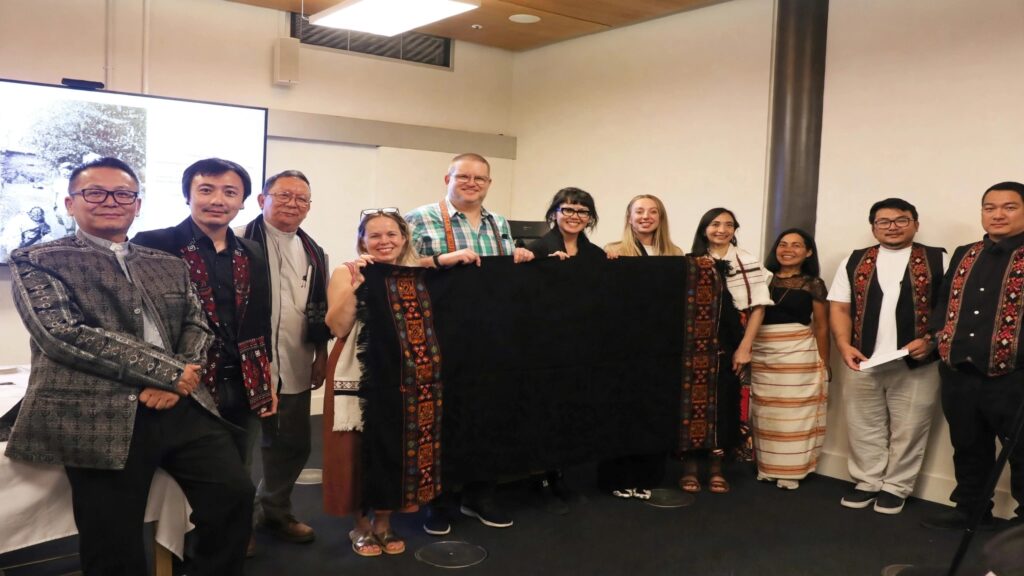
File Photo: Representatives of the Kuki community in the UK formally handing over the traditional Kuki textile ‘Numei Saipikhup’, woven and donated by Pi Nengtin Haokip, to staff and curators of the Pitt Rivers Museum, University of Oxford, during the ‘Mapping Connections’ event on 3rd August 2026 (Monday).
The day-long programme went beyond a formal museum tour. Members of the community had the opportunity to handle, view and discuss Kuki objects, textiles and archival photographs in close-up study sessions. They also traced their roots through oral narratives, recounting personal and collective experiences of weaving, place-making, memory and displacement. The sessions were interspersed with a performance of a traditional Kuki folk song, reflective sharing circles on care and healing, and presentations from both museum curators on conservation and from community elders on cultural meaning, resilience and identity.
A poignant highlight of the day was the ceremonial handing over of a living piece of heritage to the museum’s future collection. A traditional Kuki textile called Numei Saipikhup, meticulously woven and generously donated by Pi Nengtin Haokip, was formally presented by representatives of the Kuki community to the staff and curators of the Pitt Rivers Museum. In contrast to the historic objects collected during the colonial period, this textile represents a conscious act of self-representation – a gift from the present Kuki generation to be preserved on their own terms for future scholars and visitors.
Living Heritage Reclaimed: From Museum Cases to Healing and Identity
Four official photographs released for publication capture the spirit of the day: the handover of the Numei Saipikhup, a group photograph inside the PRM Lecture Theatre where sessions were held, a vibrant group portrait of the Kuki community in the UK on the front lawn of the Oxford University Museum of Natural History, and a photograph of Event Convenor S. Seigoulien Haokip (third from right) alongside the PRM’s curatorial team. As per permission granted, full credit for all photographs and details is to be given to both the Organising Team and the Pitt Rivers Museum, University of Oxford.
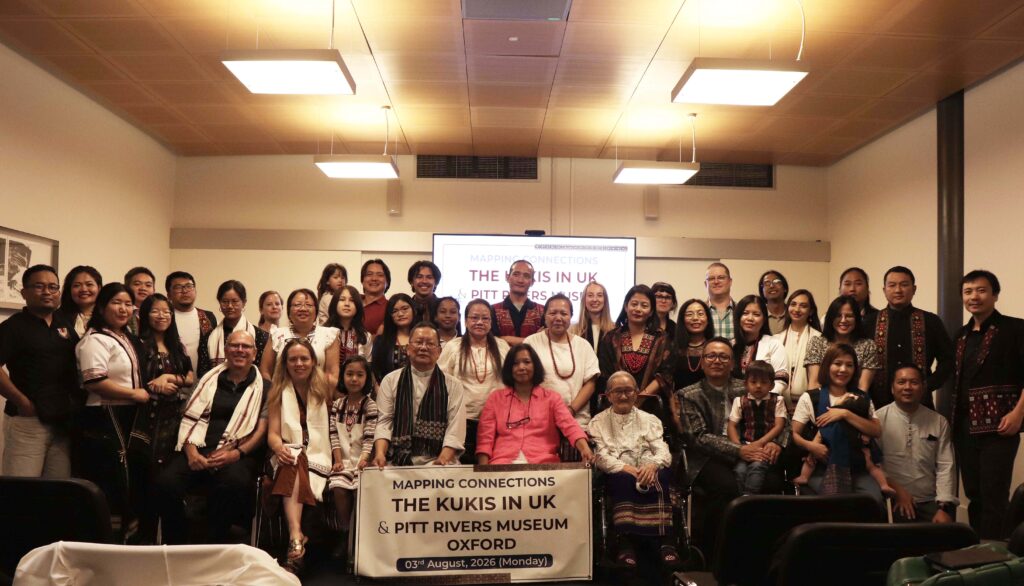
File Photo: Group photograph of Kuki diaspora in United Kingdom with Pitt Rivers Museum curators and staff inside the PRM Lecture Theatre after sessions with 1,165 Kuki artefacts, Oxford, 3rd August
For the Kuki diaspora, many of whom have settled in the UK over the past few decades, the visit was more than academic; it was a homecoming of sorts. Participants spoke of the mixed emotions of seeing their grandparents’ weaving patterns and ceremonial wear behind glass cases in Oxford, while also feeling pride that their culture has been recognized as worthy of preservation in one of the world’s most important anthropological museums. The initiative embodies a growing global movement of decolonizing museums, where institutions are moving from being mere repositories to becoming spaces of dialogue, restitution and co-curation with source communities.
Echoes of 1917-1919: Why 1,165 Kuki Artefacts Are in Britain
The historical background to why such a large Kuki collection exists in Britain dates back to the colonial period. Between 1917 and 1919, the British colonial administration and the Kuki chiefs and people in what is today Northeast India fought a major war. British colonial records termed the conflict the ‘Kuki Rebellion’, while the Kuki people remember and commemorate it as the Anglo-Kuki War (1917-1919), asserting it as a war of defence of their sovereignty and ancestral lands. The conflict was one of the most protracted uprisings against British rule in the frontier region and claimed the lives of more than 200 people from both sides, with many villages destroyed and heavy casualties.
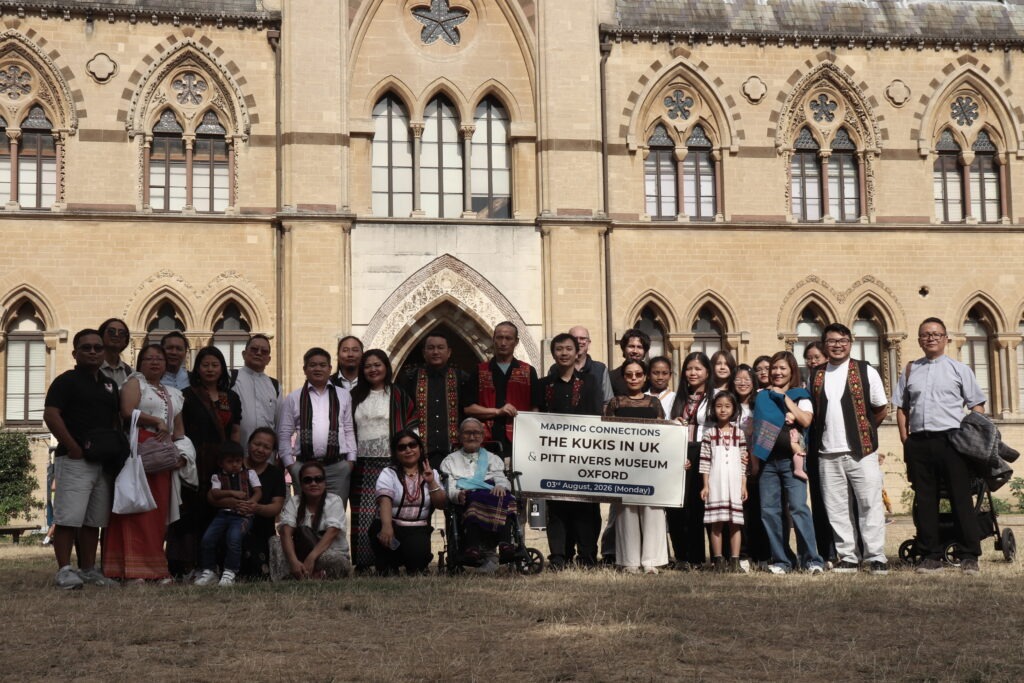
File Photo: Members of the Kuki community in the United Kingdom pose for a group photograph on the lawn of the Oxford University Museum of Natural History (which houses the Pitt Rivers Museum) after the historic ‘Mapping Connections: The Kukis in UK & Pitt Rivers Museum, Oxford’ event held on 3rd August 2026 (Monday).
During and after that war, the British forces seized numerous Kuki belongings as war trophies and ethnographic specimens. These included traditional artillery, locally-made guns such as the Thihnang, musical instruments like the Gosem [a traditional reed instrument], traditional dresses, headgear, ornaments and other everyday objects. The British Government subsequently distributed these seized artefacts to various institutions in the UK for study and display, where they are kept to this day in museums including those associated with the University of London and the Pitt Rivers Museum at Oxford University, now home to the world’s largest Kuki assemblage. Monday’s visit, therefore, represents not just a cultural programme but a symbolic reclaiming of that history by the Kuki community themselves.
Photo Credit: Organising Team and Pitt Rivers Museum, University of Oxford