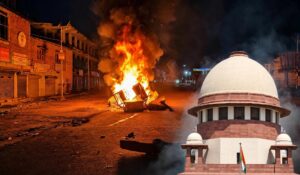
Songpi: The Supreme Court of India on Monday made a strong intervention to accelerate justice in the Manipur ethnic violence cases, proposing the establishment of exclusive Special Courts in Guwahati that will hear only cases related to the 2023 conflict.
A Bench headed by Chief Justice of India Surya Kant observed that the trials have been moving at an extremely slow pace despite the gravity of the crimes involved. The Bench has now formally requested the Chief Justice of the Gauhati High Court to constitute two separate Special Courts — one dedicated to cases investigated by the Central Bureau of Investigation and the other for cases investigated by the National Investigation Agency.
The Court directed that these proposed courts should take up the Manipur matters on a day to day basis and should not be burdened with any other regular criminal cases. All other pending matters currently before those courts should be transferred elsewhere to ensure undivided focus on the Manipur trials.
The Court has asked the High Court to file a status report on the feasibility and constitution of these exclusive courts before the next date of hearing.
CBI Files Chargesheets in 22 Cases, Closes 5
Additional Solicitor General Aishwarya Bhati, representing the Central government, presented updated status reports from both investigating agencies.
As per the CBI report, the agency was entrusted with 31 FIRs related to murder, arson, sexual violence and large scale destruction of property during the ethnic clashes. Out of these 31 cases, the investigation has been completed in 27 cases. This includes 22 chargesheets filed against accused persons and 5 closure reports where evidence was found insufficient or accused remained untraced.
Investigation is still active in the remaining 4 cases. Bhati further submitted that trial courts in Guwahati have already taken cognisance in 20 of the 22 chargesheeted cases, which means the trial stage can formally begin.
She clarified that among the 22 chargesheeted matters, only one case involves offences triable by a Magistrate. The other 21 cases involve serious offences such as murder, rape, kidnapping and use of explosives, which are triable only by a Sessions Court.
The Supreme Court had in 2023 ordered that all CBI cases be transferred out of Manipur to Guwahati to ensure safety of victims, witnesses and lawyers and to maintain judicial neutrality.
NIA Probe: Half the Cases Still Under Investigation
Regarding the NIA, the law officer informed the Bench that the agency is handling a total of 30 cases. These cases largely pertain to alleged criminal conspiracy, smuggling of sophisticated arms from across the border, and organized funding behind the violence.
Out of the 30 NIA cases, chargesheets have been filed in 15 cases. The remaining 15 cases are still under investigation, with the agency examining financial trails and interstate linkages.
Why Supreme Court Wants Exclusive Courts: 891 Witnesses Pending
The primary reason behind the Supreme Court’s proposal is the staggering number of witnesses who are yet to depose before the court.
According to the CBI’s own status report, a total of 904 witnesses have been cited across its chargesheets. Out of them, only 13 have been examined so far, while 891 witnesses are still waiting to be examined. The Court noted that if these cases continue to share time with hundreds of other regular cases in Guwahati, it may take several more years to complete the examination.
The Bench therefore emphasized that exclusive courts are necessary to bring home the guilt of the accused and to provide closure to the victims.
Petitioners Flag Delay, Centre Defends Mechanism
The hearing also witnessed a sharp exchange between the petitioners and the Centre.
Senior advocate Colin Gonsalves, appearing for victims and civil society petitioners, submitted that despite the passage of more than three years since the violence first broke out on May 3, 2023, the criminal justice process has shown little tangible progress. He argued that many of the most heinous crimes, including public humiliation, sexual assault and gangrape of women, were caught on camera and widely circulated, yet convictions remain absent.
He also pointed out that thousands of displaced persons belonging to the Kuki tribal community continue to live in relief camps in Kangpokpi, Churachandpur and other hill districts, with little hope of return.
Objecting to these submissions, ASG Bhati argued that the petitioners were attempting to reopen issues that have already been settled by the Supreme Court through a series of detailed orders over the last three years. She said the Court has already created a comprehensive framework covering investigation, appointment of legal aid counsel, protection of witnesses and oversight by a committee of former judges.
“Legal aid counsel are already in place. To raise the whole issue again when the Supreme Court has been seized of this matter for the last three years and has passed a series of directions is unnecessary,” Bhati submitted.
What Happens Next
The ethnic violence that erupted in Manipur in May 2023 has claimed more than 250 lives and displaced over 60,000 people from both Meitei and Kuki communities. The Supreme Court has been monitoring relief, rehabilitation and criminal prosecution since August 2023.
With the proposal for exclusive Special Courts, the apex court has signaled that it now wants the focus to shift from investigation to time-bound trial.
The matter will be taken up again after the Gauhati High Court responds on the creation of dedicated courts.