By Sasang Haokip
Introduction
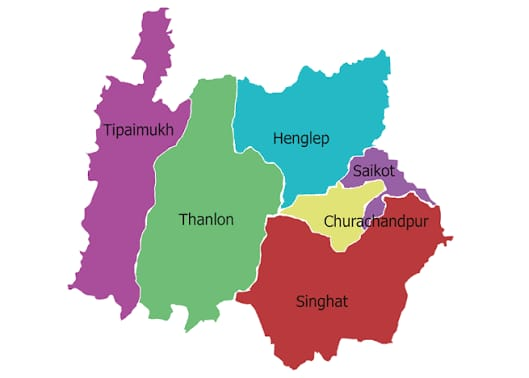
Churachandpur is the largest district in Manipur, covering 4,570 km² in the state’s southwestern corner. Its headquarters, Tuibong, is also known as Churachandpur and serves as the main administrative and commercial center of southern Manipur. The district features hilly terrain, narrow valleys supporting wet-rice cultivation, and the Khuga River, a key source of water and agriculture. It shares an international border with Myanmar to the south and southeast and borders Mizoram to the west. This article outlines the historical claims surrounding Songpi, the colonial-era naming of Churachandpur, and the contested Haokip Reserved area, based on clan histories, oral accounts, and available administrative references.
Songpi – History of Churachandpur
According to local accounts, the original name used by early settlers was Songpi. The name Churachandpur is said to have been derived from Manipur Maharaja Churachand Singh and was popularized during the princely state period. The initial administrative site was located near the junction of the Hiangtam Road and Tipaimukh Road, locally called “Lamka.” As per community records, in 1921 British officer B.C. Gasper held a feast for Labour Corps recruits that marked the formal naming of the area after the Maharaja. The old Songpi subdivision office declined after 1930 when British staff were withdrawn.
After India’s independence, a new headquarters was established about 6 km east of Songpi. This became the present-day Churachandpur town, often referred to as “New Churachandpur.” The area came under British influence after the Anglo-Manipur War of 1891 and was administered as the South-West Sub-Division of the Manipur Hill Tracts. It was formally organized as “Manipur South District” in 1969 and later renamed Churachandpur District. In 2016, parts of the district were separated to form Pherzawl district.
Before the establishment of Hiangtam Lamka (1929) and Zenhang Lamka, officially known as Bijang Loubuk (1930), several older villages existed in and around the town. As cited in clan histories and oral records, these include Songpi (reportedly Est. 1744), Joujangtek (reportedly Est. 1744), Henglep (reportedly Est. 1830), Loikhai (reportedly Est. 1840), Teiseng (reportedly Est. 1860), Mualbem (Est. 1904), Thingkangphai (Est. 1905), Haijang (Est. 1905), Khopibung (Est. 1907), Gelmol (Est. 1911), Lingsiphai (Est. 1915), and Bijang (Est. 1918). These settlements are referenced as evidence of habitation before the colonial-era “Lamka” township.
The district’s population comprises several Kuki communities, including the Simte, Gangte, Zou, Hmar, Vaiphei, Paite, and Lusei. These groups are generally classified as Tibeto-Burman. A significant number of Meitei and other valley communities also live in the town. Although each tribe has its own dialect, many residents understand multiple dialects due to long-standing social and trade ties. As per accounts available to the author, there was no recorded Paite population in and around Churachandpur before 1925.
Haokip Reserved 1907
The “Haokip Reserve,” also referenced as the “Southern Haokip Reserved 1907,” is a historically cited area in Churachandpur district. As per community records, the Haokip Reserved Land was created in 1907 under an administrative order referred to as Mr. Cosgrave’s Order (Misc. Case No. 616/1907) in the Churachandpur area. This colonial-era designation, often referred to as the Haokip Reserved Forest or Songpi Reserve, is stated in community submissions to have been reinstated in 1942 and is used in land ownership claims by the Kuki community. Community records and colonial references describe it as spanning from the Kwakta–Thangting Hill Range to Paldai Lui near Singngat.
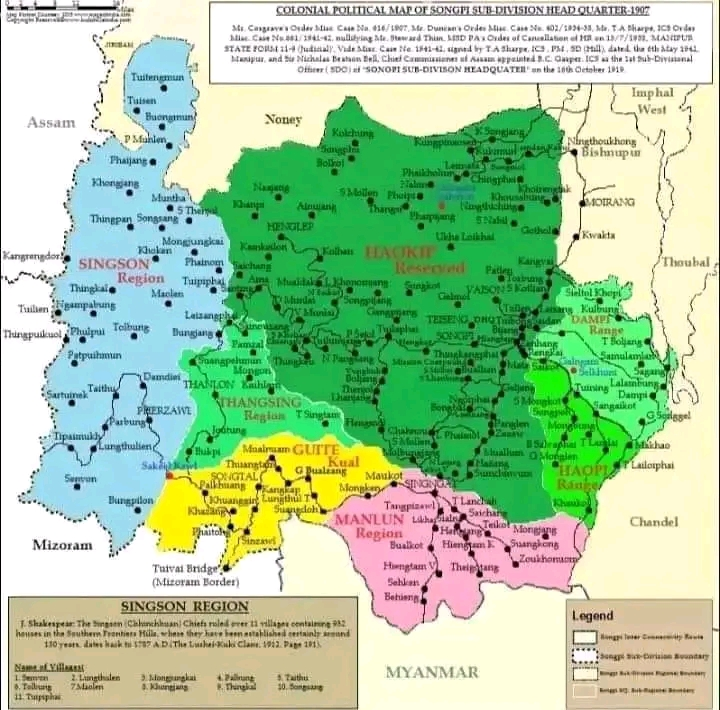
The area is tied to the Thangting/Thangjing Hill range, which is also a significant site of worship for the Meitei community as Thangching. Under the traditional Haosa chieftainship system, Haokip chiefs are recorded in oral histories as exercising authority over this tract during the late 19th and early 20th centuries. Colonial-era documentation, including Manipur State Hill Administration Reports, records Haokip chiefs controlling key routes along the southwestern hills. Songpi, cited in clan histories as founded in 1744 under Semthong Haokip, is noted as the parent village for several settlements in the region. As per local oral history, Semthong Haokip gave a piece of land to Phungkhothong Guite, and the chief of Bijang offered land to Zenhang Valte. The legal status of the Haokip Reserve remains contested. While local leaders reference it as ancestral territory, some state government records cite a 1938 order that allegedly abolished the reserve.
Conclusion
The history of Songpi and the Haokip Reserved area reflects competing narratives on land, identity, and administration in Churachandpur district. Village foundations, chieftainship records, and colonial documents are often used to assert historical continuity of settlement. The Haokip Reserve remains central to current land disputes, particularly around the Thangting Hill range, where customary claims and official revenue records differ. Understanding these claims requires careful study of oral histories, clan records, and government notifications from both the colonial and post-independence periods.
The writer can be reached at
Email: sasanghaokip123456789@gmail.com
Disclaimer: This article contains historical interpretations, oral accounts, clan records, and community claims regarding Songpi and the Haokip Reserved area. Certain land and territorial narratives remain contested and are subject to ongoing historical and legal debate.